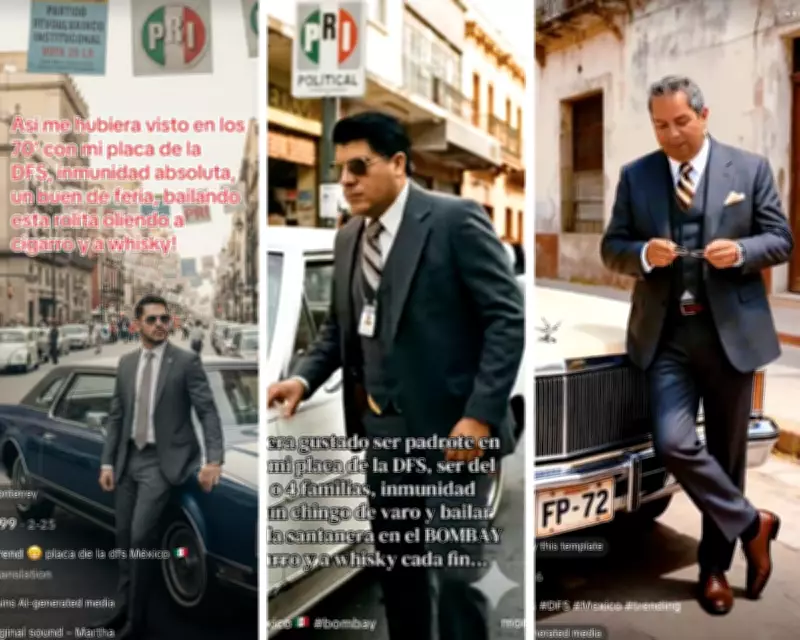
Mexican Teens Glorify 1970s Secret Police on TikTok Using AI Videos
A disturbing new trend has emerged on TikTok in Mexico, where young people are using artificial intelligence to imagine themselves as agents of the country's notorious 1970s secret police force. The Federal Security Directorate, known as the DFS, was infamous for torture, murder, and forced disappearances during Mexico's "dirty war" against political dissidents.
Glamorizing Brutality Through Digital Transformation
The viral videos predominantly feature young men dressed in grey or brown suits posing proudly before vintage 1970s luxury vehicles like Cadillacs and Rolls Royces. These AI-generated transformations are typically accompanied by catchy Mexican music and captions expressing nostalgia for what they describe as "total impunity." Common text includes variations of: "I would've loved to live in the 70s with my DFS badge, total impunity ... smelling of whiskey and smoke with a shitload of money."
This trend has sparked significant condemnation across the social media platform, with many users expressing outrage at the glorification of an organization responsible for horrific human rights violations. The DFS operated with what historians describe as "absolute impunity" during its most brutal period from the late 1960s through the early 1980s.

The Dark History of Mexico's Secret Police
Founded in 1947 under Mexico's long-ruling PRI party, the Federal Security Directorate served as the country's primary intelligence agency, modeled after the FBI. Initially tasked with monitoring subversive groups and political opponents, the DFS evolved into a brutally effective instrument of state repression.
As student protest movements gained momentum in the late 1960s and armed guerrilla groups emerged in the 1970s, the DFS developed increasingly violent tactics. These included systematic kidnapping, torture, forced disappearances, and participation in so-called "death flights" where suspected guerrillas were executed and their bodies dumped into the Pacific Ocean from aircraft.
"They developed a brutal but effective strategy to annihilate the cells of the multiple guerrilla organizations that emerged in the 70s and 80s," explained Sergio Aguayo, a prominent Mexican historian who has extensively studied the DFS. "They were ruthlessly efficient in their attacks against the insurgency."
From Political Repression to Drug Trafficking
By the early 1980s, with leftist guerrilla movements largely suppressed, the DFS shifted its focus to Mexico's emerging drug trade. According to historical accounts, the agency began offering protection to early drug trafficking organizations and even participated directly in narcotics transportation.
This criminal involvement ultimately led to the agency's dissolution in November 1985, following investigations that revealed DFS complicity in two high-profile murders: a journalist investigating connections between the DFS, CIA, and drug traffickers in 1984, and DEA agent Enrique 'Kiki' Camarena in 1985.
Cultural Analysis of the TikTok Phenomenon
Historian Sergio Aguayo interprets the TikTok trend as symptomatic of broader societal issues: "These videos represent the rise of a culture of violence and the discrediting of traditional work ethics. The underlying message promotes making substantial money quickly, without concern for ethical considerations or legal boundaries."
Digital culture expert Irene Soria offers a more nuanced interpretation, connecting the trend to Mexico's growing far-right movement and its opposition to feminist advances. "We've observed this particularly within macho-oriented online spaces," Soria noted. "There's an emerging narrative that positions opposition to feminism as a form of resistance against progressive social changes."
Interestingly, the trend isn't exclusively male-dominated. Some women have created videos portraying themselves as DFS agents, while others adopt personas as wives of agents or high-ranking PRI politicians. Soria compares this to the "tradwife" phenomenon observed in the United States, where women consciously reject modern feminist ideals in favor of traditional 1950s-style gender roles.
"There's a noticeable wave of very young women expressing desires for financial support from wealthy partners and traditional family structures," Soria explained.

Growing Backlash and Historical Memory
The glorification of the DFS has prompted a significant counter-movement on TikTok, with users creating content that highlights the agency's brutal history. One young woman's viral response used the same music featured in DFS tribute videos while delivering a powerful message: "It's incredible to see how a trend can override collective memory. We were NOT better off before; stop romanticizing one of the institutions that has done the most damage to our country."
This digital debate raises important questions about historical memory, the ethics of nostalgia, and how social media platforms can sometimes facilitate the sanitization of violent histories. As AI technology makes historical reenactment increasingly accessible, societies must grapple with how these tools are used to interpret and represent traumatic past events.
The TikTok trend continues to evolve, serving as a digital battleground where competing narratives about Mexico's complex history, gender politics, and social values collide in unexpected ways.