As I drove into London with my daughter a week ago, we passed a roadside pub festooned with dozens of England flags. Our eyes met in recognition: we were in one of those areas, we assumed. In the eyes of many, St George’s cross flags have become a kind of territorial marker in the English landscape, signifying a certain kind of identity, a certain kind of politics, not necessarily welcoming to all. As we got closer, though, we realised the pub was actually preparing for the start of the World Cup. Flags of other nations were also on display. We laughed at our mistake and relaxed a bit.
It’s a feeling many Britons might have experienced. We’re gearing up for a summer of both exciting international football and ugly far-right protests and riots, as recent events in Belfast and Southampton have shown. The England flag will be a prominent fixture of both – great news for flag sellers, but a confusing and anxious time for the rest of us. How did England’s national symbol come to evoke such mixed feelings and carry such contradictory meanings? Are we really at the stage of “good flags” and “bad flags”? What are we supposed to think when we see an England flag?
Our politicians have been as uncertain about this as everyone else. That became clear last summer, when England flags and union jacks suddenly began to appear on lamp-posts in towns and cities across the country. St George’s crosses were painted on roads, roundabouts and elsewhere, sometimes accompanied by offensive graffiti. The initiative was pushed by groups such as Raise the Colours, a self-described “grassroots movement” that proclaimed it was campaigning “to cover Britain in symbols of unity and patriotism” – but it clearly generated local support too.

Some councils took steps to remove the flags – often citing “safety concerns” or rules against tampering with public property – but others leaped to their defence. Nigel Farage wrote a supportive opinion piece in the Sun: “We have had enough of our country and its history being trashed.” Conservative leader Kemi Badenoch said it was “shameful that some councils have scrambled to remove them at the first opportunity”. Reform MP Lee Anderson said that officials who supported removing the flags “should be removed from office for betraying the very country they serve”. Predictably, Stephen Yaxley-Lennon, AKA Tommy Robinson, supported the initiative: “The message to the councils actively seeking to take down England flags is … Operation raise the colours,” he posted on X last August. At about the same time, one “grassroots” activist putting up England flags in Lichfield, who claimed to have no political affiliations, admitted to a Sky News reporter that he’d been given the flags by Robinson himself the night before.
In early September Keir Starmer said: “I’m very encouraging of flags. I think they’re patriotic, and I think they’re a great symbol of our nation.” But he responded more robustly after the Unite the Kingdom rally a couple of weeks later, when more than 100,000 protesters gathered in London, many bearing and wearing British and English flags, to listen to far-right figures such as Robinson, France’s Éric Zemmour and Elon Musk (who told the crowd: “You either fight back or you die”). The next day Starmer stated: “Our flag represents our diverse country and we will never surrender it to those that use it as a symbol of violence, fear and division.”
The fear and division have not gone away, though. Nor have the flags. In the Southey Green area of Sheffield on Monday, every lamp-post along the main street still has both a St George’s cross and a union jack on it. One lamp-post at the top of the hill sports six flags: two St George’s crosses, a union jack, the Welsh and Scottish national flags, and a remembrance flag with poppies and planes. In March, an attempt by three young men to put up flags outside Chaucer secondary school, just around the corner, reportedly turned into an angry confrontation when teachers came out to object. “You see that? Unity. Save our children,” one of the young men shouted at them, pointing up at the flag.

Talking to people in the area – which swung from Labour to Reform in the recent local elections – most appear to be either in favour of the flags or indifferent to them. “There’s a lot of people who say: ‘Ooh, it’s racist.’ How is it racist?” asks Danny, a 37-year-old white man, from the porch of a house draped in several England flags. Alongside the weathered lamp-post flags, many homes in the area are displaying bright new England flags in support of the World Cup, Danny’s included. To him, he says, the flag simply means: “We’re proud of this country. And we want to be proud of his country again because in all fairness it’s gone to shit.”
He is not racist, he says, but he’s opposed to “the ones that are coming across and getting everything for nowt”. He claims to know of eastern European migrants who laugh and joke about different benefits and student grants they are getting from the government. Everyone knows the individual who puts up the flags around here, he says. “He’s a sound guy … He’s just fed up with us getting shitted on, and they come across illegally and they get put in a hotel and given a credit card and a phone and a driver’s licence and shit like that.”
Many of the locals I spoke to evoked military patriotism in relation to the flags, saying they had relatives in the armed forces or had served themselves. There was a lot of national pride but also a sense of wounded pride, perhaps, mixed with nostalgia. “This used to be a steel town with plenty of jobs; now everyone feels like there’s no work,” an Algerian-born teacher who has lived here for 40 years tells me. Then again, he came here from Sussex to do his teacher training but never left: “It’s much friendlier up here.”
Those who are less enthusiastic about the flags in Southey Green tend to keep quiet about it. An African-born resident tells me she avoids raising the issue with her white neighbours but she finds the flags “threatening”: “I thought we were a diverse, tolerant nation, but what, suddenly now we don’t want to be?” Her daughter agrees: “They say it’s being patriotic. I’m patriotic too. What’s patriotic about excluding others?” A man of Pakistani heritage also says he finds them “a bit intimidating. I don’t mind the flags – it’s the ideology behind the flag. That’s scary.”
Outside Southey Green, most parts of Sheffield are now flag-free, in part thanks to the city council but also because of local groups such as Sheffield Communities Against Racism and Fascism (Scarf), which routinely respond to requests from locals across the city to remove flags put up against their wishes. The group must have taken down nearly 1,000 flags over the past year, four of Scarf’s members tell me when we meet in a local pub. It’s not that difficult, explains Mick, a software engineer: “Long extendable pole, carpet tape on the end. You just touch the carpet tape, the flag sticks on, twist it up, pull it off.”
They operate mostly at night now, they say. There have been confrontations with the other side, including a standoff between locals and a hired cherrypicker trying to put up flags in Walkley, west Sheffield, last October. And city council contractors in Sheffield removing flags have reported “shocking” levels of “threatening and aggressive” behaviour from members of the public, including from children, and said they had to work in groups rather than as individuals.
The line between flagging as a “grassroots” initiative and as a provocation by the organised far right has begun to evaporate. Scarf and Hope Not Hate have both identified Raise the Colours figures as former members of far-right groups such as the English Defence League, the National Front, Britain First and the UK Independence party (which is now a Christian nationalist group). Many former members of Raise the Colours have reportedly left the organisation as it has become more extreme and anti-migrant.
Raise the Colours’ influence appears to be waning. Last Saturday, the group organised a flag-waving protest march in Sheffield city centre, ostensibly against “two-tier policing” and “corruption against the British people”, though the route passed a hotel accommodating refugees. “They got emboldened by the flagging, and now they’re going out on the streets and shouting: ‘Send them home’ and ‘We don’t care if you drown’ – that kind of stuff,” says Dani, a mechanic and a member of Scarf. There were only about 50 to 60 protesters, he estimates, and 500 to 600 counter-protesters.
“Their movement has done quite a good job of toxifying a symbol and painting anyone who’s against them as anti-patriotic or anti-British,” Dani continues – but it has also galvanised groups such as Scarf. “I think we have much more of a mandate as the people of Sheffield, but also we are right.” His point is that minority groups should be protected and far-right ideologies rejected as a matter of principle, no matter how many people might agree with them locally.
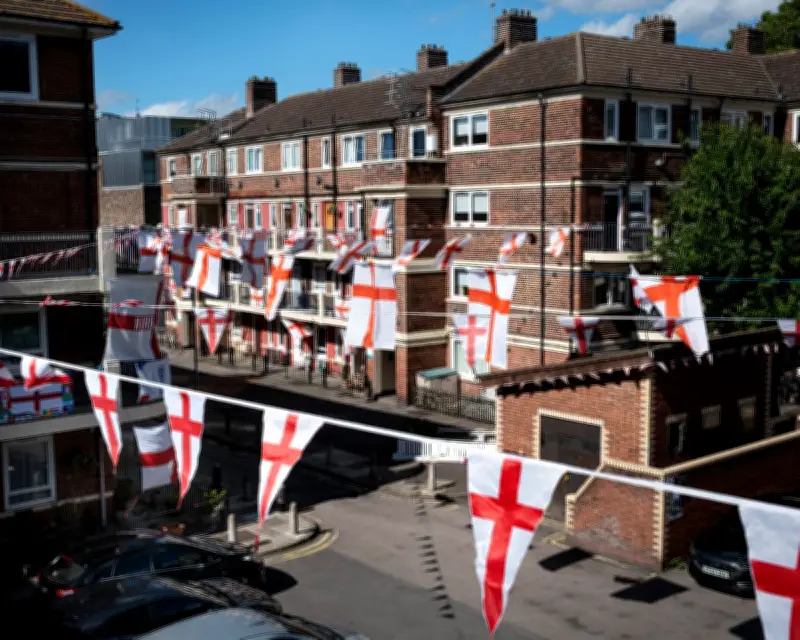
Meanwhile, in south London, a very different eruption of England flags is taking place, in stark contrast to Raise the Colours, even if at first glance it is superficially similar. The four-storey Kirby estate in Bermondsey is absolutely dripping with St George’s cross flags – on balconies and walkways, on bunting across the courtyard, painted on to walls.
“It’s nothing to do with politics at all,” says Geraldine Howard, one of the key instigators of this flag initiative. This is World Cup fever at its peak. “It’s just in support of the England football team, the men’s and the women’s, and that’s all it’s about – to get the community together.” The Kirby estate does this at every major tournament, Howard explains. “Let’s just hope it works on the men’s this year – I was two months old when they won it last time.”
It started with the men’s European championship in 2012, when she decided one day to put up a big England flag on her balcony. Her neighbour, Alan Putnam, saw it. “I liked it, so I bought a flag for myself,” he says. “Then we both started buying more and more.” Their neighbour Chris Dowse joined in, and it spiralled from there.
“When we decided to first do the entire estate, we went door to door and we asked everyone if they minded if we were going to do it – and they were all for it,” says Dowse. “People now come to us and say: ‘When are you putting the flags up?’” Now there are about 400 flags draped across the estate, as well as permanent murals depicting footballing heroes Fran Kirby and Eberechi Eze.
When they first starting doing this, comments online completely misinterpreted their intentions, Dowse recalls: “It was like: ‘Racist estate, far-right estate, Tommy Robinson’s safe haven, not one GCSE between them, all living on benefits …’ They’ve finally realised that we’re not actually like that.”
People are also welcome to put up flags of their own country, says Dowse. Draped over the balconies are flags from Colombia, France, Scotland and, confusingly, Greenland. In the past they’ve had dozens of other national flags on display. The estate is pretty multicultural, and apparently harmonious. No one I meet has a problem with the flags – quite the opposite. “I love to see how passionate people are about football here,” says Brazilian student Livia Ribolla, 22, who has lived here for seven years with her parents. “It’s probably one of the most patriotic estates in the country, but not in a way where they exclude the other nations.” She hasn’t hung out a Brazilian flag yet but she might. “We also love England; it’s a great team right now.”
News crews and social media posters come from all over the world to the Kirby estate. “I had an interview here this morning at half past six before work,” says Dowse, who works in recycling and is also a DJ. On the day of my visit, the BBC and GB News were also talking to him. The only people they don’t like coming are politicians, says Putnam. “We’ve had some MPs who’ve wanted to come down, but we’ve asked them not to because we know they probably just want to use them for their own thing.”
How can one flag be so divisive and yet so uniting? Clearly, context matters. Some England supporters are displaying St George’s crosses with obvious football slogans across them rather than the unadorned original. Many observers have suggested that football fans might be less inclined to display their allegiance this year – although we’re still in the early stages of the World Cup.
According to recent research by British Future, a non-partisan thinktank concerned with issues of integration, migration, identity and race, 62% of people in England agreed that: “I would like to be able to fly an England flag without appearing to support the far right.” And 81% of people in England, and 74% of ethnic minorities, saw the flying of England flags to support the country’s football teams in major tournaments as “a healthy expression of English national pride”.
“I personally find flags on lamp-posts a very sort of Belfast [ie sectarian] thing, and flags in shop windows and car windows and houses a very good thing,” says Sunder Katwala, director of British Future. Part of the reason the picture is so confusing, he suggests, is that the English are not really sure who they are these days. All Britons, even non-immigrants, are effectively dual nationals: we are British and we are also English, Scottish, Welsh, Northern Irish and so on. But defining or celebrating “Englishness” has become both difficult and politically charged. Restore, Reform and other rightwing groups are continually debating which politicians and public figures “belong” here, and drawing arbitrary lines based on skin colour, ancestry and place of birth.
Meanwhile, discussing Englishness in an inclusive, uncomplicated, inoffensive way has become a bit of a minefield, says Katwala: “We’ve got people hiding under the table because, you know: ‘What if I say something that the far right will disrupt?’ Or: ‘What if I say something and I didn’t quite get the tone right for the second-generation British, English, ethnic minorities? Maybe it’s best I just don’t do it.’ And that just creates the vacuum.”
Sport is one of the few things that gives people a genuinely uncomplicated sense of shared Englishness, British Future has found. The England football team is a case in point: no one bats an eyelid at the inclusion of Black and mixed-race players. This is more than just “being polite to people who score goals for us,” says Katwala. There’s no debate over whether or not Bukayo Saka or Marcus Rashford are “really” English. “We’re actually doing what we’ve always done, which is that the children, the grandchildren of migrants to Britain become English as well as British.”
It can’t only work when the football’s on, though. Nor, as the evidence shows, can we leave it to politicians and public figures to lead the way. Katwala would like to see others step up, as the Church of England did in December when it pushed back against Tommy Robinson and the far right’s attempt to co-opt Christianity. “I don’t think the large British institutions in London know how to think of England, because they associate themselves with ‘British’, so that leaves a bit of a gap,” he says.
When we have more of a settled understanding what it means to be English, perhaps the English will have a more stable relationship with their flag. Katwala, who was born in England and has Indian and Irish heritage, is also a devoted England fan. “I’m on record saying that we will win it this year,” he says. He regularly attends England matches, wearing an England shirt, waving an England flag. He even painted his nails with St George’s crosses on a recent visit to Wembley (it was his daughter’s idea, he tells me).
“It’s not so much about reclaiming the flag,” he says. “It’s about not retreating from something that we should have had a stake in all along.”