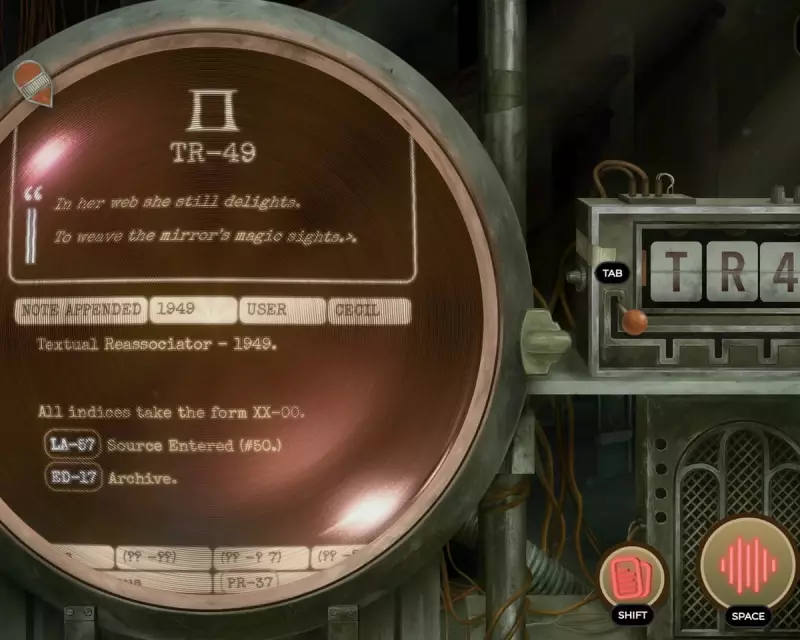
TR-49 Review: An Inventive Narrative Deduction Game Steeped in Wartime Secrets
TR-49, the latest release from acclaimed UK game developer Inkle, presents players with a uniquely cerebral challenge. This PC game constructs an intricate database mystery from an archive of fictional books, where their combined contents threaten to unravel the very fabric of reality itself. Set against the backdrop of a Britain engulfed in a mysterious civil war during the mid-2010s, the game invites players into a world where esoteric knowledge holds the key to victory.
A Machine That Feeds on Esoteric Knowledge
The game's premise revolves around a strange piece of technology originally developed at Bletchley Park – famed for its historical role with the Enigma machine and Colossus computer. According to TR-49's tantalising lore, two engineers created a machine that consumes the most obscure writings: from quantum computing treatises and dark matter meditations to pulp science fiction novels. This arcane device may hold the solution to the conflict raging above ground.
Players assume the role of Abbi, a straight-talking northerner and budding codebreaker who finds herself sifting through this mysterious machine, now relocated to a crypt beneath Manchester Cathedral. Neither Abbi nor the player understands how the device functions, creating an immediate sense of discovery and intellectual challenge from the very beginning.

The Mechanics of Literary Investigation
The core gameplay involves inputting four-digit codes – two letters followed by two numbers – that correspond to author initials and publication years. Input a correct code, and you're transported to the corresponding page as if using an exceptionally rapid microfiche reader. These pages, which might feature writings by fictional physicist Joshua Silverton or other imagined authors, contain vital clues, additional codes, and sometimes even complete book titles.
Your primary objective becomes matching codes with their corresponding book titles in a quest to locate the most crucial text of all: Endpeace. This elusive work promises to unlock the secrets of the machine's erudite ghosts and provide understanding of the broader mystery.
A Rhizomatic Network of Intrigue
Hidden within this expansive network of interconnected information lies a mystery so elegantly constructed that it unfolds naturally from each player's unique investigations. No matter which titles or authors you encounter first, or where your particular curiosities lead you, the narrative adapts to your discoveries. Connections cascade like waterfalls, often swerving in unexpected directions that defy traditional linear mystery storytelling.
The game provides an in-game notepad for tracking your findings, though seasoned players might find keeping actual pen and paper nearby enhances the immersive experience. This tactile element reinforces the game's literary nature and the physicality of archival research.
Broader Philosophical Concerns
While some might interpret TR-49 as commentary on contemporary AI large language models that scrape data, the game's concerns prove broader and more ambitious. It recalls the recent works of Chilean author Benjamín Labatut, particularly When We Cease to Understand the World and The Maniac. Like Labatut's writing, TR-49 brims with awe, scepticism, and horror at the reality-shredding possibilities of twentieth-century scientific and technological advances, while simultaneously pushing these concepts into a playful, fantastical space.
Narrative Strengths and Weaknesses
Where the mystery told through the machine itself proves lavishly detailed and compelling, the external narrative elements sometimes feel underdeveloped. Conversations between Abbi and her companions via radio transmission lack the depth of the central mystery, while the nature of the conflict raging above ground remains frustratingly vague. Abbi's personal reasons for being in the crypt receive insufficient exploration, creating a slight narrative imbalance.

A Triumph of Interactive Mystery
Despite these minor shortcomings, the interactive heart of TR-49 – trawling through the codebreaking device for secrets – represents an unqualified success. The game's database mystery rivals Sam Barlow's acclaimed works Her Story and Immortality, though TR-49 maintains an unashamedly literary character compared to those more filmic counterparts.
Initially, players might feel overwhelmed by the mass of inscrutable writings, but quickly they learn to swim elegantly through the archive, becoming conversant in its many peculiarities. Across several evenings of play, the experience of disappearing into this fictional archive proves utterly captivating – cavorting from log to log, title to title, following threads and losing track of time completely.
Each discovered scrap of paper, water-damaged periodical, and rare first edition threatens to solve the overarching mystery, yet none can accomplish this in isolation. Just as the fictional creator of this archive fell under the spell of these records and materials, players too find themselves seduced by TR-49's intellectual charms. The game represents a significant achievement in narrative game design, offering a genuinely unique experience for players seeking cerebral challenge and literary intrigue.
TR-49 is available now from 21 January, inviting players to embark on one of the most inventive mystery adventures in recent gaming history.