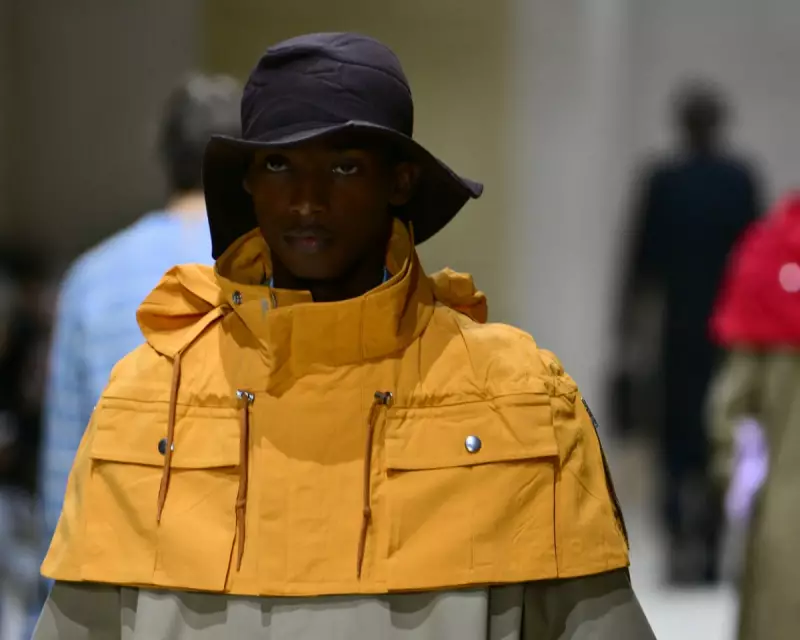
The recent Milan Fashion Week menswear shows for Fall/Winter 2026-2027 have ignited significant conversation, moving beyond mere aesthetics to confront pressing social and political themes. Two of Italy's most prominent fashion houses, Prada and Dolce & Gabbana, found themselves at the centre of very different debates, highlighting fashion's complex role in contemporary culture.
Prada's 'Uncomfortable' Dialogue with Politics
Following their show on Sunday, designers Miuccia Prada and Raf Simons openly discussed the challenge of reflecting the current volatile global climate through clothing. "You talk about the world now," said Prada, "or you talk about fashion … The two things together, in this moment, are difficult." The resulting collection was described as intentionally "uncomfortable," not in terms of wearability but through its juxtaposition of disparate elements within a single outfit.
This conceptual approach was evident in looks that paired the top of a red sou'wester with a trenchcoat, or a yellow scoop-neck jumper with deliberately extended, deconstructed shirt cuffs. Raf Simons pointed to these styling choices as a deliberate rejection of established power structures. "We don't want the American corporate kind of masculine power," Simons stated. "No, make it youthful." The dishevelled cuffs, he explained, were a way to subvert the polished image of the political elite.

Simons reflected on the evolving connection between style and society, noting that while fashion in the 60s and 70s was a direct reaction to world events, today the relationship is more nuanced. "We feel like we should not sit still, we want to try," he said, emphasising the designers' daily questioning of their role. For Prada, the collection posed fundamental questions about preservation and transformation in a time of great change.
Dolce & Gabbana's Recurring Casting Controversy
In stark contrast, Dolce & Gabbana's show on Saturday became a talking point for its apparent lack of diversity. The presentation, titled The Portrait of Man, featured what critics identified as an entirely white cast of models. The swift backlash on social media platforms like Instagram was led by fashion commentators including Blakely Neiman Thornton and Louis Pisano.
One notable critic, Lyas, posted a video dubbing the show "50 shades of white" and questioning the "audacity" of its title. The post garnered over 41,000 likes, with model Bella Hadid commenting in support: "Shocked people actually support this company still it's embarrassing … years of racism sexism bigotry xenophobia … how are we shocked still?"
This incident is not an isolated one for the brand. Dolce & Gabbana has faced repeated accusations of racial and cultural insensitivity over the past decade. Past controversies include:
- 2012: Earrings featuring Blackamoor figures.
- 2016: Naming a shoe style the "slave sandal".
- 2018: Adverts deemed culturally insensitive towards Chinese consumers, followed by alleged offensive direct messages from Stefano Gabbana.
Broader Industry Reckoning
The scrutiny on diversity and cultural appropriation extends beyond a single show. Prada itself faced criticism for its previous menswear presentation in June, when models wore footwear inspired by India's traditional Kolhapuri sandals, which date back to the 12th century. Following a complaint from the Maharashtra chamber of commerce, Prada's head of corporate responsibility, Lorenzo Bertelli, acknowledged the inspiration and suggested potential collaboration with Indian artisans, though no such designs have yet appeared on the brand's website.
These concurrent events at Milan Fashion Week underscore a pivotal moment for the industry. Where Prada actively engages with political discourse through design language, Dolce & Gabbana faces renewed condemnation for perceived exclusionary practices. The conversations sparked on the runway and across social media confirm that in 2026, fashion's impact and responsibilities are being judged as critically as its creativity.