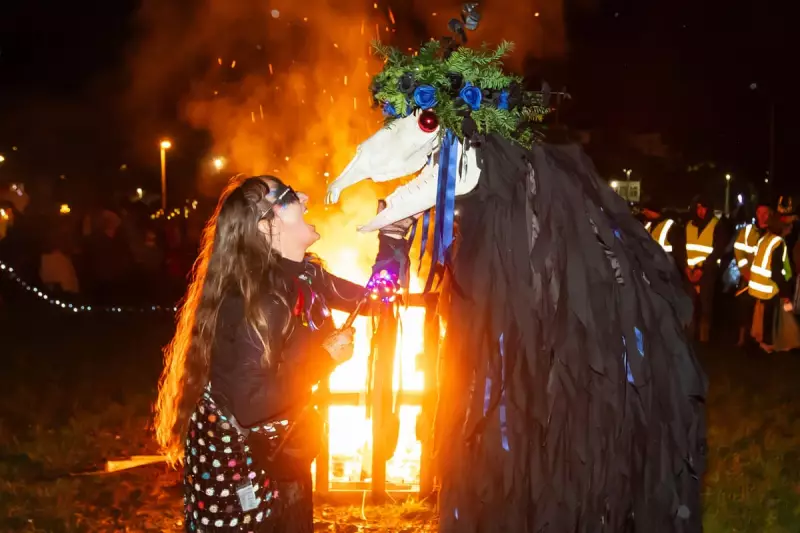
As thick clouds of incense smoke envelop a hyped-up crowd, a man clad in a suit of twisted roots cries out "Hoo hoo Holly!". This is the moment the Montol festival in Penzance, Cornwall, erupts into life on the winter solstice. Two towering 10ft tree gods, the Oak King and the Holly King, clash in a dramatic battle, their struggle illuminated by bursts from flamethrowers. This is just one of the many mysterious and rambunctious traditions that define Cornwall's largest solstice celebration.
A Festival Forged from Community and Cornish Culture
Each year on 21 December, the high streets of Penzance close to traffic. Thousands don elaborate costumes and take to the streets, some wearing real horse skulls known as 'osses'. The air fills with the sound of Cornish carols, the scent of burning effigies, and the occasional thud of a Brussels sprout missile. While elements of Montol draw from ancient pagan roots involving animal masks and cross-dressing, the festival itself is a modern creation.
It began in 2007 when Simon Reed, a former mayor and campaigner for Cornish culture, discovered the word 'Montol', meaning 'balance', in an old Cornish dictionary. Co-organiser Paul Tyreman recalls its humble origins: a wind band, the Turkey Rhubarb Band, leading a procession where people sang carols, lit a beacon, and went home. From this seed, Montol has grown into an eight-hour spectacle across 22 locations, supported by a £7,500 grant from the town council.

"What is really important about our festival culture here in Penzance is that they are community festivals," says Mayor Stephen Reynolds. "They are by the community for the community. Our job is to support, but not direct or control... We are the antithesis of corporate down here."
Invented Traditions and Poignant Tributes
Over time, Montol has woven together authentic Cornish customs with entirely invented ones. The 'osses' prowling the streets connect to the Padstow May Day 'obby oss' and the Welsh Mari Lwyd. 'Guise dancing', where participants wear costumes and masks, dates back to at least the late 19th century.
Other traditions are newer. Co-organiser Aaron Broadhurst explains that Simon Reed invented the 'Guilds' – costumed troupes who roam pubs after dark performing absurd plays and 'testing the ale'. Then there's the unique currency of the day: Brussels sprouts. Used as both ammunition and a token of honour, the sprout-throwing has a poignant origin. It pays tribute to the late John Dudding of Falmouth, the self-styled 'Chancellor of the Cabbage', who attended every Montol dressed as a cabbage to be pelted with sprouts. He died suddenly in 2021.
The festival faces the challenge of balancing different viewpoints. "There's one lady who won't have anything to do with it because she thinks it's too pagan," says Tyreman. Conversely, Broadhurst adds, "I have to deal with a bunch of pagans who think it's a pagan festival, and tell me to get rid of all this Christian iconography!"
From Morris Dancing to the Burning of the Sun
The day begins gently at 2pm with Border Morris dancing on the traffic-free Greenmarket. Troupes like Pensans Morris, clad in the county's black, white, and yellow, perform with clacking sticks. The 'guise dancers' follow, with groups like the Scaleybacks of Hakeybay embracing nautical themes as selkies, mermaids, and lighthouses.
A highlight is the eerie presence of the 'osses'. Mid-afternoon, osses named Penhood and Maur Bras stalk down Causewayhead, expertly snapping hats from heads with their articulated jaws. "With the osses, there's this tingling sensation," says Aaron Broadhurst. "Our osses are so skilful, they can use their teeth to pick up bags of sprouts from the Co-op." Acquiring a skull involves sourcing one from an abattoir or eBay, then cleaning and articulating the jaw for a satisfying snap.
The ceremonial heart of the festival beats at 5:30pm with the battle between the Oak King and Holly King under the Greenmarket clock. Choreographed by Joe Gray, formerly of Bristol's Invisible Circus, the fight symbolises calling back the sun's light. As is tradition on the winter solstice, the Oak King triumphs. "There's a sense of anarchy and misrule and mischief that goes along with all of it," says Gray.

Led by the Raffidy Dumitz Band and the Kelliwik Golowi Band, a procession then winds its way to the muddy Princess May Recreation Ground. Here, the climax occurs: the ceremonial burning of a sun effigy, showering the crowd in a cascade of orange sparks.
Revels, Torchlight and Defiant Spirit
By 8pm, the formalities give way to the Guilds' 'revels' and the sprout-lobbing intensifies. At the Admiral Benbow pub, vegetables fly from windows and behind road closure signs used as riot shields. The festival culminates in a torchlit procession led by Tas Nadelik (Cornish Father Christmas) through sprout-carpeted streets to the sea. On the promenade, the Mock, or yule log, is chalked and burned in a roaring brazier.
So what does Montol truly mean? For its organisers and participants, it's an act of homemade ritual and Cornish defiance. "The parades are small acts of reconquest," says Aaron Broadhurst. "We're taking ownership of our little town." For Mayor Stephen Reynolds, it's a vital injection of energy on the year's shortest day: "The festival makes your hair stand on end... The further west you go, the wilder it gets." In Penzance, the winter solstice is not just observed; it is conquered with fire, folklore, and a formidable supply of sprouts.