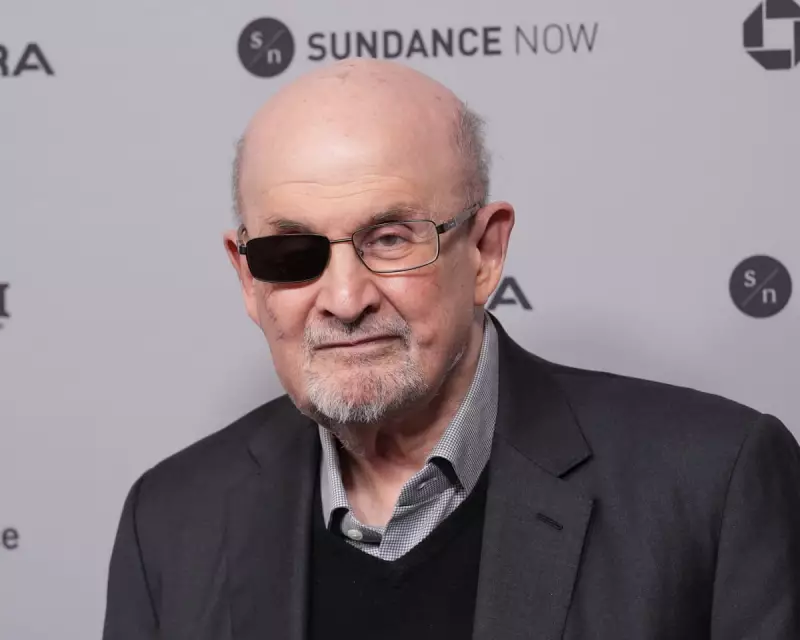
Salman Rushdie made a powerful appearance at the 2026 Sundance Film Festival, where the documentary Knife: The Attempted Murder of Salman Rushdie received a standing ovation from an emotional audience. The film, directed by Alex Gibney and based on Rushdie's memoir, delves into the author's harrowing physical and spiritual healing journey following the near-fatal knife attack in 2022.
The Attack and Its Aftermath
On 12 August 2022, as Salman Rushdie prepared to deliver a lecture on protecting writers at New York's Chautauqua Institution, a masked assailant stormed the stage and stabbed the Indian-born British-American author 15 times in the face, neck, and torso. The brutal assault left Rushdie on a ventilator, with severed tendons in his left hand and the loss of his right eye, narrowly surviving the ordeal thanks to audience members who intervened.
A Documentary of Defiance
The documentary opens with a chilling recreation of the attack from Rushdie's perspective, capturing 27 seconds of struggle and violence. It features never-before-seen footage recorded by his wife, poet and author Rachel Eliza Griffiths, showing Rushdie's gruesome injuries—discolored skin, a bisected abdomen held by stitches, and a mangled eye. His first coherent thought upon regaining consciousness was, "We need to document this," highlighting the film's raw and unvarnished approach to his recovery.

Griffiths explained at the sold-out premiere in Park City, Utah, that recording the recovery was both a coping mechanism and an act of defiance. "It wasn't like 'let's make a film,'" she said. "It was 'what's going to happen to us? How did this happen to us? And here we are, in this moment.'"
Cultural Resistance Against Authoritarianism
Rushdie, now 78, emphasized that the documentary transcends his personal story, addressing broader themes of political violence. "For the authoritarian, culture is the enemy," he told the Sundance crowd, many of whom were moved to tears. "The uncultured and ignorant and tyrannical don't like it. And they take steps against it, which we see every day."
Gibney, known for films on controversial topics like Scientology and the Trump administration's Covid response, uses the attack as a springboard to explore Rushdie's past. The documentary traces his early life in a secular Muslim family in India and his later experiences in London, where his writing faced backlash from those who viewed it as antithetical to Islam.
Historical Context and Modern Parallels
The film revisits the 1988 publication of Rushdie's novel The Satanic Verses, which sparked global protests and a fatwa from Ayatollah Khomeini calling for his death. Clips show effigies of Rushdie being burned in cities like London and New York, eerily foreshadowing the 2022 attack. Rushdie, who spent nearly a decade in hiding under UK police protection, noted his initial reluctance to revisit that era but realized, "if you don't understand what happened then, you don't understand what's happening now."
Gibney drew connections to contemporary issues, such as recent unrest in Minneapolis, Minnesota, where ICE agents killed a US citizen. He warned that the death threats that once forced Rushdie into hiding echo today in "how violence unleashed by an irresponsible political leader could spread out of control."
Humanity and Humour in Recovery
Despite the trauma, the documentary highlights Rushdie's resilience and sense of humour. Griffiths's footage shows he never lost his "righteousness and principles" during recovery. In response to his assailant's jailhouse interview expressing surprise at Rushdie's survival, the author quipped, "Thank you! That demonstrates intent."
Gibney stressed the importance of embracing humanity against authoritarian rule. "It's important that we continue to embrace our humanity, to love each other, and to achieve that kind of intimacy that's so important to us as human beings," he said.

A Testament to Human Nature
The documentary concludes with third-party footage of the attack, captured by conference cameras, showing every stab and the strangers who saved Rushdie's life. Reflecting on that day, Rushdie told the Sundance audience, "I experienced, almost simultaneously, the worst side of human nature—violence, led by ignorance, induced by the irresponsible—and on the other hand, the best side of human nature, because the first people who saved my life were the audience."
He added, "Here are the people rushing to defend me against an ideologically driven man with a knife. And yet they all agreed to do that, to risk themselves in order to save me. We are that, too." General release details for Knife: The Attempted Murder of Salman Rushdie will be announced at a later date.