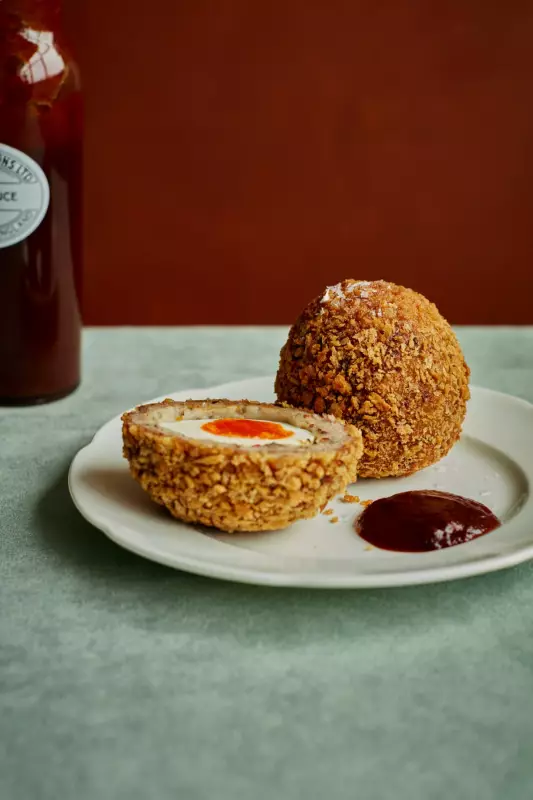
For food critic and writer Jimi Famurewa, the true taste of Christmas arrives not on the 25th, but in the chaotic, blissful days that follow. It's found in the ritual of assembling a plate of festive leftovers—a glorious jumble of cheese, ham, cake, and chutney. Yet, in his household, this Twixmas picky tea always features one sacred, non-negotiable item: a hefty, golden half of his mother's fiercely peppery homemade scotch egg.
The Heart of a Family Tradition
Over the past quarter-century, Famurewa's Christmases have seen dramatic shifts—from hospital stays and pandemic separations to family trips to Florida. Through it all, the presence of those homemade scotch eggs, whether delivered in steamed Tupperware or fresh from the fryer, has been the constant. "There is no Christmas without those boulderous, deep-fried orbs," he asserts. The tradition began modestly, as a clever use for an excess of sausage meat intended for stuffing. It has since evolved into the family's most cherished culinary ritual, a labour of love that symbolises festivity and togetherness.
He recalls one memorable Christmas Day where, after a post-feast nap, he and his wife awoke at 1am to the sound of sizzling pork and his mother's cheerful announcement: "The scotch eggs are ready." This anecdote perfectly captures the dish's role—a beloved, slightly anarchic project that binds the season together.

A Surprising Global Journey
While Famurewa once believed his family's scotch egg obsession was unique, he discovered its popularity is well-established in parts of West Africa. Following the introduction of eggs by colonial missionaries in the 1920s and 1930s, scotch eggs became a staple at Nigeria's Mr Bigg's fast-food chain. In Cameroon, a local variation often features spiced mackerel in place of pork.
Famurewa's own adaptation stays true to his mother's method, which includes a "double scotch" of heat from scotch bonnet pepper and all-purpose seasoning. He notes that the dish's inherent qualities—its celebratory effort, core ingredients, and perfect fit on a grazer's plate of leftovers—make it an ideal food for the Twixmas period.
How to Make Jimi Famurewa's Festive Scotch Eggs
For those inspired to create this centrepiece for their own leftover feasts, Famurewa shares the recipe from his book, 'Picky'. Begin by soft-boiling four medium eggs for seven minutes in salted water for a fudgy yolk, then cooling them in cold water. Create a seasoning paste by grinding together a teaspoon each of black peppercorns, fennel seeds, all-purpose seasoning, chopped fresh sage, and a quarter of a finely chopped scotch bonnet pepper.
Mix this paste into the meat from eight quality pork sausages (about 450g). Divide the meat into four balls, flatten them, then wrap each around a peeled, lightly floured egg, ensuring a tight seal. Follow a standard pane setup: coat each ball first in plain flour, then beaten egg, and finally 120g of panko breadcrumbs.
Fry the breaded eggs in about two and a half inches of vegetable oil at 150°C for six to eight minutes, until golden. Drain on kitchen paper. Serve cool or at room temperature with piccalilli or brown sauce, alongside a chaotic plate of Christmas remnants and, perhaps, a handful of mid-tier chocolates.
Jimi Famurewa's book 'Picky' is published by Hodder & Stoughton at £20.