They were the must-have items of their day, sitting at the very forefront of technology and selling in their millions. Yet today, these pioneering gadgets from the 1960s, 70s, 80s, and 90s have largely faded into obscurity, rendered obsolete by relentless technological progress and shifting consumer tastes.
From living room entertainment to portable music and early computing, these devices changed how we lived, worked, and played. Now, they are often found discarded or gathering dust in attics, reduced to mere footnotes in the history of modern consumerism. But as design classics that paved the way for the tech we use today, they deserve to be remembered.
Sound & Vision Revolutionaries
The Stylophone, a miniature analogue synthesiser launched in 1967, was designed as a child's toy but captured the imagination of a generation. Its unique sound and simple design proved so enduring that it found favour with professional musicians like David Bowie and John Lennon. Its remarkable durability and cult status led to a surprise relaunch in 2007, introducing it to a new audience.

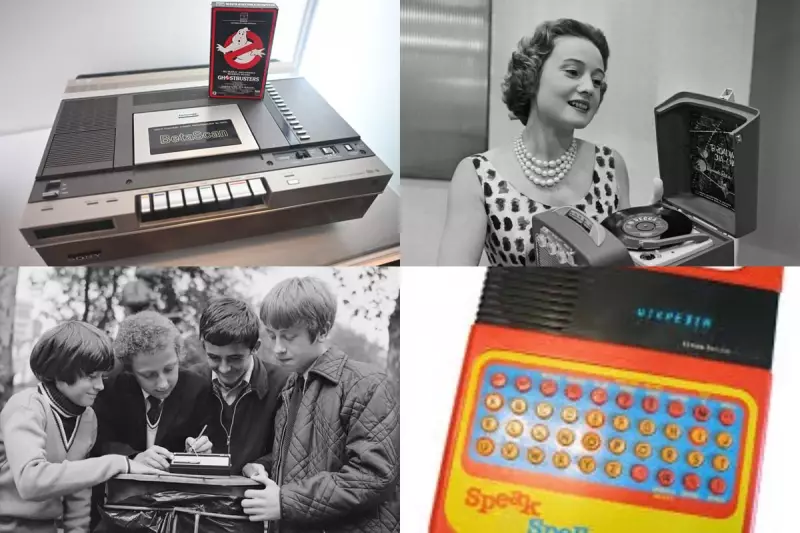
In the battle for home video dominance, Sony's Betamax, launched in 1975, initially seemed poised for victory. With superior picture quality, it was the connoisseur's choice. However, its initial one-hour recording limit was a fatal flaw for movie fans. Even when this was extended, the higher resolution had to be sacrificed. By the late 1980s, VHS had decisively won the format war, though Sony, perhaps stubbornly, continued producing Betamax recorders until the early 2000s.
Before the personal stereo, there was the Dansette record player. First introduced in 1952, its peak came in the following two decades, with over a million units sold in the 50s and 60s alone. Designed for portability with its built-in handle and speaker, it was a prized possession for teenagers, who would carry it to friends' houses to listen to the latest records. It was not a cheap gadget, but for those who owned one, it was the centrepiece of social gatherings.
Photography, Transport & Early Computing
The Kodak Instamatic camera truly democratised photography when it hit the market in 1963. Its genius lay in its affordability and sheer simplicity, opening up a hobby that had previously been complex and expensive. Its success was staggering, with more than 50 million units sold between 1963 and 1970. The name 'Instamatic' became so synonymous with easy-to-use cameras that it was used to describe a whole genre of point-and-shoot imitators.
Visionary inventor Clive Sinclair followed his home computer success with the Sinclair C5 in 1985. This one-person electric tricycle was heralded as the future of sustainable urban transport. However, the public was not convinced. With a top speed of 15mph and limited battery life, it was a commercial disaster. Only around 5,000 of the 14,000 manufactured were sold before the company went into receivership. Despite its initial failure, it has since been reappraised as a cult design classic and is now highly collectable.
For many children in the late 1970s and 80s, the Speak & Spell was their first introduction to something resembling a computer. Launched in 1978, this educational toy used a synthesised voice to help children aged seven and over learn to spell more than 200 tricky words. It quickly became a must-have item, and the distinctive sound of its electronic voice is a powerful memory for a generation. Its nostalgic appeal proved so strong that it was relaunched for a new generation in 2019.
The Fads That Faded
In the late 80s and early 90s, no school bus journey was complete without the tinny cacophony of a sound effects keyring. These small gadgets, with their eight coloured buttons, produced a range of noises from imitation gunfire to falling missiles. A hugely popular stocking filler, they were a source of delight for children and despair for parents. Their reign was ultimately cut short by the rise of mobile phones, which ushered in a new era of personalised ringtones.

These seven gadgets represent a fascinating slice of social and technological history. They remind us that today's cutting-edge innovation is tomorrow's nostalgic memory, and that even the most popular products can eventually be consigned to the attic of history.