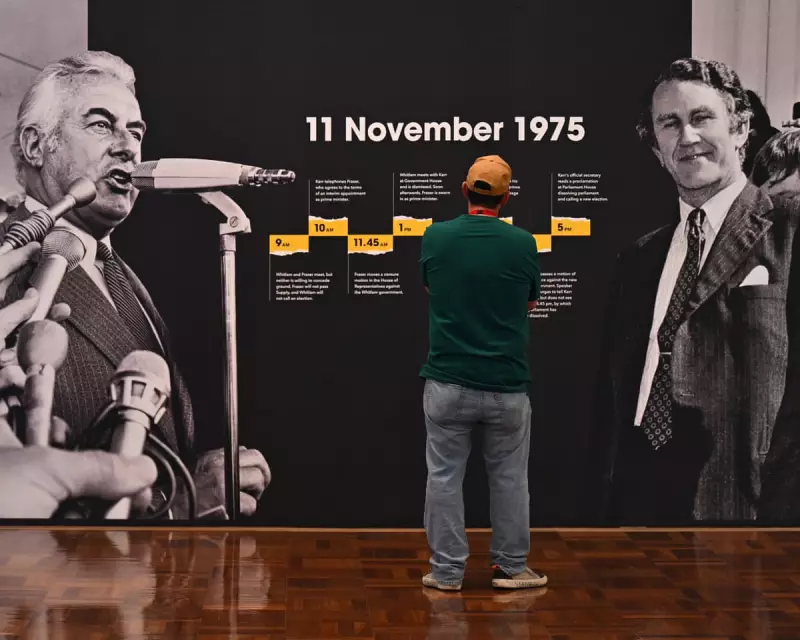
Prime Minister Anthony Albanese has delivered a powerful condemnation of the events that led to Gough Whitlam's government dismissal fifty years ago, labelling it "a calculated plot" by conservative forces to remove a democratically elected administration.
A Political Ambush Remembered
Speaking at Old Parliament House ahead of Tuesday's 50th anniversary of the dramatic constitutional event, Albanese rejected the traditional description of the 1975 crisis as purely constitutional. He instead characterised it as a carefully orchestrated political manoeuvre designed to overturn the will of Australian voters.
"The opposition orchestrated a parliamentary gridlock over the budget and then secretly prevailed upon the governor general to break it, by sacking the prime minister," Albanese stated in his address to gathered dignitaries and Labor supporters.

The Prime Minister specifically criticised the roles played by then opposition leader Malcolm Fraser and Governor General Sir John Kerr in the events of 11th November 1975. He accused the Coalition of forming government without any "legitimate pretext" after Whitlam's Labor government had secured majority support in two consecutive federal elections within three years.
The Mechanics of the Dismissal
Albanese detailed how conservative forces had exploited constitutional conventions to achieve their political objectives. "The dismissal was a calculated plot, hatched by conservative forces which sacrificed conventions and institutions in the pursuit of power," he asserted.
The Prime Minister revealed that Whitlam had maintained an "unshakeable belief" that Kerr would act appropriately to resolve the parliamentary deadlock over stalled budget bills. This confidence proved tragically misplaced when Kerr instead sought advice from Chief Justice Garfield Barwick and High Court justice Anthony Mason before hinting to Fraser that he was prepared to use the constitution's reserve powers to dismiss the government.
Albanese argued that "the old suffocating conservatism" of the Menzies era had effectively reached from its political grave to remove a government chosen by the Australian people.
Whitlam's Enduring Legacy
Despite focusing on the dramatic circumstances of the government's removal, Albanese emphasised that the dismissal should not overshadow Whitlam's significant policy achievements during his three-year administration.
The Prime Minister highlighted several landmark reforms introduced by the Whitlam government, including:
- The creation of Medibank, precursor to Australia's modern healthcare system
- The introduction of free university education
- The formal end of the White Australia policy
- The establishment of the Racial Discrimination Act
- The normalisation of diplomatic relations with China
"After years of drift, a new sense of confidence and purpose and ambition emerged," Albanese recalled, describing the transformative impact of Whitlam's leadership on Australian society and national identity.
Personal Memories and National Commemoration
The Prime Minister shared personal memories of learning about the dismissal as a year seven student, when his history teacher Vince Crow burst into the classroom with the shocking news. "What I remember most of all from those days is the sense of dismay," Albanese reflected.
To ensure Whitlam's legacy receives permanent recognition, Albanese announced plans to commission a statue of the former prime minister to be placed at Old Parliament House, now home to the Museum of Australian Democracy. The tribute will join existing depictions of other political figures including Sir Robert Menzies, John Curtin and Ben Chifley.
The commemorations come as Australia reflects on one of the most controversial episodes in its political history, with the governor general Sam Mostyn, former prime minister John Howard, members of the Whitlam family and numerous Labor figures participating in anniversary events.

Paul Keating, who served as a junior minister in the Whitlam government, will headline Tuesday's main commemorative events, ensuring that the dramatic events of half a century ago continue to inform contemporary discussions about Australian democracy and constitutional conventions.