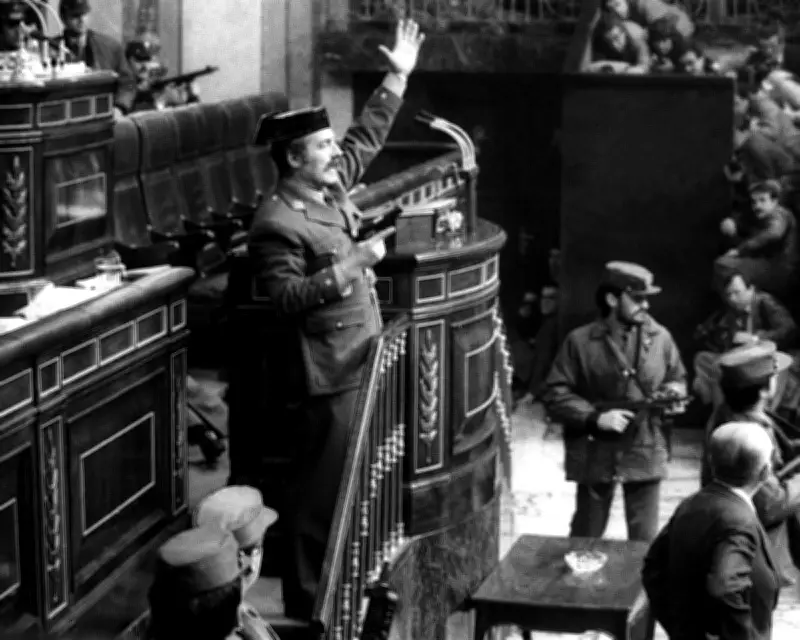
Antonio Tejero, Military Officer Behind 1981 Spanish Coup Attempt, Dies at 93
Lt Col Antonio Tejero Molina, the military officer who led the infamous armed assault on Spain's parliament in 1981, has died at the age of 93. His death occurred on the very day that government documents related to the coup attempt were declassified, exactly 45 years after the dramatic events that shook Spain's young democracy.
The 23 February 1981 Parliament Assault
On the evening of 23 February 1981, during the investiture of Leopoldo Calvo-Sotelo as Spain's new prime minister, approximately 250 civil guards stormed the semi-circular chamber of the Cortes, Spain's lower house of parliament. Tejero, pistol in hand, strode to the rostrum shouting "¡Quieto todo el mundo!" ("No-one move!") before firing shots into the ceiling and screaming the notorious phrase "¡Se sienten, coño!" ("Sit down, fuck it!").
For 18 tense hours, the entire parliament was held hostage until a negotiated surrender occurred the following morning. Communist party leader Santiago Carrillo later revealed he had expected to be executed during the ordeal. Tejero's bushy moustache, angry stare, and traditional civil guard tricorne hat became iconic images of the failed coup attempt, which represented an effort to return Spain to the fascist dictatorship of Francisco Franco that had ended in 1975.

The Conspiracy and Its Aftermath
The coup attempt emerged during a period of profound crisis for Spain's fledgling democracy, established through the 1977 elections. The Basque terrorist group Eta had been killing members of the army and police weekly, while Prime Minister Adolfo Suárez's government was collapsing amid economic turmoil. Several politicians had been irresponsibly calling for "a touch on the rudder" - a bloodless intervention to "correct" what they saw as a faltering democracy.
Tejero conspired with two other military leaders: General Jaime Milans del Bosch, who deployed tanks onto the streets of Valencia, and General Alfonso Armada, who visited the parliament during the hostage crisis ostensibly to negotiate but actually to give the impression that King Juan Carlos supported the coup. At 1:12 am, seven hours after the assault began, King Juan Carlos appeared on television in full military uniform to condemn the insurrection and defend democratic processes, effectively ending the coup attempt.
Remarkably, this was not Tejero's first military rebellion. In 1978, he had conspired in the "Galaxia" plot to attack the Moncloa palace and arrest the entire cabinet. That plot failed when an invited participant informed police, resulting in Tejero receiving only a seven-month prison sentence without demotion or expulsion from the civil guard, leaving him positioned to attempt the 1981 coup.
Trial, Imprisonment, and Later Life
Tejero was among 32 conspirators tried for the 1981 coup attempt. In June 1982, he was convicted and sentenced to 30 years in prison. Despite being expelled from the civil guard, he served his sentence in a military prison in Figueres where conditions were comfortable and staff sympathetic. He was released in 1996 after serving approximately 15 years.
While awaiting trial, Tejero established a political party called Solidaridad Española (Spanish Solidarity) with the provocative slogan "Enter Parliament with Tejero!" However, in the 1982 general election, he received only 28,451 votes and failed to enter parliament through democratic means.
In a revealing October 2023 interview with El Español newspaper, Tejero claimed he himself halted the coup when he realized Armada wanted a "government of national salvation" including leftwing representatives rather than a full military dictatorship. He felt betrayed, describing himself as being "tossed aside like a used cigarette butt" according to his wife Carmen.
After prison, Tejero devoted himself to painting and gardening, dividing his time between Torre del Mar near Málaga and Madrid. He maintained a low political profile but attended weekly mass and, on rare public appearances, demonstrated his unchanged political views. In 2019, he attended the removal of Franco's remains from the Valle de Cuelgamuros mausoleum, where he was greeted by fascist supporters with cries of "Long live Spain! Long live Tejero!"

Early Life and Family
Born on 30 April 1932 in Alhaurín el Grande near Málaga, Tejero came from a poor family with military connections. His father was a rural school teacher. He attended the Military Academy in Zaragoza and entered the civil guard at age 19, leading a typical military life with postings to at least six destinations over 20 years before becoming lieutenant colonel in the Basque country in 1974.
In 1958, he married Carmen Díez Pereira, daughter of a civil guard officer who predeceased him. Tejero is survived by their three sons, three daughters, and sixteen grandchildren. Despite rumors that he wrote memoirs in prison, when publisher Planeta offered him a blank cheque for them in 2000, he showed no interest.
The newly declassified government documents support the official version that King Juan Carlos saved Spanish democracy by opposing the conspirators, though Tejero's death on the same day as their release adds a poignant historical symmetry to the conclusion of this controversial figure's life.