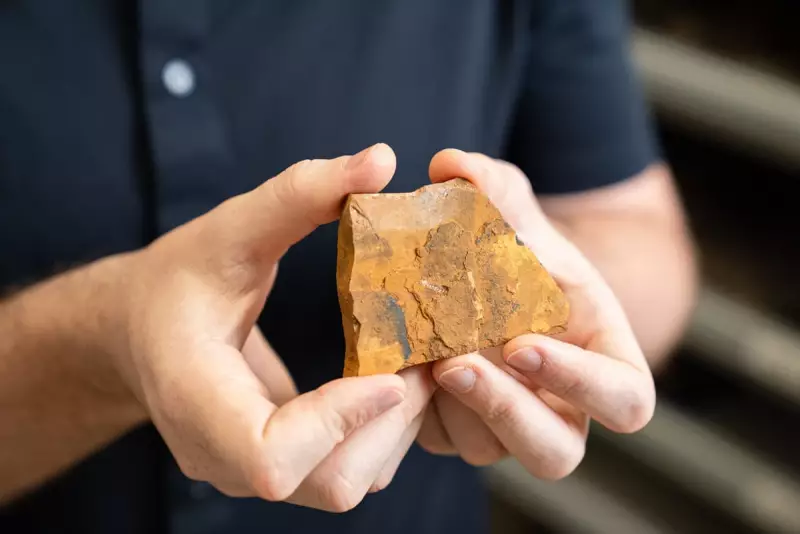
In an extraordinary twist of fate, a retired science teacher from Australia has unearthed a fossil discovery that's rewriting evolutionary history books across the Southern Hemisphere. What began as a casual exploration in the rugged Australian outback has revealed ancient marine creatures dating back an astonishing 480 million years.
The Accidental Palaeontologist
John Molyneux, a 68-year-old former educator who spent decades teaching science to Australian students, never imagined his retirement would lead to one of the most significant palaeontological finds in recent memory. While exploring near the Amadeus Basin in central Australia—a region better known for its arid landscapes than ancient oceans—Molyneux spotted something unusual protruding from the rock formations.
The discovery consisted of exceptionally preserved marine fossils from the Ordovician period, a time when much of Australia was submerged beneath tropical seas. These weren't just any fossils; they represented entirely new species that had never been documented by science. The most remarkable aspect? At 480 million years old, they now stand as the oldest fossils ever discovered in the Southern Hemisphere.

Unlocking Ancient Marine Secrets
When professional palaeontologists examined Molyneux's find, they realised the magnitude of what the retired teacher had stumbled upon. The fossils included various marine organisms perfectly preserved in the limestone, offering an unprecedented window into life nearly half a billion years ago.
Dr. Marissa Collins, lead palaeontologist at the Australian Museum of Palaeontology, confirmed the significance of the discovery. "What John has found is truly exceptional," she explained. "These fossils provide our first clear evidence of complex marine ecosystems in the Southern Hemisphere during the Early Ordovician period. They're completely changing our understanding of how and where early life evolved."
The newly discovered species include several types of trilobites, ancient arthropods that dominated prehistoric oceans, along with other marine creatures that scientists are still working to identify. The exceptional preservation quality means researchers can study minute details of their anatomy that are rarely available in fossils of this age.
Rewriting Evolutionary History
This discovery carries implications far beyond adding new species to the scientific register. The 480-million-year-old date places these creatures at a critical juncture in Earth's history—the Great Ordovician Biodiversification Event, when life on our planet experienced an explosive diversification.
Previously, most knowledge about this period came from Northern Hemisphere fossil sites. The Australian discovery proves that similar evolutionary processes were occurring simultaneously in southern waters, suggesting a more connected global ecosystem than previously thought.
The find challenges existing theories about how life spread across ancient oceans and may force scientists to reconsider the timing of key evolutionary developments. For John Molyneux, the retired teacher turned accidental discoverer, the experience has been life-changing. "I've always loved science and teaching young minds about our natural world," he reflected. "To make a contribution like this in retirement is beyond anything I could have imagined."
His discovery serves as a powerful reminder that groundbreaking science isn't confined to professional laboratories and research institutions. Sometimes, the most significant finds come from curious minds with a passion for exploration and a keen eye for detail.