On April 26, 1986, the world's worst nuclear accident occurred at the Chernobyl plant near Pripyat, Ukraine, then part of the Soviet Union. The catastrophe was so severe that even the secretive Soviet state acknowledged a public disaster. The accident released a cloud of radioactive material across Russia, Eastern Europe, and Scandinavia, altering generations of people's health, contaminating the environment, and forcing a global reassessment of nuclear power.
What Caused the Chernobyl Accident?
The plant operators intended to test whether the facility could continue operating for 40 to 45 seconds without power. However, testers at Reactor No. 4 disabled nearly all safety features before conducting the emergency shutdown test. Nuclear power plants generate electricity by splitting atoms to produce intense heat, or radiation. This heat boils water into steam, which spins turbines to generate power. During the test, workers turned off the steam, causing the reactor's cooling systems to malfunction. Operators attempted to reinsert control rods to slow the reaction, but a design flaw caused them to jam. The resulting power surge triggered steam explosions that destroyed the core and ignited a graphite fire that burned for days. The meltdown released a hundred times more radiation than the bombs dropped on Hiroshima and Nagasaki. Inspectors concluded that the accident was caused by a remarkable range of human errors and violations of operating rules.
Vince Zabielski, a former nuclear engineer and partner at international law firm Pillsbury, notes that while staff were at fault, the Soviet-era RBMK reactor design was also to blame. Unlike Western reactors, it lacked a containment structure to limit the release of radiation. Its scale, severity, and enduring impact set it apart from all other nuclear accidents. As a condition of entry into the EU, all countries using the RBMK design had to permanently cease operations.

How Many People Died?
Two plant workers were killed within hours of the meltdown. Another 28 people died from radiation poisoning, including firefighters who responded to the scene. Anatoli Zakharov, a surviving firefighter, recalled joking with colleagues: 'There must be an incredible amount of radiation here. We'll be lucky if we're all still alive in the morning.' Radiation can also cause slow, long-term deaths. Thousands or possibly millions have died from radiation-associated illnesses, including children. Petro Hurin, a 'liquidator' who helped clean up the reactor, told Reuters that only five of the 40 people in his team are still alive. 'Not a single Chernobyl person is in good health,' said the 76-year-old. 'It's death by a thousand cuts.'
Ionising radiation, the energy emitted by atomic reactions, can damage living tissue and break DNA strands. Even low doses can cause cancer and other long-term health problems. An estimated 4,000 to 6,000 thyroid cancer cases, mostly in children, are directly linked to the disaster. However, Dr. Thom Davies, associate professor of geography at the University of Nottingham, believes the true toll in fatalities and ongoing health implications may never be known. 'One reason Chernobyl was so devastating was the sheer scale of the disaster – larger than any other toxic accident in human history,' he explains. 'This radioactive material spread silently and invisibly across much of Europe, including the UK, transforming areas near the reactor into what I call “toxic geographies”: landscapes still contaminated decades later. What makes radiation frightening is its invisibility. You cannot see it, hear it, or smell it – yet it has the power to cause illness, displacement and death.'

Do People Still Live in Chernobyl?
It took 36 hours to evacuate Pripyat, a town of nearly 50,000 residents, after the blast. The delay occurred partly because Soviet officials did not inform residents of the true extent of the meltdown, instead herding them onto buses. Doctors were forbidden from diagnosing radiation sickness, attributing symptoms to nervous conditions. It took a Swedish monitoring station 800 miles away detecting high radiation levels for the Kremlin to admit that something terrible had happened. In the years following, the government relocated 350,000 people, making them 'nuclear refugees,' according to Dr. Davies. 'To put that into perspective, this is roughly equivalent to uprooting the entire population of Iceland or the Maldives and telling them they could never return home,' he adds.
The disaster site, now called the Chernobyl Exclusion Zone, spans 1,000 square miles. While radiation levels have declined somewhat through decay, the area remains largely empty. Around 150 survivors live on the outskirts, many of them women in their 80s who call themselves samosely, or 'self-settlers.' Among them is Yevhen, who was a 49-year-old teacher at the time of the accident. He returned a decade later to work in radiation protection. 'Did we survive? We did! Did anyone get sick? No one! Did anyone die of radiation? No one,' he told Ukraїner. 'If I hadn't returned immediately, I would have kicked the bucket. I want to live in Chernobyl, nowhere else.'
Chernobyl Now
In the aftermath, officials built a makeshift shelter around the reactor to contain radioactive dust, called the sarcophagus. It has been encased by a 40,000-ton steel shell, the New Safe Confinement, since 2016. After the area was declared safe for limited visitation, tourists became a common sight for over a decade, with 120,000 visiting in 2019 alone, following the HBO miniseries Chernobyl. While the Russia-Ukraine war led to a decrease in numbers, travel firms still offer tours for as little as £25. Visitors are shown decaying churches, rusted ships, and road signs pointing to abandoned villages. Tour operators stress that you don't need to pack your own Geiger counter. 'Expecting silence, ghost streets and an empty atmosphere? Not at all, you are about to see the real living face of Chernobyl today in just one hour,' one tour from Chernobyl X claims. Their excursions include riding Soviet-era vehicles, wearing 'liquidator costumes,' and having a 'Cher-noble' time.
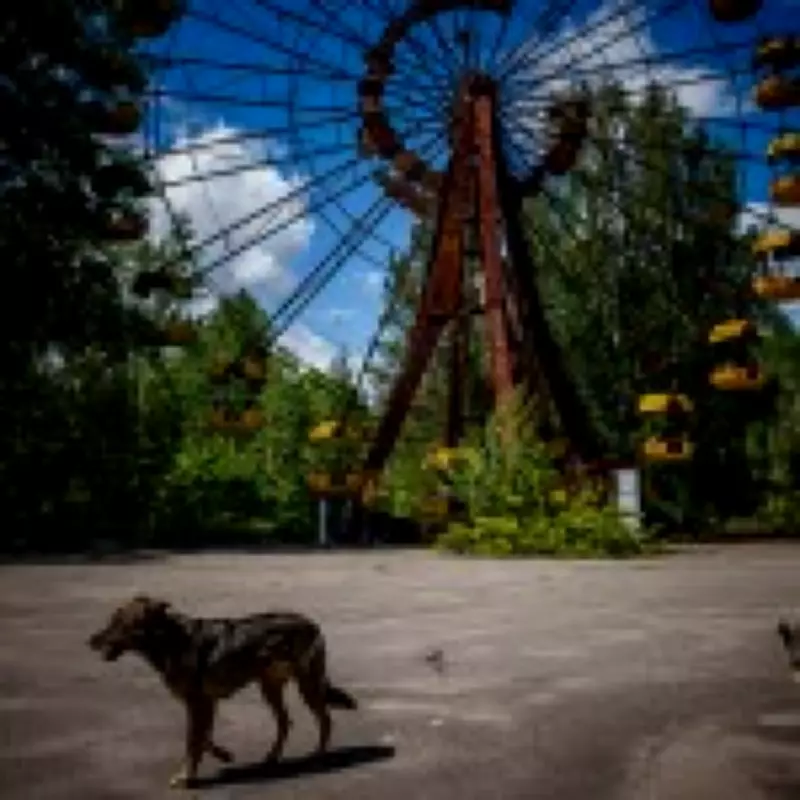
With so few humans, the area has turned into a post-apocalyptic nature haven. Wolves, horses, and the descendants of abandoned pet dogs roam around crumbling apartment blocks and rusted amusement park rides. Scientists consider the zone a laboratory to study how chronic, low-level radiation impacts animals. Despite high radiation exposure, wolves have developed genetic mutations that make them more resilient to cancer – the opposite effect seen in humans – while frogs have evolved darker skin to protect against the radiation.