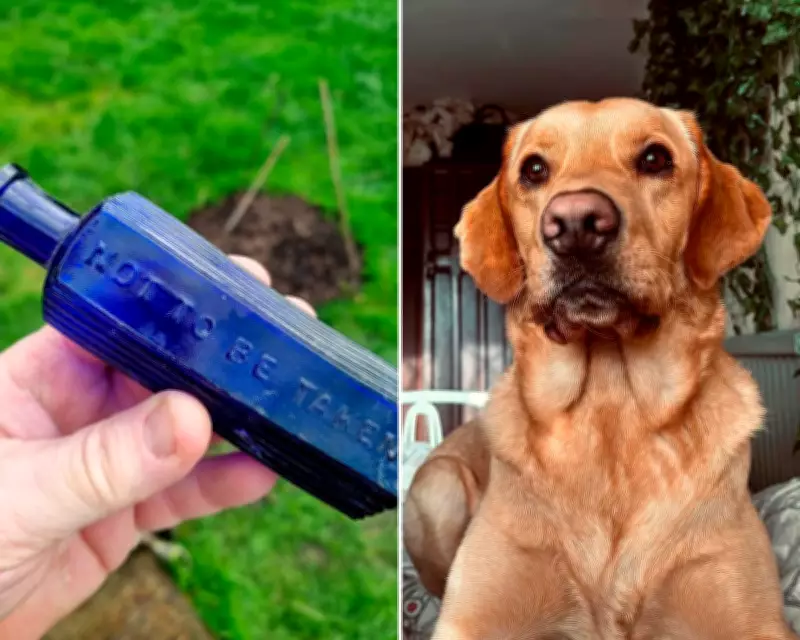
Dog's Garden Discovery May Link to Victorian Murder Case in Devon
A Devon man believes his Labrador has uncovered a crucial piece of evidence in his back garden that could be connected to a notorious Victorian murder case. Paul Phillips, aged forty-nine, reported that his dog, Stanley, dug up a distinctive blue glass bottle with the words "Not to be taken" inscribed on the side at their home in Clyst Honiton.
Possible Connection to Notorious 1865 Poisoning
The discovery immediately reminded Phillips of an article he had read about the murder of William Ashford by his wife, Mary Ann Ashford, in 1865. Further research suggested the couple may have resided in a neighbouring property, adding weight to the potential connection. The blue bottle is identified as a poison bottle that became common in the mid-nineteenth century, aligning with the timeline of the Ashford case.
Historical Significance of Mary Ann Ashford's Execution
Mary Ann Ashford was convicted of murder by arsenic poisoning and was hanged in Exeter in front of a crowd of twenty thousand spectators. Her execution was notoriously botched, taking several minutes to complete, which reportedly contributed to public opposition against public hangings. This event is often cited as a catalyst in the movement that led to the abolition of public executions in England during the 1860s.

Phillips explained to Devon Live, "I thought it was a really interesting and beautiful thing when I cleaned it up and just remembered something about the murder. I searched the internet and it came up with Clyst Honiton and Mary Ann's hanging." He speculated on the bottle's origin, noting, "I can't say why it was buried here, and a bottle like this would have been very useful for various different things, but what possible reason would they have to bury it? It could have been the bottle she used."
Dog's Persistent Digging Leads to Find
Stanley, the Labrador, repeatedly returned to the same spot in the garden, despite Phillips regularly repairing the damage. This persistence eventually led to the recovery of the bottle. Phillips recounted how Stanley's behaviour prompted the investigation, highlighting the dog's role in uncovering this potential historical artifact.
Background of the Ashford Murder Case
According to online newspaper reports cited by Phillips, Mary Ann Ashford was alleged to have been having an affair with a man twenty-two years younger than her. She was accused of plotting to kill her husband to steal his inheritance and start a new life. Her trial took place at the Devon Lent Assizes on March 16, 1866, with the jury reaching a guilty verdict in just a few minutes.
Phillips added, "We believe that we live next door to the property resided by William and Mary Ann Ashford in 1865. I believe the lad she was having an affair with worked at the local bakery, and there used to be one down the lane opposite the property." This local context strengthens the possibility that the bottle is indeed linked to the historic crime.
The discovery has sparked interest in the community, blending elements of local history, crime, and canine curiosity. While definitive proof is lacking, the bottle serves as a tangible reminder of a dark chapter in Devon's past and the enduring fascination with Victorian-era mysteries.