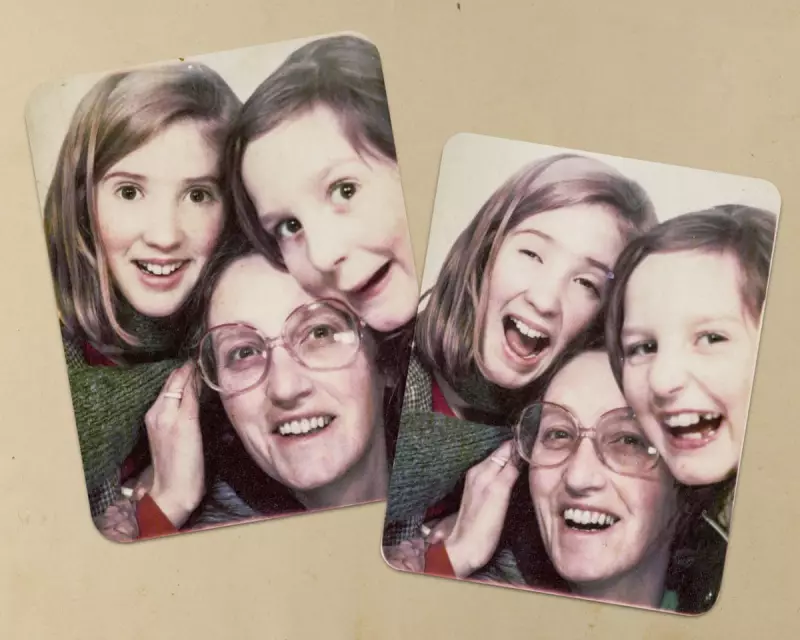
For years, Gwen's account of her daughters' teenage years in the mid-1980s to early 1990s was definitive. The broad brush strokes painted a picture of delinquency and stroppiness, a family legend where her children, Zoe and Stacey, were seemingly allergic to her presence. Yet, a single photobooth strip, unearthed while preparing for Gwen's funeral, told a startlingly different and sunnier story.
The Family Legend vs. The Photographic Evidence
Gwen, a woman deeply engaged in progressive politics, had a particular way of summarising the era. "Zoe was delinquent, couldn't get a word of sense out of her," she would say. Or, for the year 1986, the verdict was simple: "That was the year Stacey was awful." Her curated photo album seemed to corroborate this: images of Zoe sarcastically sniffing a geranium, or Stacey outside a European cafe, her lips seemingly forming a petulant "piss off" to the camera.
Their home in Wandsworth was a hub of activism, papered with posters on issues from pit closures to nuclear disarmament. Gwen created spoof public information campaigns, replacing government "Protect and Survive" nuclear advice with her own "Protest and Survive" posters. Her constant refrain was her amazement that her daughters seemed unbothered by the demise of the Greater London Council (GLC) or the threat of nuclear war, despite often joining her on protests.

"Do you know, when the Iraq war broke out, these girls didn't even notice?" was a typical Gwen pronouncement. She believed documenting marches was frivolous, so the only proof of their involvement, ironically, came from the local Wandsworth Borough News.
A Different Story in a Photobooth Strip
The process of gathering pictures for Gwen's funeral montage, however, prompted a profound reassessment. Photos sent by her friends revealed a contrasting narrative. The most compelling evidence was a simple photobooth shot from 1985, featuring Gwen with a teenage Zoe and Stacey.
In this tightly framed image, all three are smiling genuinely. "We're plainly not, as her legend had it, allergic to her," Zoe reflects. The picture suggested a warmth and ease that contradicted the established family lore of a household divided between a mother battling adversity and devil-possessed teenagers.
Reconciling Memory with Myth
Zoe acknowledges their family never resembled the glossy, fun-loving dynamic of TV's Gilmore Girls—a show Gwen would have dismissed as sentimental trash. But the rediscovered photos proved it wasn't the grim cross between Tenko and Rosemary's Baby her mother's stories suggested either.
The images, especially that intimate photobooth strip, served as a testament to their underlying sunny dispositions. They also hinted that the sisters were likely more aware of world events, like the outbreak of the Iraq war, than their mother ever credited. The photo became a poignant key to unlocking a more nuanced, affectionate memory of their politically charged childhood, challenging a lovingly crafted but ultimately flawed legend.