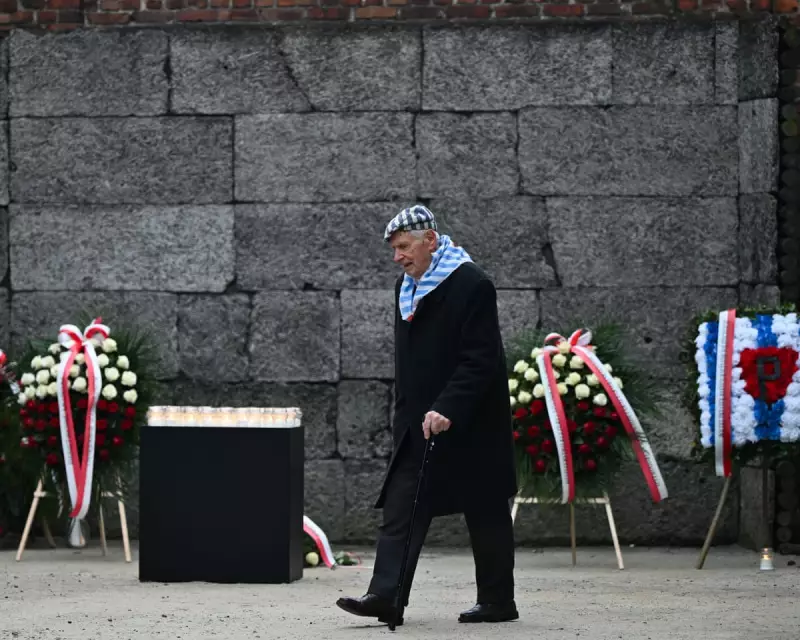
Holocaust Survivors Issue Stark Warnings on International Memorial Day
As Europe and the world commemorated the 81st anniversary of the liberation of Auschwitz, survivors of the Nazi concentration camp gathered at the memorial site to lay flowers and candles in solemn remembrance. International Holocaust Memorial Day, observed annually on 27 January, serves as a poignant reminder of the systematic extermination of millions, with Jewish leaders and remaining survivors issuing urgent calls to confront contemporary threats of populism and extremism.
Survivors Confront Rising Far-Right Movements
Among those speaking out was 87-year-old Tova Friedman, a survivor who is scheduled to address the German parliament this week. In her forthcoming speech, Friedman plans to directly challenge the far-right Alternative für Deutschland (AfD) party, questioning their stance with powerful words: "How dare you? Who do you think you are?" Friedman, who emigrated to the United States after the war and became a successful therapist, warned specifically about the resurgence of populist far-right movements across Europe.
The AfD, which is contesting elections in five German states this year with strong polling predictions in at least three, has repeatedly advocated for ending what it terms a "culture of guilt" regarding Nazi crimes. This anti-immigrant party supports policies including mass deportation of non-naturalised citizens, creating significant concern among Holocaust survivors and Jewish communities.

Commemorations Across Europe
At the Auschwitz memorial site in Poland, 24 former prisoners braved freezing temperatures to lay wreaths at the infamous 'Wall of Death,' where German soldiers executed primarily Polish political prisoners. Polish President Karol Nawrocki later joined survivors for a ceremony at nearby Birkenau, the vast complex where Jews from across Europe were transported to be murdered in gas chambers.
In Berlin, candles were lit and white roses placed on the snow-covered Memorial to the Murdered Jews of Europe, the sea of grey concrete blocks that stands as an enduring symbol of German contrition. Across the continent, commemorations took diverse forms:
- Events at museums, schools, and railway stations throughout Germany
- Informal gatherings at Stolpersteine memorial plaques embedded in pavements marking former Jewish residences
- A candlelit procession planned for Thursday evening at Terezín, site of the former Theresienstadt concentration camp in the Czech Republic
- A silent procession through Amsterdam's Jewish quarter marking the Netherlands' national Holocaust memorial day
Educational Concerns and Demographic Realities
The Irish government announced increased funding for Holocaust education in schools following a concerning survey revealing that 15% of young people had never heard of the Holocaust, while 10% of those aged 18-29 considered it a "myth." This highlights the pressing need for continued educational efforts as firsthand survivors become fewer.
According to the New York-based Conference on Jewish Material Claims Against Germany, approximately 196,600 Jewish survivors are believed to remain alive globally today, compared to 220,000 just a year ago. This demographic reality underscores the urgency of preserving testimonies and ensuring accurate historical transmission.
New Challenges in Preserving Memory
European Union's top diplomat Kaja Kallas warned that antisemitism has reached levels not seen since the Holocaust itself, taking on "new and disturbing forms." She specifically highlighted concerns about AI-generated content deliberately created to blur lines between fact and fiction, distort historical truth, and undermine collective memory.
The Frankfurt-based Anne Frank Educational Centre drew attention to a "flood" of AI-generated propaganda content that ridicules victims with the aim of denying or trivialising the Holocaust. Meanwhile, Jewish community representatives including Josef Schuster, president of the Central Council of Jews in Germany, urged people to demonstrate "civil courage" and stand up for democracy against forces seeking to push Jewish communities out of public life.

Personal Stories of Survival
Tova Friedman's personal story exemplifies both the horror of the Holocaust and the importance of testimony. Deported to Auschwitz-Birkenau at just five years old from her home near Gdansk, she likely survived due to a technical malfunction of the gas chambers and later hid among corpses during death marches in January 1945.
"I represent one and a half million children who were murdered and who are not here to speak for themselves," Friedman told German media. "My story is representative of all their stories because we all had similar experiences. I was simply luckier than them, because I survived."
Together with her 20-year-old grandson Aaron Goodman, Friedman maintains a TikTok account called 'TovaTok' where they discuss her experiences and warn against growing antisemitism. Goodman represents a growing number of surviving relatives taking on the vital task of preserving family stories for future generations.
Contemporary Threats to Remembrance
The commemorations occurred against a backdrop of concerning incidents, including police investigations into vandalism at a memorial in front of the remains of a synagogue in Kiel. Flowers and candles placed at the site had been crushed and scattered, according to local media reports, highlighting ongoing challenges in preserving Holocaust memory.
As survivors like Friedman prepare to address political institutions and share their stories through modern platforms, their messages carry renewed urgency: the lessons of the Holocaust must not be forgotten, and vigilance against extremism remains essential for protecting democratic values across Europe and beyond.