As the clock struck midnight on 31 December 1925, cities across Britain erupted in celebration to welcome 1 January 1926. The festivities in Manchester and London were particularly notable, marking a vibrant, if muddy, return to post-war revelry.
A Heterogeneous Welcome in Manchester's Albert Square
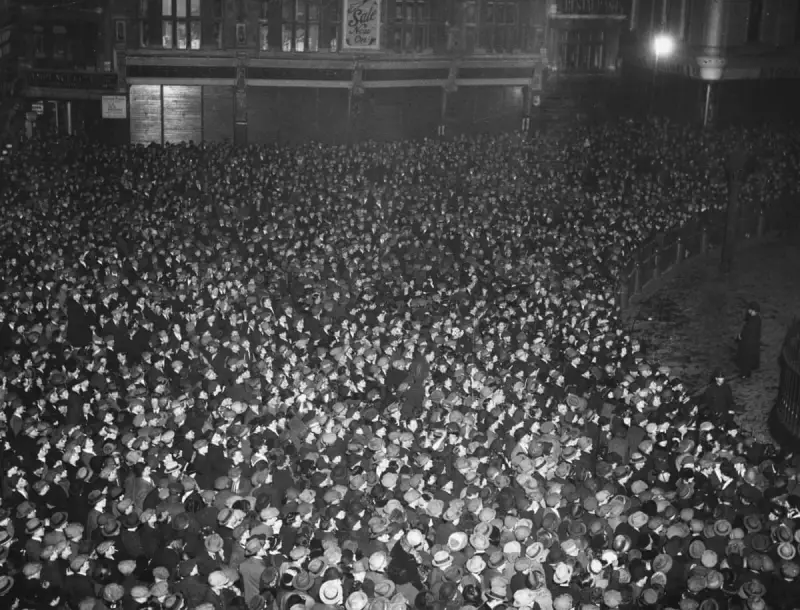
Manchester extended its traditional, mixed welcome to the dawn of the new year. Many thousands of citizens with a communal spirit gathered in the heart of the city, Albert Square, to see the old year out together. The crowd lingered long after the chimes of midnight, which held a special significance far greater than on any ordinary night.
Across the city, countless others celebrated on dance floors prepared for the occasion. The slogan "Start 1926 Dancing!" was embraced on every social level. At the Midland Hotel, transformed into a grand garden for the event, the figure of Miss 1926 descended from the ceiling of the Octagon Court to bestow her smiles upon the dancers.

Revelry took many forms. Guests at the Queen's Hotel were greeted by bells and trumpets at the mystical moment, with happy new year wishes displayed on electric signs. At the Ice Palace, people skated right up to midnight, while the great ballroom at Belle Vue kept the party going until 1am. Carnival and masked dances were held on varying scales across Manchester.
The Enigmatic Unmasking at Midnight
The phrase "Unmasking at midnight!", borrowed from a ball announcement, seemed fitting for the mystery drawing crowds to Albert Square. What did they see when 1926 was revealed? The features of the new year appeared too enigmatic for anyone to discern clearly. In essence, Manchester looked much as it had in the final moments of the old year.
The weather played its part. Although heavy rain had fallen earlier in the evening, it had ceased by the time of the celebrations. However, Albert Square was characteristically dirty underfoot, with mud churned almost to a froth by dancing, promenading, and, in some cases, staggering feet.
Amidst the noise, quieter forms of observance persisted. In churches and chapels across the city, people attended watch-night services, their prayers a counterpoint to the boisterous celebrations outside.
London's Gayest Post-War Celebration
Meanwhile, in the capital, New Year's Eve celebrations were probably the gayest of any since the war. With the rain holding off, would-be revellers made their way to the West End early, creating scenes of animation as trains, tubes, trams, and buses discharged their lighthearted loads.
One of the principal events was a grand carnival at the Albert Hall, organised by a group of papers including The Sphere and The Tatler on behalf of the Middlesex Hospital and the British Empire Service League. Several thousands of dancers, most in fancy costume, gathered to bid farewell to the old year.
Another time-honoured tradition continued at St Paul's Cathedral. Thousands of people packed the churchyard and its approaches long before midnight, passing the time by singing popular songs and dancing in the limited space available. The crowd, armed with balloons and rattles, was boisterous but good-humoured. Itinerant vendors did a thriving trade in Scottish paper hats and other fancy headgear.
As the clocks began to strike midnight, a marked silence fell over the throng. When the new year was finally heralded, cheers erupted, and Auld Lang Syne was sung with great heartiness. Then began the homeward journey, with everyone facing whatever 1926 had in store.
These vivid snapshots from 1 January 1926 capture a nation embracing the new year with a blend of traditional communal spirit, chaotic revelry, and hopeful, if uncertain, steps into the future.