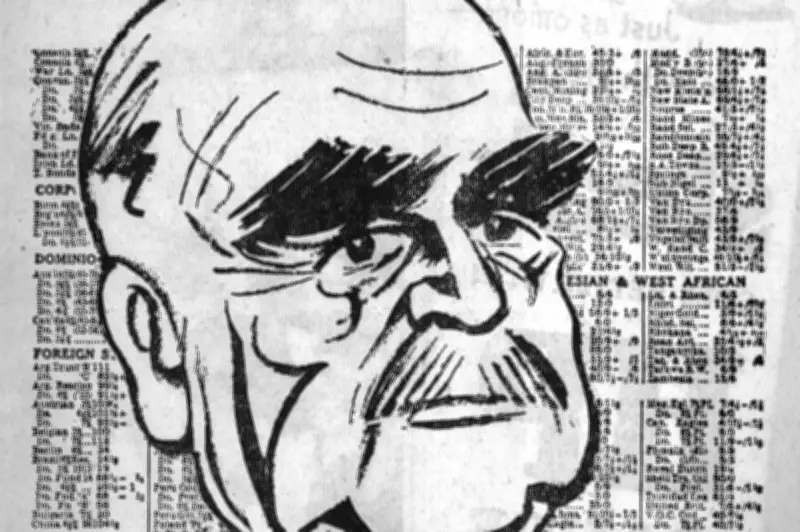
The Death of a Financial Titan
On March 31, 1913, in Rome's Grand Plaza Hotel, John Pierpoint Morgan passed away in his sleep at the age of 75. The official cause was listed as "nervous exhaustion," a fitting end for a man whose life was defined by immense pressure and monumental achievements. Morgan was a towering figure, both physically at 6'2" with a distinctive purple nose due to rhinophyma, and financially, with a personal fortune estimated at $90 million, equivalent to $3 billion today. His influence, however, extended far beyond his wealth, as he played a pivotal role in stabilizing the United States during two major financial crises.
Early Life and Rise to Power
Born in 1837 in Hartford, Connecticut, Morgan did not come from humble beginnings. His family was already established in business, with his grandfather Joseph Morgan amassing a fortune in fire insurance and his father Junius Spencer Morgan becoming a partner in a prominent dry goods firm. By age 20, Morgan had completed an art history degree in Göttingen and was fluent in German. His entry into the family business coincided with the Panic of 1857, an early economic downturn that tested his mettle.
In 1861, he founded J. Pierpoint Morgan & Co. in Manhattan, just as the Civil War erupted. The conflict reshaped his operations, shifting focus from cotton and iron to securities and foreign exchanges. Through strategic partnerships, such as with Anthony Drexel to form Drexel Morgan & Co., he became a key agent for European investment in the U.S., fostering a national capital market and forging close ties with the government.

Building an Empire and Facing Crises
Morgan's firm grew into one of the world's largest banking houses by the turn of the century. He financed the booming railroad industry and applied his expertise to steel, orchestrating the creation of United States Steel in 1901—the first billion-dollar enterprise in America, representing 4% of the nation's GDP. His power was most dramatically demonstrated during the Panic of 1907, when a run on New York banks threatened to collapse the financial system.
With no central bank in place, Treasury Secretary George Cortelyou turned to Morgan for help. After assessing the situation, Morgan concluded that the Knickerbocker Trust could not be saved, but he acted decisively to prevent the panic from spreading. He oversaw the liquidation of assets, secured loans from other trust companies, and persuaded President Theodore Roosevelt to allow US Steel to acquire Tennessee Coal, Iron and Railroad Company, which helped restore market confidence.
Legacy and Controversy
Morgan's actions during the 1907 crisis saved America's financial system, though he personally lost $21 million. This episode highlighted the immense influence of bankers, leading to scrutiny from Congress. The Pujo Committee investigated his company's power, and Morgan faced rough cross-examination, which many believe hastened his declining health. He fell ill while traveling in Egypt in March 1913 and died shortly after in Rome.
His death sparked headlines hailing him as the "Master of Finance," with the press noting his role in the 1907 rescue and the toll of the Pujo investigation. The reform momentum outlasted him, culminating in the Federal Reserve Act of 1913, which established a central banking system. Benjamin Strong, one of Morgan's trusted advisers, was appointed to lead the Federal Reserve Bank of New York.
Often portrayed as a Gilded Age robber-baron, Morgan was a complex figure. He believed that commercial credit rested on character, not just money, stating, "a man I do not trust could not get money from me on all the bonds in Christendom." His bank underwrote major companies like AT&T, General Electric, and GM, leaving an indelible mark on the American economy. In many ways, we still live in a world shaped by JP Morgan's vision and power.