Medieval Chess Sets Uncover Vision of Equality and Mutual Respect
Far from serving as a metaphor for racial tension, chess in the medieval period often functioned as a vehicle for equality and mutual respect, according to new research. Analysis of medieval manuscripts, paintings, and chess sets by University of Cambridge historian Dr. Krisztina Ilko has revealed a vision of a "just world" where intellectual exchange took precedence over race or religion.
Historical Depictions Challenge Preconceptions
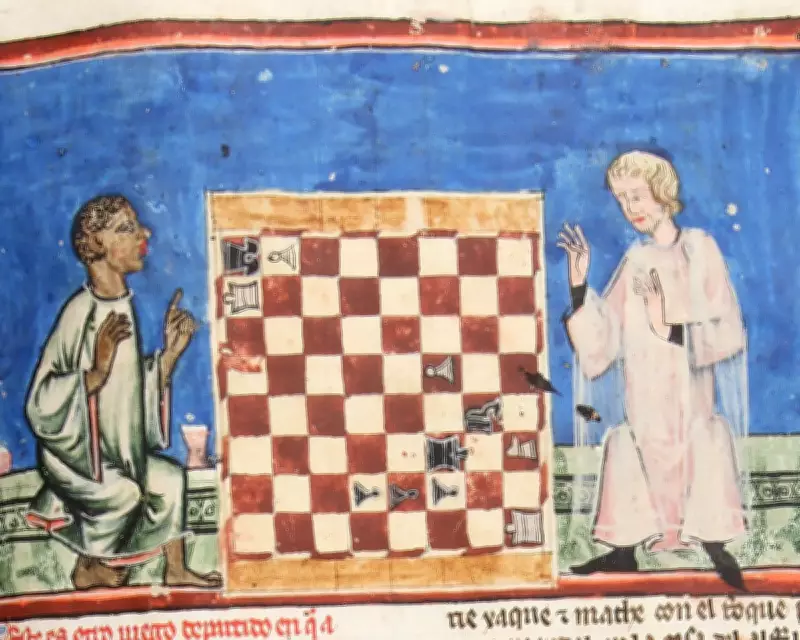
The Libro de axedrez, an illustrated 13th-century treatise on chess produced for King Alfonso X of Castile, features dozens of depictions of players from Africa, the Middle East, and Asia that defy common assumptions about medieval social attitudes. In one scene, a Black player is shown on a finely decorated bench, with a bottle of wine nearby, about to defeat his white opponent in a friendly game. Another image portrays four Mongol men, often depicted as violent warriors in medieval imagination, with one leaning casually on his sabre, his weapon more ornament than threat, as combat is confined to the checkered board.
In a further scene from the Libro de axedrez, a Muslim and a Jewish player sit down to a game, illustrating that while political conflict, religious differences, and medieval notions of race were realities, chess offered a way to bridge divides. Ilko notes in her paper that chess was not a projection of a fictitious egalitarian society but rather "an imaginary space that did not eradicate preconceived social norms and hierarchies but rather empowered players to challenge them."

Chess as an Intellectual Exchange
Dr. Ilko explains, "When people with non-white skin colour are depicted in medieval images, scholars have tended to see them in either exalted or subdued positions. Chess reveals a different, more complex story. Chess operated on a different plane where people could engage with each other as equals, irrespective of their skin colour. What mattered was 'who’s smarter?', 'who can win?', not 'who’s more powerful or socially superior?'"
Her study, Chess and Race in the Global Middle Ages, published in the American medieval studies journal Speculum, has been awarded the Medieval Academy of America’s Article Prize in Critical Race Studies. Ilko, a medieval historian from Queens’ College, Cambridge, states, "Medieval sources repeatedly state that chess is war without bloodshed, and that it represents a just world. Chess became a representation of the known world, the people in it and how society should function through orderly moves. Chess was a powerful vehicle for people hailing from widely different places to interact with each other. It was an intellectual exchange."
Global Spread and Cultural Impact
Ilko points out how King Alfonso’s court eagerly acquired and translated Islamic knowledge, with 88 of the 103 chess problems in his treatise following the Muslim playing style. Other depictions of chess in medieval works, such as a late 14th-century altarpiece from the demolished church of San Nicolás in Portopí, Mallorca, and illustrated versions of the Persian epic the Shahnama, challenge "value systems that privileged whiteness" by depicting royalty and intellectuals with darker skin.
Chess is believed to derive from Chaturanga, a board game played in 7th-century India, whose pieces were inspired by sections of the Indian army—infantry, cavalry, chariots, and elephants. As chess-style strategy games spread across different civilizations, pieces took on human features. Ilko notes, "Chess boards immediately had two contrasting colours and the opposing chess pieces were also differentiated through colour. This allowed medieval people to project ideas of skin colour and race on to the game. Chess was a game of war, which prompted not only an occasion for social interaction but also an active and competitive challenge between two players who each had an equal opportunity to win, regardless of status, wealth, or skin colour."
She concludes, "So much has changed since the middle ages but chess is more global than ever. Chess reveals a more diverse and fun middle ages."