Nigeria Becomes First African Nation to Archive History in Arctic Vault
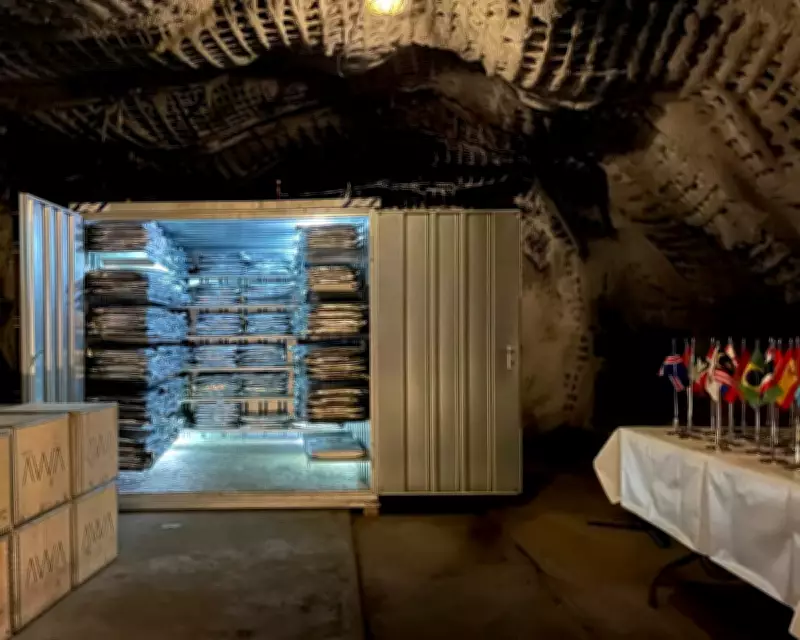
In a groundbreaking move for cultural preservation, Nigeria has become the first African country to deposit its historical and cultural records in the Arctic World Archive. This secure data storage facility is located 300 meters beneath a mountain in Svalbard, within a decommissioned coalmine near the North Pole.
The Arctic World Archive: Preserving Humanity's Memory
The Arctic World Archive (AWA) is a specialized data storage unit where organizations and individuals can deposit records on Piql film, a digitized medium designed to last up to 2,000 years. Established in 2017 by the Norwegian technology company that developed Piql, the archive was inspired by the nearby Svalbard Global Seed Vault. It aims to preserve the "world's memory" for future generations by leveraging Svalbard's cold, dark, and dry conditions, which are ideal for long-term preservation.
The facility currently holds an eclectic range of historical and creative records from 37 countries. Notable deposits include materials from the Vatican Library, the European Space Agency, Chopin's manuscripts, and works by Belgian photographer Christian Clauwers documenting the Pacific's disappearing Marshall Islands.

Nigeria's Historic Deposit
On February 27, Nigeria officially placed its archives at the AWA. The Nigerian records represent a rich mix of social and cultural history, along with archives from the country's creative industries. These materials were drawn from 12 Nigerian organizations, including private art foundations, museums, and libraries.
The collection was initiated by historian Nze Ed Emeka Keazor, who was appointed chair of Piql's first Africa office in Lagos in 2022. Keazor spent over a year approaching cultural organizations across Nigeria to encourage them to preserve their records. He traveled to Svalbard last month with colleague Esona Onuoha to personally hand over the archives.
Preserving Nigeria's Cultural Legacy
Institutions involved in the Nigerian deposit include Lagos art gallery Bloom Art, the Asaba Monument Trust which memorializes the 1967 Asaba massacre, the Nsibidi Institute (a social research organization run by Keazor), and the Umuchieze Community Legacy Deposit, a cultural project aimed at preserving Indigenous knowledge and history.
"It is important to me that Nigeria is remembered, because my work is about building cultural infrastructure," says Ugoma Ebilah, founder of Bloom Art. "Nigeria has produced some of the world's brightest and most creative people. It's not a coincidence that in the same year this archive deposit is made, the Grammys finally decided to acknowledge the contributions of Fela Anikulapo Kuti."
The timing of Nigeria's AWA deposit coincides with significant recognition for the country's creative community. British-Nigerian director Akinola Davies Jr recently won the outstanding debut Bafta for his film "My Father's Shadow," a coming-of-age story set during Nigeria's historic 1993 election. In his acceptance speech, Davies encouraged everyone to "archive your loved ones. Archive your stories, yesterday, today and for ever."
Addressing Preservation Challenges
In Nigeria, where libraries and museums are often underfunded and remain largely paper-based, research materials and historical documents are particularly vulnerable to being lost or damaged. Dr. Chima Korieh, an expert in West African social and economic history at Marquette University in Wisconsin, led a project to help the Umuchieze community in Imo State preserve their stories, cultural practices, and records from precolonial Nigeria.
"I can tell you, from 1960 onwards most of the public records that should be in the archives in Nigeria are not there," says Korieh. "Some of the materials you have in the Nigerian archives today are in danger of being lost because they are not well preserved."

The Umuchieze community's AWA deposits include manuscripts detailing the history of the Umuchieze people and reports highlighting their judicial and political systems. For Korieh, the project extends beyond simply storing information in a remote facility. "The whole community is involved in this process, and we aim to open up a community centre in Umuchieze where the public would have access to the materials."
Broader Implications for Digital Preservation
The need for secure long-term data storage has become increasingly urgent in the digital age. According to a 2024 Pew Research Center study, 38% of webpages between 2013 and 2023 no longer exist, meaning vast amounts of information and history have simply disappeared.
"The world is getting more and more aware of how fragile data storage is – each time you need to migrate it, it can change," says AWA co-founder Katrine Loen.
However, preservation comes at a cost. At €9,000 (£7,773) per reel, Piql film represents a significant investment for cash-strapped institutions. In response, AWA transitioned from a commercial enterprise to a non-profit organization in 2025, allowing funds to be used to subsidize organizations needing financial support to participate. This year, AWA partnered with UNESCO to archive the organization's Memory of the World Register, which includes significant heritage documents and records of world heritage sites stored as digital 3D scans.
Ensuring Future Accessibility
Alongside the archives stored at AWA are instructions on how to decode them. The facility also plans to provide depositors with tokens that will guide future generations to the storage location. Svalbard's unique geology, featuring rock formations from nearly every geological era, has earned it a reputation for containing the history of the world. "Now," says Loen, "We are putting in the knowledge of humanity."
For Nigeria, this represents just the beginning of what Obi Asika, director-general of the National Council for Arts and Culture, calls "a long journey towards narrative restitution and making sure that in all the spaces where we should be, we are presenting." The National Commission for Monuments and Museums and the National Council for Arts and Culture also made deposits, including reports on Nigeria's creative economy encompassing the music and film industries.
"One of the key things that has affected Africa is memory. It is oftentimes not properly recognised or stated because we have not been deliberate about protecting and projecting our narrative," says Asika. "So when the opportunity came to partake and be part of the first in Africa to publish there, it was good to be part of history. We're proud to be part of that."