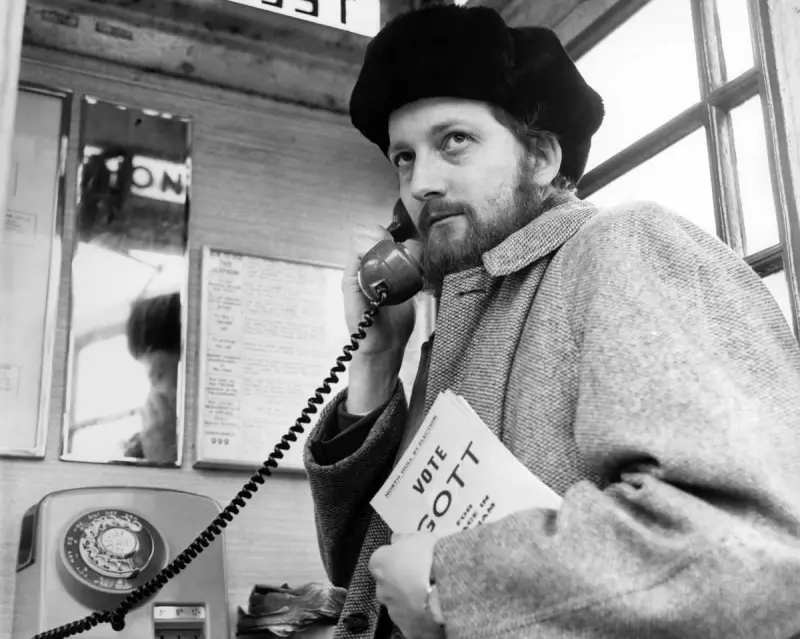
The Journalist Who Couldn't Be Bought
The recent passing of Richard Gott has prompted reflections on the extraordinary career of a journalist who remained steadfastly independent in the face of intense political pressure. Gott, whose death was reported in November, became renowned for his courageous reporting from South America during the 1970s, where he uncovered brutal realities that many powerful interests wished to keep hidden.
Resisting Cold War Propaganda in Chile
While researching British connections to South American regimes in the National Archives, historian Grace Livingstone discovered Gott's name appearing repeatedly in official documents. During the early 1970s, a Cold War propaganda unit called the Information Research Department (IRD) operated from the British embassy in Santiago, Chile. This unit actively encouraged journalists to adopt a pro-Pinochet stance in their reporting.
An IRD official stationed at the embassy explicitly stated their strategy: "We point them towards the new military authorities for contacts and background." The diplomat expressed hope that the combination of extensive briefings and gin and tonics on the patio would achieve the desired pro-regime coverage. However, this sophisticated schmoozing campaign completely failed to influence Gott.

The same official noted with frustration the "private mutterings" from Chilean military figures who complained bitterly about Gott's uncompromising reporting. While other journalists might have been swayed by diplomatic hospitality, Gott remained committed to revealing the atrocities committed by Augusto Pinochet's dictatorship.
Exposing Argentina's 'Disappeared'
Gott's commitment to truth-telling extended beyond Chile. Following the 1976 military coup in Argentina, he traveled to the country and became one of the first international correspondents to document the phenomenon of the "disappeared" - political opponents of the regime who were systematically kidnapped, never to be seen again.
His reporting made such an impact that the British Foreign Office identified him as part of what they termed the "triumvirate of Latin American correspondents who influence British opinion", alongside fellow journalists Hugh O'Shaughnessy and Christopher Roper. This recognition underscores how Gott's work fundamentally shaped British understanding of South American politics during this turbulent period.
A Legacy of Principle and Irony
Martin Hamilton, Director of Leeds Civic Trust, recalls another dimension to Gott's complex character. In 2018, with apparent irony, Gott agreed to unveil a blue plaque honouring his ancestor, Benjamin Gott (1762-1840), a prominent textile magnate.
Given Richard Gott's well-known interests in armed struggle and revolutionary movements, he likely found it amusing that his ancestor's business almost certainly supplied textiles for uniforms worn by opposing sides in various military conflicts. This historical connection highlights the fascinating contradictions that characterized Gott's life and worldview.
Richard Gott's career stands as a powerful testament to journalism's highest ideals - fearlessness in the face of power, resistance to propaganda, and an unwavering commitment to telling difficult truths. His groundbreaking work from Chile and Argentina in the 1970s exposed brutal regimes at great personal risk and provided a crucial historical record that continues to resonate today.