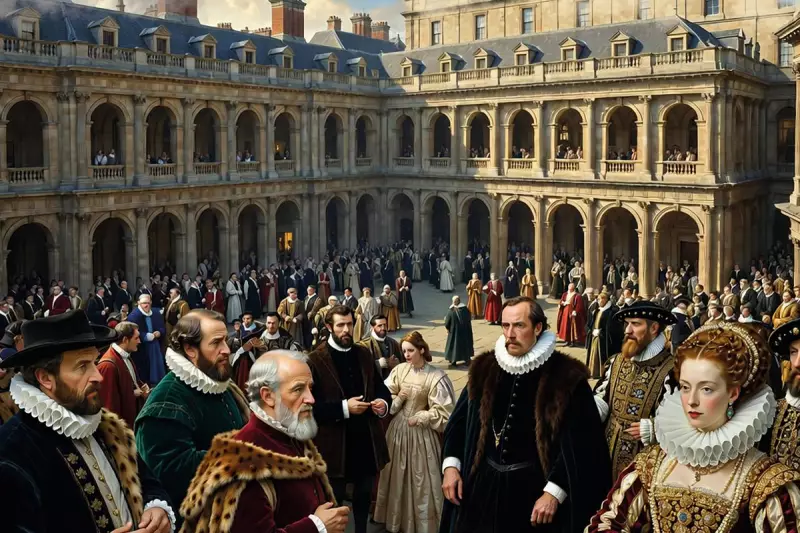
The Royal Exchange: Elizabeth I's Grand Opening That Revolutionised London Commerce
On this day, 23rd January 1571, Queen Elizabeth I formally inaugurated the Royal Exchange in London, marking a transformative moment in England's economic history. This event, occurring 455 years ago, represented the culmination of Tudor England's growing commercial ambitions and established a dedicated centre for trade that would shape the nation's financial future for centuries.
Tudor Economic Transformation and the Rise of Trade
Tudor England witnessed profound economic changes and a fundamental shift in how the state approached commerce. When Henry VII seized the throne in 1485, England's population stood at approximately 2.1 million. By the death of Elizabeth I in 1603, this figure had doubled to around 4 million, driving not merely economic growth but complete transformation. While agriculture remained central to national wealth, it was the dramatic expansion of trade that propelled England towards becoming a leading European economy.
This burgeoning trade focused heavily on raw wool and finished cloth, commodities so vital that the Lord Chancellor traditionally sat upon a Woolsack in the House of Lords as a constant reminder of their importance. England's primary trading partners were located in the Low Countries, just across the English Channel, creating a vibrant and expanding commercial relationship that set the stage for visionary individuals to make their mark.

Sir Thomas Gresham: The Merchant Financier Behind the Vision
Enter Thomas Gresham, a figure whose background and experience positioned him perfectly to revolutionise London's commercial infrastructure. Born into a prominent mercantile family, Gresham was the son of Sir Richard Gresham, who served as Lord Mayor of London (1537-38), represented the City in Parliament, and was a wealthy cloth merchant. Thomas Gresham was admitted as a liveryman of the Worshipful Company of Mercers in 1543 at age 24, before departing for the Low Countries where he worked as a merchant, initially for his father and uncle before establishing his own reputation.
Gresham settled principally in Antwerp, which historian Fernand Braudel described as "the centre of the entire international economy." This thriving port served as a cosmopolitan hub for ambitious merchants and bankers, and in 1531 had seen the opening of the Handelsbeurs, the world's first purpose-built commodity exchange. Gresham quickly gained recognition as a skilful and shrewd financier among Antwerp's international merchant community.
In 1552, his financial acumen led to his appointment as the King's Merchant, acting as the Crown's agent in Antwerp and managing royal finances. He corresponded regularly with Secretary of State William Cecil (later Lord Burghley) and proved invaluable for his ability to secure substantial loans on reasonable terms from financial markets. Gresham helped Edward VI pay off nearly all his debts and, after briefly falling from favour under Mary I, was recalled because no one else could match his financial capabilities. He returned to London in 1567 as tensions between Protestant populations in the Low Countries and their Spanish Catholic ruler escalated into the Dutch Revolt.
The Birth of London's First Purpose-Built Exchange
Sir Thomas Gresham – knighted by Elizabeth I in 1559 – inherited his father Sir Richard's unfulfilled ambition to construct a London stock exchange modelled on Antwerp's successful bourse. Gresham made a strategic offer to the City of London Corporation: if they provided a suitable plot of land, he would finance the construction himself.
This proposal was not purely altruistic. The planned exchange, inspired by Antwerp's Handelsbeurs, would include shops on its first floor, generating approximately £700 annually in rental income that would eventually surpass Gresham's initial investment. The chosen site at the intersection of Cornhill and Threadneedle Street became home to a lofty four-storey building with a central courtyard, constructed using timber from Gresham's Ringshall estate, slate from Dordrecht, and glass and woodwork imported from Amsterdam.

The Royal Exchange's Inauguration and Early Operations
On 23rd January 1571, Queen Elizabeth I formally opened the institution, bestowing upon it the title "Royal Exchange" to reflect her patronage. Following a banquet at Gresham's Bishopsgate mansion, the Queen and her court proceeded to the newly completed bourse for the official ceremony. The Exchange operated six days weekly with two hour-long trading sessions each day, marked by the ringing of the bell in its distinctive tower.
For the first time, London's wealthy merchant class had a dedicated meeting place displaying daily stock and commodity prices, shipping arrivals and departures, and news of recent bankruptcies. Interestingly, for its first centuries, the Royal Exchange admitted only merchants trading in physical goods. Stockbrokers were explicitly banned due to their perceived "bad manners" and rowdy behaviour, forcing them to conduct business in nearby inns and coffee houses that proliferated around the Exchange.
Architectural Evolution Through Fire and Reconstruction
The Royal Exchange's physical structure has undergone significant transformation through history. Gresham's original Flemish-inspired edifice was destroyed in the Great Fire of London in 1666, replaced by a more classical design by Edward Jarman. This second building also met a fiery fate in 1838 when an overheated stove caused a blaze visible from Windsor, 24 miles away. The current neoclassical building, designed by Sir William Tite, was opened by Queen Victoria in 1844 and stands as the third incarnation of this historic institution.
Lasting Legacy and Foundations of British Financial Dominance
While England was not the birthplace of modern commerce, its merchants and financiers demonstrated remarkable adaptability and vision. The establishment of the Royal Exchange attracted traders from across Europe and facilitated the creation of chartered companies to exploit emerging overseas markets. Subsequent developments, including the founding of the Bank of England in 1694, allowed the Crown to raise finance on an unprecedented scale, surpassing rival nations' capabilities.
From the coffee houses that had hosted exiled stockbrokers emerged two further pillars of British finance: Lloyd's of London in 1689 and the London Stock Exchange in 1801. These institutions formed the powerful sinews of the Commercial Revolution and provided the driving force behind the British Empire's economic expansion. In many respects, this financial ascendancy began on Cornhill in January 1571, under the watchful gaze of Elizabeth I and the man who financed that glory – the visionary Sir Thomas Gresham.