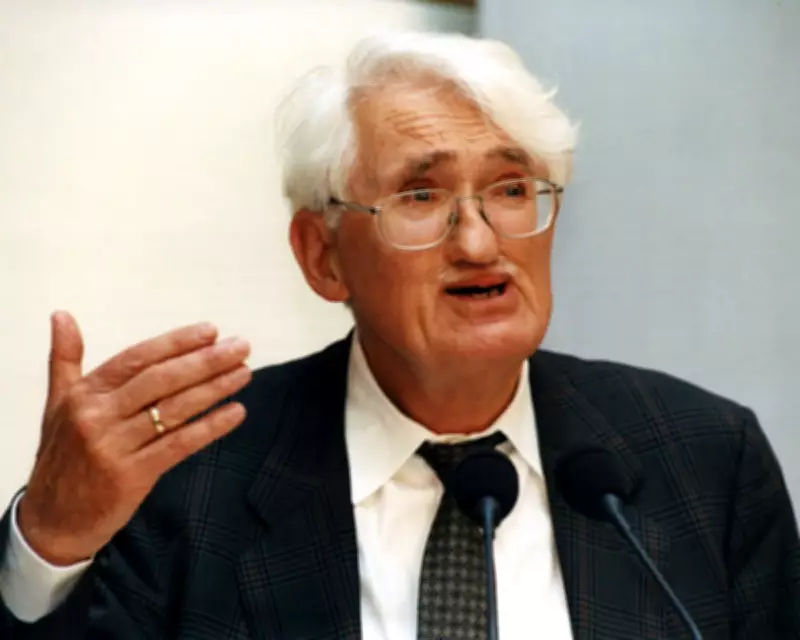
In 1998, Jürgen Habermas addressed a cultural forum on social democracy in Berlin, a moment captured in a photograph that symbolizes his enduring influence. The philosopher, who passed away on March 14, 2026, at the age of 96, was often misrepresented as a consensus-seeking liberal, but his belief in shared understanding had a profoundly radical foundation.
The Frankfurt School: A Constellation of Critique
Contrary to its name, the Frankfurt School is not a traditional institution but a constellation of thinkers dedicated to critical theory. For over a century, this scholarly group has pursued critique not as mere criticism but as a transformative endeavor to reshape reality through intellectual discourse. Habermas emerged as a fixed star in this constellation, guiding generations of German and North American philosophers with his prolific output of more than 40 books and charismatic presence.
Beyond Caricature: The Radical Roots of Habermas's Thought
Early in his career, Habermas was considered too radical by Max Horkheimer, then director of the Frankfurt Institute for Social Research, and only Theodor Adorno's intervention secured his place. His early writings reveal a commitment to Marxist principles, seeking progressive forces in history. However, Habermas diverged by focusing on communication rather than technological or productive labor as a source of reason, inspired in part by Hannah Arendt's emphasis on public speech.

This shift led to his concept of "communicative reason," which posits that communication accumulates progressively alongside human history, despite its flaws like colonial violence and gender oppression. Habermas highlighted democratic clubs and a free press as tools for emancipation, with later extensions by thinkers like Nancy Fraser and Alexander Kluge enhancing its relevance.
The Theory of Communicative Action and Lifeworld Dynamics
In his seminal 1981 work, Theory of Communicative Action, Habermas detailed how systems such as markets and bureaucracy can override the communicative negotiations of the "lifeworld"—spheres like family, civil society, and education. He argued that only the lifeworld, organized communicatively, can respond to moral demands, offering a framework to resist reification, where people are reduced to objects.
Habermas traced this critique through the Frankfurt School, from György Lukács to contemporaries like Axel Honneth, Judith Butler, and Rahel Jaeggi, emphasizing a continuity in challenging dehumanization. His later work became more formalist, using "formal pragmatics" to argue that communication inherently seeks shared understanding and non-coercive consensus, even if most utterances fall short.
Relevance in an Age of Communication Collapse
In today's era of nihilism, disinformation, and AI-generated content, Habermas's ideas gain new urgency. If communication breaks down, society risks descending into a proto-fascist "might is right" mentality. Yet, as Habermas noted, the aspiration for understanding persists, even amid failures like his controversial stance on Israel's actions in Gaza, which some critics saw as a lapse in judgment.
Despite such controversies, Habermas's work remains a vital resource within critical theory. His emphasis on communicative reason offers a pathway to recover from breakdowns, underscoring that, in principle, language aims for consensus and morality. As we navigate complex global challenges, his legacy reminds us that talk is precious, and the pursuit of shared understanding is a radical act against oppression.