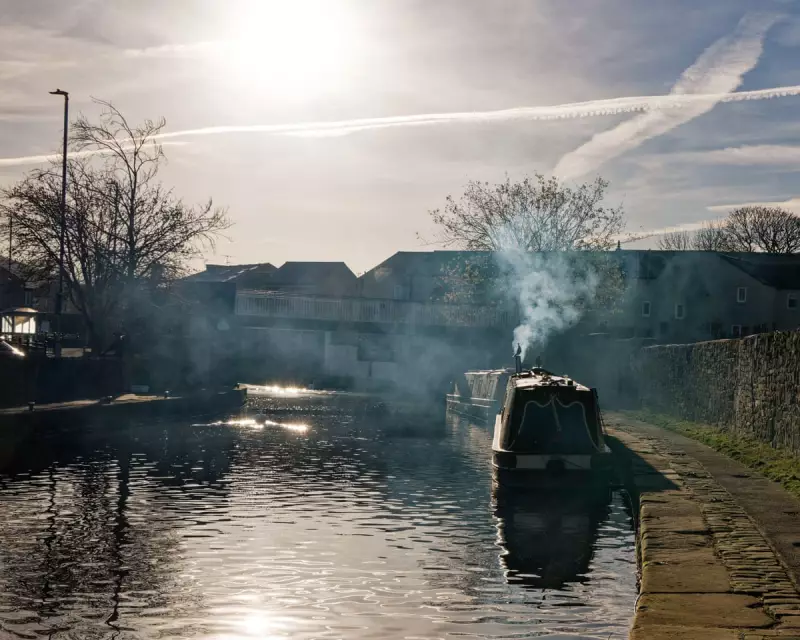
In a poignant new work, poet Chris McCabe captures a haunting December encounter on a Liverpool canal, weaving personal grief with a Dickensian spectral vision. The poem, titled 'Down on the canal on Christmas Day', is the featured 'Poem of the Week' and forms part of McCabe's latest and sixth collection, 'Hedonism'.
A Spectral Meeting in Water-Light
The poem opens with a striking image: a man approaching the speaker out of the distinctive 'water-light' of a canal on Christmas Day. Described as 'Cratchit-wrapped', the figure immediately evokes the shivering, underpaid clerk Bob Cratchit from Charles Dickens's A Christmas Carol. This is no biblical apparition, but a ghost from a more worldly, literary tradition.
The stranger recognises the poet with a simple, direct greeting: 'I know you. Hello Chris.' This moment of mutual recognition, underscored by plain end-rhyme, occurs in a 'time-ripped landscape' where a low winter sun spills through a metallic staircase, painting a scene of urban decay and redevelopment.

From Rat-Light to Father-Light
The initial joy of the meeting gives way to a longer, bleaker journey. The speaker is haunted by the man's smile for 'miles' along a 'long blasted path', a walk punctuated by the grim image of a dead rat, its belly resembling a 'purple crinoline Christmas hat'. This blend of the festive and the decomposing is central to the poem's unflinching realism.
McCabe builds a spectrum of experience through a cascade of compounded 'lights': 'canal-light, in time-light, in Cratchit-light, in ripped-light, in rat-light, in Solstice-light...'. This technique culminates in a powerful, quiet revelation. From this complex tapestry of light and memory, sparked by a stranger's smile, the speaker declares: 'I remake my father.'
Hedonism and Hauntology
The poem is a standout piece in 'Hedonism', a collection that explores pleasure as a philosophical pursuit. McCabe's work, however, is no simple celebration. It is noted for its 'sustaining emotional realism' and acts as an antidote to melancholia while fully acknowledging life's rough textures.
A key theme weaving through the book is the loss of the poet's father, an event associated with Christmas. The canal-side walk represents an attempt to move the festive period 'out of doors, into a local but larger-than-family setting', allowing the past to be reconfigured.
The critical analysis accompanying the poem draws a connection to the concepts of 'haunting' and 'hauntology', ideas championed by the late writer and philosopher Mark Fisher. This theoretical edge adds depth to McCabe's vision, framing the encounter as a way of making the future from the ghosts of the past, and perhaps, of turning a stranger into kin.
With this collection, McCabe confirms his reputation for assimilating complex ideas into experimental forms, using the 'full muscle and gristle of lived language' to remake personal grief into resonant, shared art.