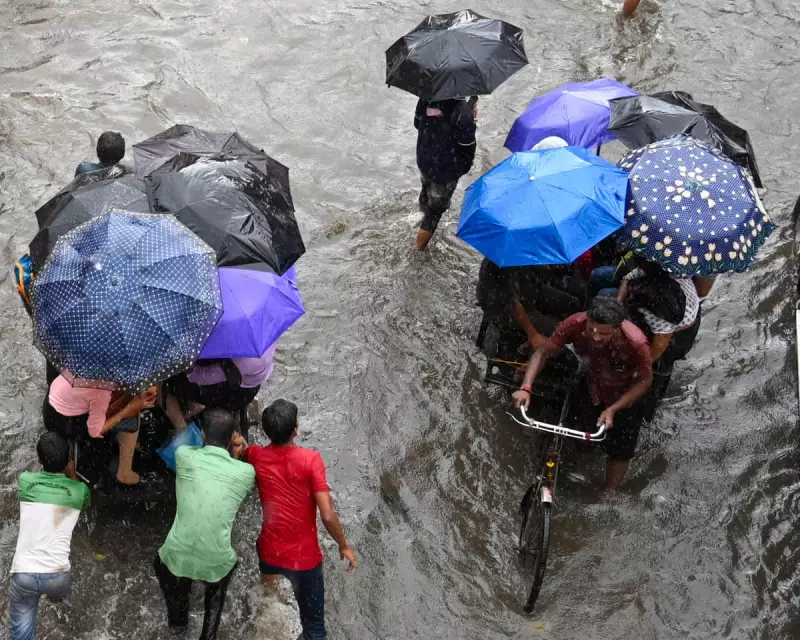
In her compelling second novel, A Guardian and a Thief, Megha Majumdar crafts a moral thriller set in a climate-ravaged Kolkata, where floods and extreme heat have plunged the city into a state of persistent food shortages. The story revolves around two central characters: a young man known only as Boomba and a woman referred to as Ma, each viewing themselves as a guardian while perceiving the other as a thief. This narrative framework invites readers to observe the complex interplay between morality and survival in a deteriorating urban landscape.
A City Transformed by Climate Change
Kolkata, once a vibrant metropolis, is depicted as a city thrust backward into a grim past due to the impacts of climate change. Majumdar vividly portrays a world where black marketeers hoard essential items like eggs, fruit, and vegetables, while fish—a cornerstone of Bengali cuisine—has vanished entirely. The spectre of famine looms large, highlighting how environmental crises exacerbate social inequalities and force individuals into desperate actions.
Ma, who manages a homeless shelter, has long justified stealing food from the shelter to care for her elderly father and infant daughter, framing her theft as a necessary act of guardianship. However, her plans to escape Kolkata with her family via coveted "climate visas" to the United States are upended when Boomba, a new shelter resident who witnesses her theft, breaks into her home. He steals not only the pilfered food but also her purse, which contains the family's passports and the vital visas.

Narrative Style and Moral Exploration
Majumdar employs what Martin Amis termed "vow-of-poverty prose," characterised by its efficiency and clarity. This style eliminates semicolons, run-on sentences, wordplay, and digressions, opting instead for a straightforward third-person narrative that avoids free indirect style. While this approach sacrifices some traditional novelistic tools, it enhances the book's pace, akin to a thriller, though the drama stems more from escalating moral dilemmas than suspense.
The novel excels as a sharp critique of Indian societal dynamics, particularly the helplessness felt by even privileged Indians when dealing with Western consular officials and the deep class divides that hinder mutual understanding. Majumdar astutely captures how the Indian elite often use familial obligations to justify overriding others' needs, offering a perceptive account of specifically Indian anxieties.
Strengths and Shortcomings as Climate Fiction
As a work of climate fiction, A Guardian and a Thief presents both strengths and weaknesses. On one hand, it effectively dramatises the Indian elite's fear of being forced to share resources in a world scarred by climate change. On the other hand, the plot's reliance on the accidental theft of passports leads to moments of strained plausibility. For instance, Boomba's ignorance of passports, despite his urban experience, feels inconsistent, and the concept of "climate visas" being issued by the US in a dystopian future may challenge readers' suspension of disbelief.
Majumdar pits "some Americans" who oppose climate immigration against "others" who welcome it, but this dichotomy somewhat trivialises the West's fears of uncontrolled migration. While the novel engages sympathies, it may not fully unsettle readers with the broader implications of climate displacement.
Overall, A Guardian and a Thief is a thought-provoking exploration of morality, survival, and class in a climate-ravaged setting, though its narrative choices occasionally raise questions about its form and plausibility. Published by Scribner, it stands as a significant contribution to contemporary Indian literature and climate-themed fiction.