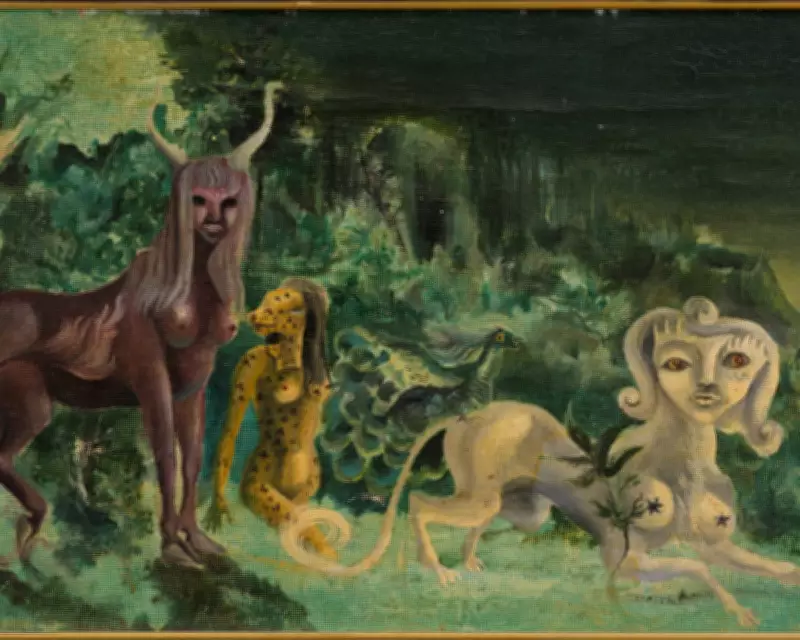
A recently discovered painting by surrealist artist Leonora Carrington, created during her confinement in a Spanish psychiatric hospital in 1940, will be exhibited publicly for the first time in London this summer. Titled Villa Pilar, the work was painted while Carrington was a patient at Sanatorio Morales in Santander, after she fled Nazi-occupied France following the arrest of her partner, German artist Max Ernst.
A Symbolic Underworld
Carrington suffered a psychological breakdown in Madrid and was admitted to the institution, where she underwent traumatic psychiatric treatments later described in her memoir Down Below. Encouraged by her psychiatrist, Dr. Luis Morales, she sketched daily and created two paintings: Down Below and Villa Pilar, both depicting the hospital as a symbolic underworld. Carrington described this period as akin to “being dead.”
Exhibition Details
Villa Pilar will feature in the exhibition Leonora Carrington – the Symptomatic Surreal at the Freud Museum, where Sigmund Freud spent his final year after escaping Nazi-occupied Vienna. The exhibition has been extended until August 10 before traveling to Faro Santander, a new arts center in northern Spain, in September.

Carrington's Artistic Journey
Born into a wealthy Lancashire family in 1917, Carrington rebelled against expectations for upper-class women. She studied at Chelsea School of Art before meeting Ernst in 1937, beginning a scandalous relationship that led them to live in Saint-Martin-d'Ardèche until the German invasion. She found kindred spirits among surrealists like André Breton, Salvador Dalí, and Man Ray, who shared her fascination with dreams and the subconscious. After settling in Mexico in the 1940s, she became one of the country's most celebrated artists, part of a community of women creatives including Remedios Varo and Kati Horna. Carrington was later embraced as a feminist icon, once remarking, “I didn’t have time to be anyone’s muse... I was too busy rebelling against my family and learning to be an artist.” She died in Mexico City in 2011 at age 94.
The Painting's Rediscovery
Carrington gave Villa Pilar to Dr. Morales when she left the sanatorium, and it remained in his family for decades. It was rediscovered during research for the exhibition by the Faro Santander team, who persuaded the Morales family to loan it publicly for the first time. Curator Vanessa Boni said Carrington created the work as “a parting gift” to thank Morales, despite the “brutal” treatments she endured, including cardiazol injections. The painting depicts hybrid human-animal figures in vivid green gardens, imagery central to her later work. “It speaks to ideas of inner transformation, metamorphosis and otherness,” Boni said.
Legacy and Record
After leaving Santander, Carrington traveled to Mexico, becoming a leading surrealist. In 2024, one of her paintings sold for £22.5 million, a record for a UK-born female artist. While in New York, she gave her Santander sketchbooks to collector Julien Levy, whose collection was dispersed in 2004. This exhibition marks the first attempt to reunite these works for a major public display. Daniel Vega Pérez de Arlucea, director of Faro Santander, said: “This is not simply a matter of showcasing the work of one of the most important surrealist artists, but of recognizing and revisiting a chapter of her life deeply rooted in this city.”