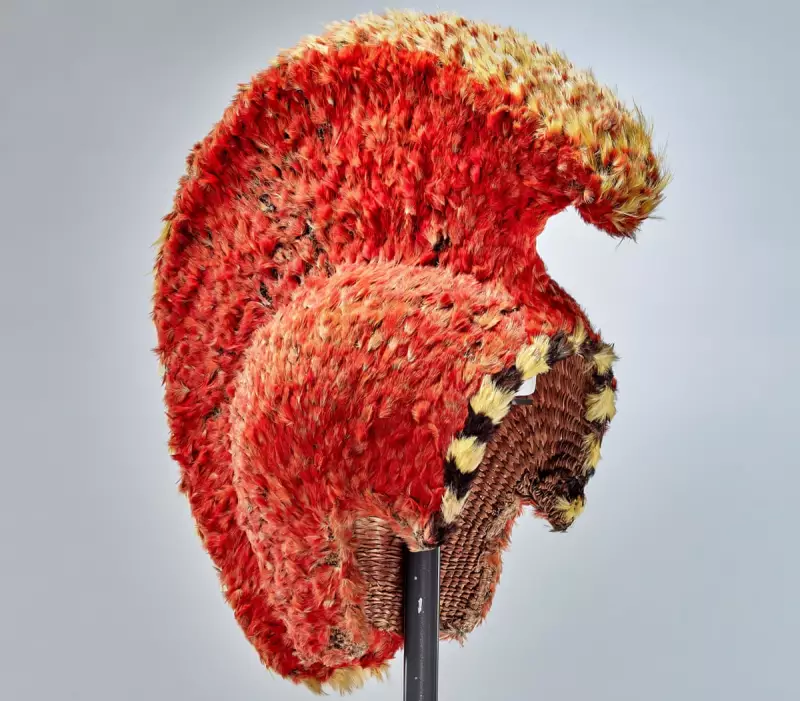
A new exhibition at the British Museum is reframing the history of the Pacific, moving beyond the infamous death of Captain Cook to tell a richer, more complex story of cultural encounter and royal diplomacy. 'Hawaii: A Kingdom Crossing Oceans' presents a stunning array of 18th and 19th-century treasures, many collected during Cook's voyages, to explore how the Hawaiian kingdom asserted its sovereignty on the world stage.
Beyond the Death of Cook: A Legacy of Objects
While the violent death of Captain James Cook at Kealakekua Bay on 14 February 1779 casts a long shadow, the exhibition consciously avoids centring the British explorer. Instead, his ghost lingers in the remarkable objects he and his crew brought back to Britain. These are not mere curiosities but profound cultural masterpieces.
The gallery is filled with awe-inspiring creations: grimacing feathered god masks with luminous mother-of-pearl eyes, a fearsome club embedded with tiger shark teeth, and finely carved wooden bowls. These pieces testify to a sophisticated Polynesian culture connected across vast ocean distances long before European contact.

A Dialogue of Monarchs: Feathers and Jewels
The exhibition cleverly identifies monarchy as a common language between Hawai'i and Britain. In a pivotal act of statecraft, King Kamehameha I in 1810 sent a magnificent feathered cloak, or 'ahu 'ula, to King George III. Loaned from the Royal Collection, its red and yellow diamond pattern is displayed alongside George IV's glittering coronation costume, highlighting the unique ceremonial traditions of both nations.
This diplomatic dialogue reached its peak in 1824, when King Liholiho (Kamehameha II) and Queen Kamāmalu undertook an extraordinary reverse voyage to London. Received with full honours by George IV, they visited theatres and even the British Museum itself, where they likely saw Hawaiian god figures collected by Cook on public display.
A Tragic End and Enduring Legacy
The ambitious mission ended in tragedy. Both the Hawaiian king and queen succumbed to measles in London in 1824. George IV sent their bodies home on a Royal Navy ship, a mark of respect. While their journey was fatal, it succeeded in its core aim: convincing Britain to recognise Hawai'i as a legitimate nation-state, thus averting British colonisation.
The exhibition, created with Hawaiian curators and scholars, powerfully argues that these artefacts are not relics of a dead past. A beautifully preserved 18th-century feathered gourd rattle ('uli'uli) is shown alongside video of contemporary Hawaiian dancers using its modern equivalent. The pieces are presented as living vessels of memory and identity.
Ultimately, the show is a celebration of Hawaiian artistry and a nuanced defence of encyclopaedic museums. The British Museum's role in preserving these fragile feather, wood, and bark works for 250 years is noted, as is its effort to contextualise them within a living culture. The story reminds us that while Hawai'i later fell to American annexation, the cultural resistance embodied in these objects continues. The shark-toothed club, as the exhibition wryly notes, still seems to hold a warning.
'Hawaii: A Kingdom Crossing Oceans' is at the British Museum, London, from 15 January to 25 May.