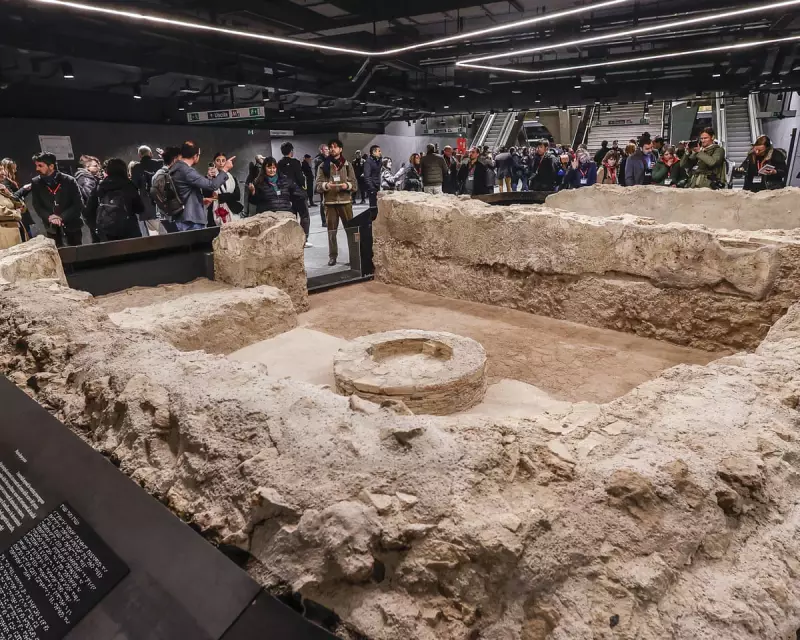
Commuters and tourists in Rome can now travel through millennia of history, following the long-awaited inauguration of two spectacular 'museum stations' on the city's Metro Line C. The Colosseo-Fori Imperiali and Porta Metronia stations finally opened to the public on Tuesday, after years of delays caused by the extraordinary archaeological discoveries made during their construction.
A Subway Journey Through Ancient Rome
The new stations are not just transport hubs but veritable underground museums. The Colosseo-Fori Imperiali station, a sprawling four-level complex beside the Colosseum, displays dozens of relics unearthed during its build. These include the remains of a Republican-era townhouse, thermal baths from the early imperial period, and an astounding collection of 28 ancient wells.
Archaeologists found a wealth of votive offerings within these wells, such as jugs, bowls, a stag's antlers, and hairpins, all now preserved behind glass screens for passengers to admire. These wells were in use long before Rome's first aqueduct was constructed, offering a rare glimpse into the city's earliest water systems.

An Exceptional Military Discovery
Meanwhile, at Porta Metronia station in the San Giovanni area, builders stumbled upon a vast military barracks complex at a depth of between 7 and 12 metres. The barracks, believed to date from the early second century AD, predate the famous Aurelian Walls. It includes a commander's house complete with intricate frescoes and mosaic floors.
"The military complex was an exceptional find," stated Simona Moretta, the scientific director of the excavation. She explained that the soldiers stationed there were likely part of the emperor's guard or tasked with city security. While trains are already running from Porta Metronia, the full museum exhibition at this station is set to open in early 2025.
A Strategic Milestone for Rome's Infrastructure
The opening of these two stations adds a crucial 3km (1.9 miles) to the driverless Metro C line, which connects Rome's suburbs to its historic centre. The extension, built by a consortium led by Webuild, is a significant step in the line's eventual expansion towards Piazza Venezia and the Vatican area.
Pietro Salini, CEO of Webuild, hailed the delivery as "a strategic milestone that combines in an exemplary way progress in infrastructure with the conservation of our heritage." The project highlights the unique challenges of building in Rome, where every shovel of earth can reveal buried history, often leading to lengthy but rewarding delays.
For Romans like historian and tour guide Carlo Andrea, who chronicled the construction on his blog 'Odissea Quotidiana', the opening is a moment of relief and pride. "It’s been an eternal wait," Andrea remarked while visiting the new Colosseo station. "There has been a bit of resignation too... But then on days like this, we’re reminded that it’s important to build the subway, even if it’s a challenge in Rome, also because it brings us wonderful things."
The new 'museum stations' offer a compelling solution to Rome's limited underground network, providing much-needed relief for commuters while enriching the cultural experience of every visitor to the Eternal City.