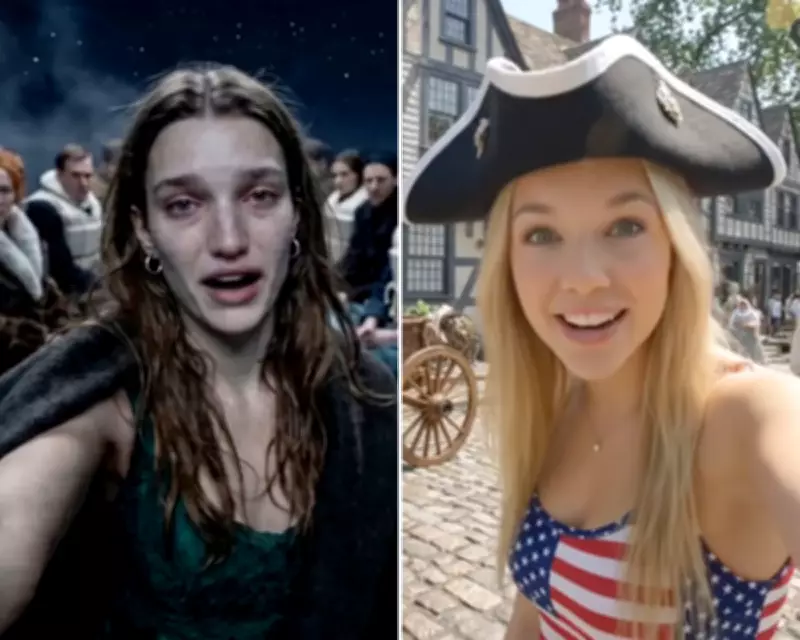
AI-generated vloggers such as Chloe VS History and Nova VS History are taking social media by storm, offering viewers a unique blend of history and modern vlogging. Their creators describe the format as 'taking an already-proven format and applying it to history.'
The Rise of AI History Influencers
On YouTube and other platforms, users are flocking to watch these digital characters vlog their travels to historical settings. One of the most popular channels, Chloe VS History, boasts over 610,000 Instagram followers and 15 million YouTube views. Viewers can follow Chloe as she tries eel pie at a Tudor market, explores the Titanic's first-class suites, or takes a dip in an ancient Roman bath.
The format has been replicated by other channels like Janella Through Time, Nova VS History, and Esmetimetravels, with popular destinations including ancient Rome, Pompeii, the Wild West, and England during the Black Death.

Creator's Vision
Jonathan Laramy, the 32-year-old creator of Chloe VS History, aims to 'get younger people more interested' in history. He believes that history is a visual experience that is often poorly taught through textbooks. 'Why not use the technology we have to bring that to life in a really visceral way?' he asks. Laramy uses Seedance 2.0 to produce his videos, relying on historical sources, journal articles, and contemporaneous drawings to ensure accuracy.
Despite his commitment to accuracy, Laramy admits to occasional hiccups, such as AI generating people wearing sunglasses or watches in ancient Rome. 'The AI is trained on modern data, so there is a risk it's going to hallucinate,' he explains.
Reception and Criticism
The response has been overwhelmingly positive, but some critics label the content as 'AI slop,' referring to low-effort, mass-produced content. Laramy understands the concern: 'Some people see it as really scary that AI can do this now. I'm trying to use it for purely positive reasons.' His first viral video, a 14-minute episode of Chloe on the Titanic, garnered 4 million views.
Adam Smith, a historian at Oxford University, praises the format, comparing it to Horrible Histories. He believes AI-generated videos could 'massively enhance' history education by connecting viewers with a visceral sense of the past. 'It's quite a deep-seated psychological need in many people, to understand themselves in time,' Smith notes.
Smith suggests that AI video could be used to visualize lesser-known historical events and figures, working in collaboration with academic historians. 'Ways of presenting history always evolve,' he says, highlighting the potential for creative and educational innovation.