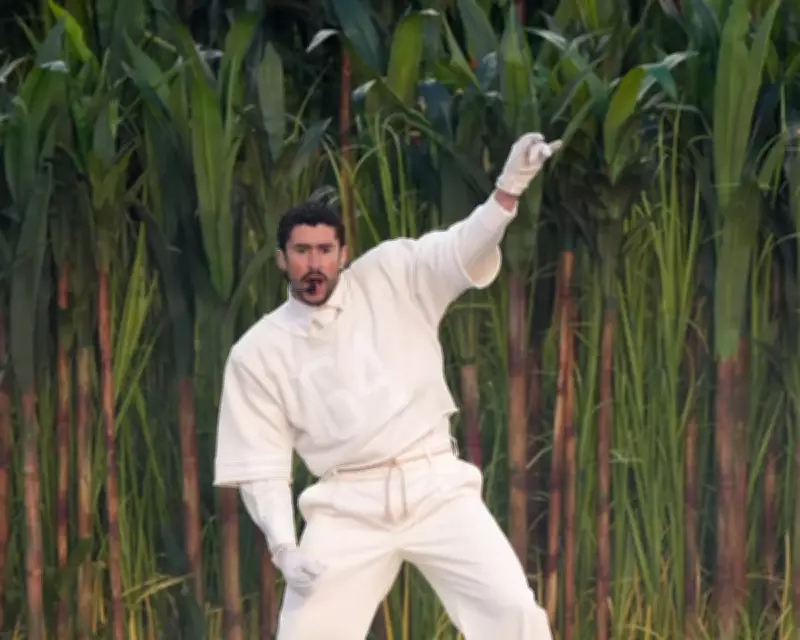
Puerto Rican superstar Bad Bunny delivered a groundbreaking performance at the Super Bowl LX halftime show that fundamentally challenged conventional understandings of American identity. The artist's fourteen-minute spectacle moved beyond colonial tropes to present a vision of America that spans the entire Western Hemisphere, creating what many are calling a cultural watershed moment in sports entertainment history.
A Revolutionary Performance with Deep Cultural Significance
The performance was a dense, rich tapestry of musical and visual elements that rewarded repeated viewing despite its brief duration. Among the most powerful moments came just over nine minutes into the show when the cuatro puertorriqueño made its appearance. This traditional Puerto Rican stringed instrument, played by the talented cuatrista José Eduardo Santana, received its own spotlight moment before Ricky Martin took the stage.
The inclusion of this national instrument from a colony raised profound questions about national identity and sovereignty. What does it mean that a colony possesses a national instrument? Could this signify that Puerto Rico functions as a country despite its political status? For Bad Bunny, who proudly advocates for Puerto Rican independence and displays the light blue Puerto Rican flag associated with that political stance, the answer is unequivocally affirmative.

Redefining American Citizenship and Identity
Bad Bunny has clearly been contemplating Puerto Rico's place within the Americas and the meaning of genuine American citizenship for some time. This intellectual engagement is evident in his defiant track La Mudanza from his album DeBÍ TiRAR MáS FOToS, where he references Puerto Rican educator and intellectual Eugenio Maria de Hostos.
Hostos, who died in the Dominican Republic in 1903 and famously requested burial in an independent Puerto Rico, was known as "El Gran Ciudadano de las Américas" – the great citizen of the Americas. Bad Bunny's tribute to Hostos during his performance, though not through that specific song, created a powerful connection between historical aspirations for Antillean unity and contemporary cultural expression.
The artist's declaration of "God Bless América" followed by his listing of countries throughout the hemisphere, accompanied by a parade of flags that placed the United States on equal footing with its neighbors, represented a radical reimagining of American identity. He transformed the most quintessentially "American" of sporting events into a platform for hemispheric solidarity.
Challenging Colonial Language and Perceptions
For many Puerto Ricans, certain terms commonly used to describe their homeland prove particularly difficult to accept. Words like "territory," "commonwealth," and especially "mainland" reinforce colonial power dynamics and psychological distance. The term "American" itself has been monopolized by the United States despite applying geographically to all nations in the hemisphere.
When right-wing critics objected that Bad Bunny wasn't "an American artist" and therefore undeserving of the Super Bowl halftime spotlight, liberal responses often fell back on colonial justifications – essentially arguing that Puerto Rico's colonial status made the performance acceptable. Bad Bunny's show transcended this limited framework entirely, presenting an alternative vision where the United States participates in rather than dominates the cultural conversation.
A Joyful Challenge to Imperial Narratives
What made Bad Bunny's intervention particularly powerful was its joyful, celebratory nature. Rather than delivering a stern lecture about linguistic imperialism, he invited the United States to a party where it wasn't the centre of the universe – demonstrating that alternative perspectives can be not just intellectually valid but genuinely enjoyable.
The performance showed that challenging dominant narratives doesn't require becoming what some might call "the wet blanket in a US newsroom" who constantly reminds everyone that America constitutes an entire hemisphere. Instead, Bad Bunny created a space where multiple American identities could coexist and celebrate together, offering a model for more inclusive cultural discourse moving forward.

This Super Bowl halftime show will likely be remembered not just for its musical excellence but for its profound cultural and political implications. By centering Puerto Rican identity while expanding the concept of "American" to hemispheric proportions, Bad Bunny created a milestone moment in the ongoing conversation about identity, colonialism, and cultural representation in the twenty-first century.