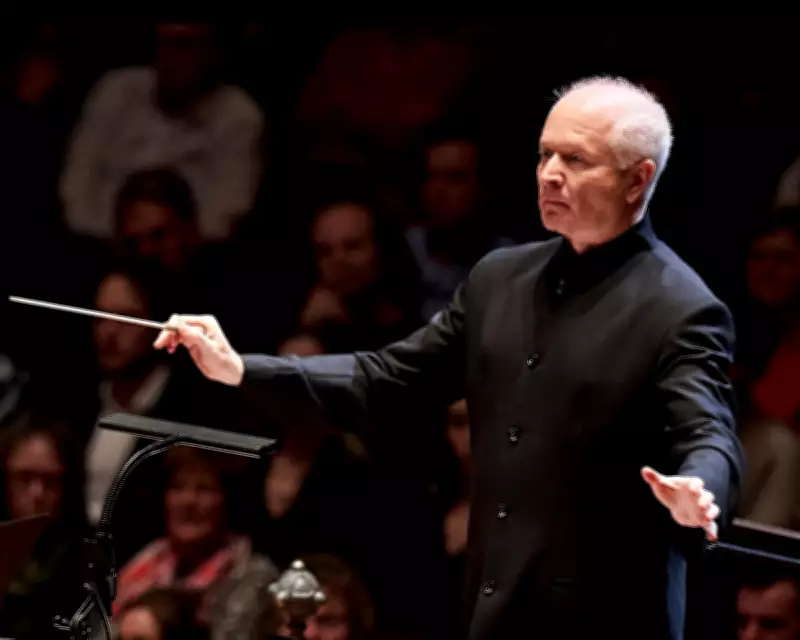
London Philharmonic's Composer-in-Residence George Benjamin Conducts Masterful Evening of Musical Precision and Hedonistic Pleasure
In a concert marked by shimmering colors, translucent textures, and illuminating shafts of musical light, the London Philharmonic Orchestra's composer-in-residence George Benjamin took up the conductor's baton at London's Royal Festival Hall. The meticulously programmed and beautifully executed performance showcased Benjamin's trademark rigour and precision across works by Scriabin, Stravinsky, Ravel, and Benjamin himself, creating an evening of crystalline clarity and hedonistic pleasure.
Sensual Exploration in Scriabin's Poem of Ecstasy
The concert opened with Alexander Scriabin's single-movement symphonic ode to joy, The Poem of Ecstasy, where sensuality ruled supreme. Languorous strings and woodwind sections indulged in voluptuous musical foreplay, spurred on by priapic brass passages that created waves of tension and release. Benjamin demonstrated impressive control over his vast orchestral forces – including no fewer than nine horns – refining Scriabin's unrestrained textures before dramatically ramping up the adrenaline for a climactic explosion of hedonistic pleasure that left the audience breathless.
Crystalline Clarity in Stravinsky's Modernist Work
Benjamin brought his characteristic crystalline clarity to Igor Stravinsky's Symphonies of Wind Instruments, highlighting the work's startling modernity with surgical precision. The London Philharmonic Orchestra, impressive throughout the entire concert, laid bare the complex score with the exactitude of a surgeon's knife, revealing the fleshless remnants of what might be described as a deconstructed version of Stravinsky's more famous The Rite of Spring. This interpretation emphasized the work's structural innovation and forward-looking musical language.

Complete Presentation of Ravel's Mother Goose
At the opposite end of the musical spectrum, Maurice Ravel's Mother Goose was presented in its complete form rather than the more commonly performed suite version. Every detail emerged cleanly defined under Benjamin's direction, with special interest focused on the rarely heard connecting sections that bridge the individual movements. Benjamin expertly led the orchestra from Sleeping Beauty's graceful pavane to the flirtatious chuntering of Beauty and the Beast, the latter featuring delightfully ungainly contrabassoon passages that bubbled with character.
The pentatonic tinkling of the Empress of the Pagodas and the throbbing intensity of The Fairy Garden brought Ravel's magical score to its iridescent conclusion, demonstrating Benjamin's ability to navigate contrasting musical landscapes with equal authority.
Benjamin's Signature Palimpsests Works
The concert featured George Benjamin's own Palimpsest I and its darker companion piece Palimpsest II, signature works that reflect the composer's fascination with layered texts. A palimpsest refers to a manuscript on which one or more later texts have been inscribed over original writing, an idea that resonates throughout much of Benjamin's compositional output.
These unusually visual pieces employed an unconventional orchestral layout featuring eight double basses but no cellos, augmented by harps, celesta, a substantial brass section, and an ethereal group of upper strings that occasionally sounded as if they were floating on helium. This distinctive instrumentation revealed the music's inner workings most effectively in live performance, with Benjamin crafting the pieces' tectonic shifts while bringing out their startling peculiarities and rare beauty with authoritative command.
Masterful Programming and Execution
The London Philharmonic Orchestra demonstrated exceptional versatility throughout the concert, adapting to the diverse demands of four distinct compositional voices while maintaining technical excellence across all sections. Benjamin's dual role as both composer and conductor provided unique insight into the programming choices, creating thematic connections between works separated by decades but united by their exploration of texture, color, and structural innovation.

This concert reaffirmed George Benjamin's position as one of contemporary classical music's most significant figures, capable of bridging historical repertoire with modern composition while bringing fresh perspectives to established masterworks. The London Philharmonic Orchestra continues to showcase why it remains one of Britain's premier musical institutions, capable of executing challenging programs with both precision and passionate engagement.