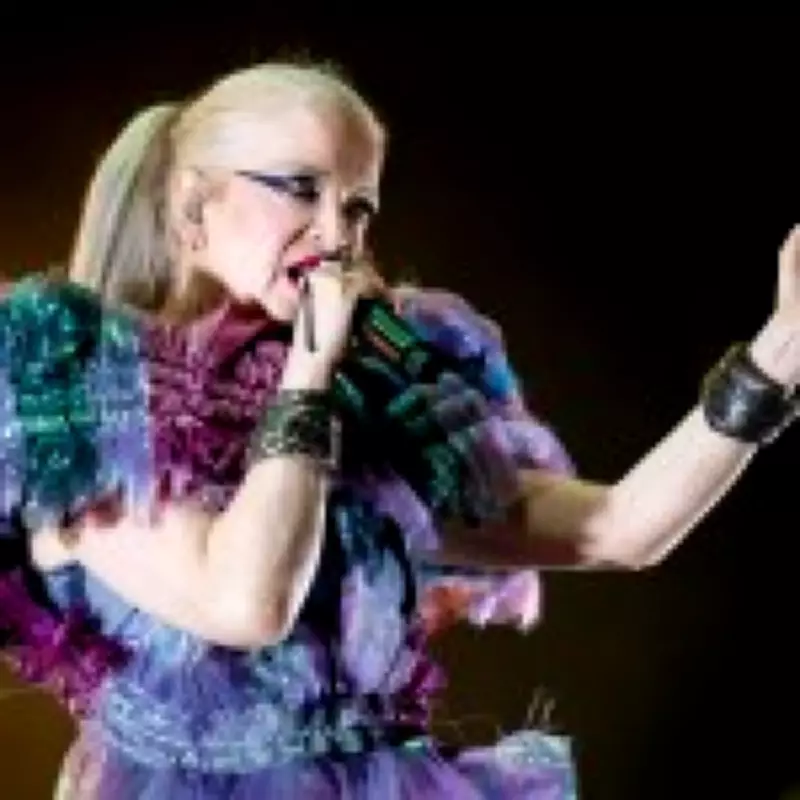
Shirley Manson, the iconic frontwoman of the legendary band Garbage, has spent three decades as a vocal and influential figure in the music industry. Now, she is passionately urging more artists to join her in speaking truth to power and supporting crucial charitable causes.
A Lasting Career Built on Authenticity
It is nearly impossible to think of the seminal 90s rock band Garbage without envisioning Shirley Manson, renowned for her bold aesthetic and fearless attitude. Despite their enduring success, Manson expresses genuine bafflement at the band's continued resonance with fans worldwide. 'I don't really know why we still have a career,' she laughed in a recent interview, 'But I'm very grateful for it.'
The band, comprising Manson, Duke Erikson, Steve Marker, and Butch Vig, is set to perform at London's prestigious Royal Albert Hall on March 28th. This concert is a highlight of the Teenage Cancer Trust's 2026 concert series, expertly curated by Robert Smith of The Cure.

The Vital Role of the Artist in Society
Manson, 59, credits younger generations for 'tolerating' Garbage's music, but suggests the band's anti-establishment lyrics may be gaining deeper relevance in today's climate. She articulates a powerful philosophy on the artist's purpose.
'Artists are essential because they exist within this system [but] they're answerable to no one, and so they're free in ways that are threatening to the status quo,' Manson explained. 'That's why they're vital. That's why we need them, because they say things that are not allowed or are feared within the system.'
She believes artists have a unique duty to criticise power and the abuse of power, holding a mirror to society and demanding accountability.
Activism Rooted in Upbringing
While reflecting on a growing wave of politically aware new artists, Manson modestly downplays her own role in inspiring this movement. Her drive to support causes stems from a deeply personal place, inspired by her late father's community dedication in Scotland.
'I don't do it because I'm a saint,' she shared. 'I also get so much out of it. It brings me so much joy. It makes me feel safer, it makes me feel happier, it makes me feel more fulfilled.'
However, she is careful not to judge peers who are less vocal. 'Not everybody has that [confidence] and a lot of people are much more introverted, perhaps than I am,' she reasoned. Reflecting on specific events, she admitted frustration when others stay silent, but emphasised, 'I'm uninterested in bullying someone into speaking up.'
Speaking Out Despite Personal Cost
Manson acknowledges that her consistent activism on difficult subjects has sometimes come at a personal and professional cost. 'It's caused a lot of problems for me in my life,' she admitted. Yet, she remains steadfast, guided by a principle instilled in childhood: 'you must speak out where you see injustice.'
This altruistic spirit, nurtured by singing in nursing homes and hospital wards as a child, has now come full circle with Garbage's upcoming performance for the Teenage Cancer Trust.
Supporting the 'Forgotten Sufferers'
Manson speaks with heartfelt urgency about the Trust's mission, having witnessed a friend's battle with teenage cancer. She describes teens as the 'forgotten sufferers' in the wider fight against cancer, due to their specific and complex needs during treatment and development.
'They need support in ways perhaps that not everybody else who's fighting the good fight does,' she said. 'So this feels very urgent to me, very pressing, and I'm very thrilled that me and my gorgeous band are able to come and support this initiative. We're very proud.'
A Star-Struck Fan of a Legend
Despite her own iconic status, Manson reveals an endearing fan-girl excitement about working with Robert Smith, who curated the concert series. 'He's one of the few of our heroes that we haven't met,' she said, joking about how that might sound.
Calling Smith 'the dream', she confessed the invitation left her 'quite lightheaded' and she 'literally nearly swooned'. Garbage has long cited The Cure as a major inspiration.

'I loved him so hard, crushed on him, really, seriously, obsessively,' she gushed. 'I love everything he stands for. I love how wild he presents now... He's just an amazingly authentic person. I mean, I want to be Robert Smith when I grow up.'
In a final, characteristically humble note, Manson reflected that not everyone has the foundation of a strong community-driven upbringing that gave her the confidence to speak out. Her message remains clear: the world needs artists who are unafraid to challenge power and champion vital causes like the Teenage Cancer Trust.