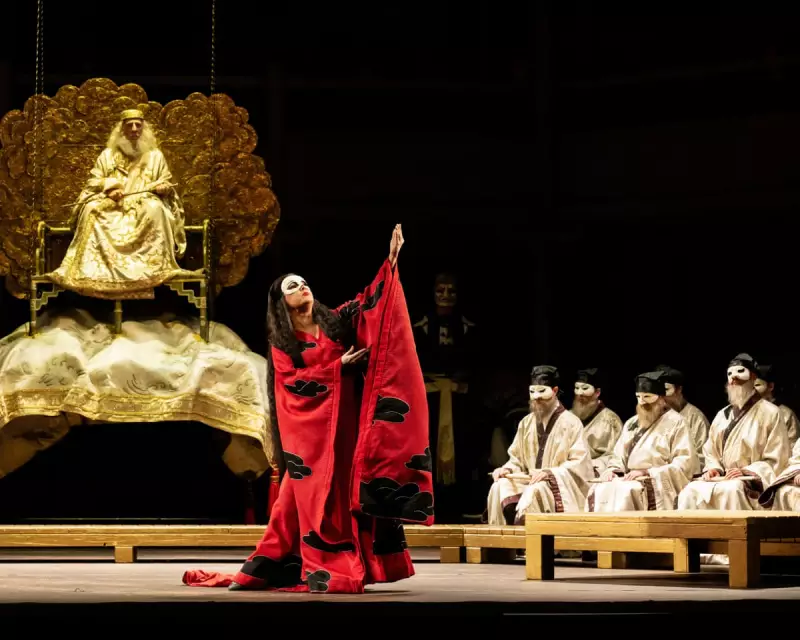
The Royal Opera House in London is witnessing a remarkable run of Puccini's final masterpiece, Turandot, with a staggering 22 performances scheduled within a single year. The enduring appeal of Andrei Serban's production, now over four decades old, is undeniable. Yet, for a select few performances this December, the production has been utterly transfigured by the arrival of Russian soprano Anna Netrebko in the title role, delivering a performance of such vocal grandeur that it redefines the entire experience.
A Theatrical Classic Confidently Revived
Andrei Serban's 1984 staging remains a formidable piece of theatre. Its oppressive sets and shadowy, ever-present watchers create a ritualistic and darkly captivating world perfectly suited to Puccini's choral-heavy score. Revived by Jack Furness, the production retains its powerful visual language, complemented by Kate Flatt's eye-catching orientalist choreography. In an era of financial pressure for arts institutions, this Turandot offers box-office certainty, thanks largely to the perennial popularity of the tenor aria Nessun Dorma.
Netrebko's Arrival Changes Everything
The true event, however, is Anna Netrebko's assumption of the icy Princess Turandot. The character's first vocal entrance is delayed until the second act, and from that moment, the performance ascends to a different plane. Netrebko brings a vocal richness and majestic phrasing that signals operatic greatness. While the role demands immense power, which she supplies effortlessly, Netrebko also finds moments of softness and delivers an extended lyrical line where Puccini allows, avoiding any metallic harshness in the crucial riddle scene.

Criticisms of occasional vibrato or textual nuance are noted, but such observations place her in the league of legends like Maria Callas and Joan Sutherland. Her performance is not merely loud; it is layered, commanding, and ultimately humanises the brutal princess.
A Strong Cast in a Formidable Shadow
Inevitably, the other principals operate in the substantial shadow cast by Netrebko's star turn. Yusif Eyvazov began strongly as the suitor Calaf, though his Nessun Dorma leaned more on forceful heft than subtle lyricism by the final act. Masabane Cecilia Rangwanasha offered a warmly sung and deeply moving Liu, the opera's true emotional heart. The trio of ministers—Simone del Savio, Emmanuel Fonoti-Fuimaono, and James Kryshak—provided lively relief as Ping, Pang, and Pong, with Rafał Siwek a dignified Timur and Raúl Giménez as Emperor Altoum. In the pit, Daniel Oren's conducting was relentless but offered few new insights into the score.
This revival confirms the enduring power of Serban's classic production. Yet, the pre-Christmas performances will be remembered for the seismic shift brought by one artist. Anna Netrebko's Turandot is a rare demonstration of vocal authority that elevates a dependable classic into an unforgettable night at the opera. The production continues at the Royal Opera House until 4 February.