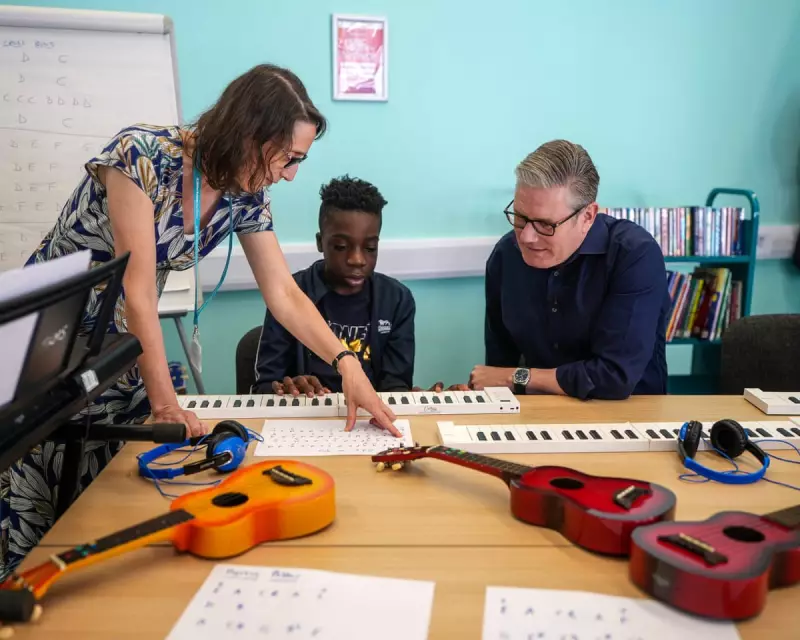
Britain's cultural landscape is facing a profound crisis of funding and accessibility, placing a unique leadership challenge at the feet of Prime Minister Keir Starmer. As the first occupant of Number 10 with formal musical training since Edward Heath over fifty years ago, Starmer's personal connection to the arts has raised hopes for a much-needed renaissance.
A Sector Under Siege: Funding Cuts and Cultural Marginalisation
The experience of attending a Christmas performance of Handel's Messiah can create an illusion of cultural health. Yet behind this enduring tradition lies a reality of increasing insecurity for music and the arts across the United Kingdom. The sector is becoming more marginalised, a trend exacerbated by the media's own reduced coverage, particularly at institutions like the BBC.
Margaret Hodge's recent and damning report on Arts Council England (ACE) delivered a stark wake-up call. It revealed that Britain spends significantly less per capita on culture than almost every other European nation. To put this into perspective, the city of Greater Berlin alone allocates more public money to culture than the combined arts budgets of ACE and the Mayor of London.

While not every challenge can be solved by money, a great many can. The UK is, simply put, too mean. Wealthy individuals often fail to contribute back, corporate sponsorship budgets are minimal, and governments at every level treat culture as a dispensable luxury amidst other spending pressures.
The Root of Inequality: An Educational Divide
The crisis is fundamentally linked to a deep educational divide. Children in state schools have far fewer opportunities to engage with the arts compared to their privately-educated peers. This disparity directly shapes the intakes of conservatoires and arts colleges, which remain socially top-heavy.
Institutions like the Trinity Laban Conservatoire in south-east London are celebrated exceptions, actively working to broaden access. However, without systemic change to make arts education central to the national curriculum, as Labour has proposed, the UK will continue to perpetuate and widen this unfair gap.
Compounding the issue is a national 'psychodrama' over cultural elitism. As Alexandra Wilson's book Someone Else's Music highlights, society often possesses closed minds, quick to label a £100 opera ticket as elitist while ignoring the thousand-pound price tags for major sporting events.
A Blueprint for Change and a Call for Leadership
The Hodge report provides a clear blueprint for reform. Its core principle is that excellence and access must not be opposing forces. It argues for applying the lessons of sports funding—where elite success and grassroots participation are both valued—to the arts. This means supporting both national institutions like the English National Opera and local community playhouses.
The report also calls for a restructuring and clear-out of the leadership at Arts Council England. The critical question now is whether Starmer's government, currently struggling in opinion polls, will have the political will to embrace, own, and drive this essential overhaul.
While civil society plays a role, the government holds a unique and irreplaceable responsibility. When an audience rises for the Hallelujah chorus—a quirky British tradition—it is an avowal of shared cultural inheritance. It is a recognition of something to be cherished and passed on. The government's duty is to ensure that this chain remains unbroken. The time for prime ministerial talk about the importance of music is over. The moment now demands decisive action, commitment, and results.