For the past 45 years, acclaimed photojournalist Ed Kashi has positioned himself at the heart of the world's most defining social and geopolitical events. His camera has served as both a witness and a diplomatic passport, capturing dramatic headlines and the quiet, human moments that often escape wider attention. Now, a comprehensive new book, A Period in Time, offers an expansive retrospective of his prolific and eye-opening career, published by The University of Texas Press.
A Life Through the Lens: From Derry to Damascus
Kashi's work is a profound testament to the power of visual storytelling. His journey began in the late 1980s, documenting the tensions within Northern Ireland's Protestant communities in Derry, where he captured children playing in the Fountain estate. This early project set the tone for a career dedicated to illuminating complex, often overlooked narratives.
His lens soon turned to a reunified Berlin in 1991, where he found a city grappling with a fin-de-siècle malaise rather than the rebellious art scene he sought. He documented the hypersexual commercial energy of West Berlin making inroads east, a symbol of a nation adjusting to newfound unity while bearing the wounds of 45 years of separation.

Perhaps one of his most significant long-term engagements has been with the Middle East, a region he first entered in 1991 to cover the plight of the Kurdish people. His series 'When the Borders Bleed' includes a powerful image of a Kurdish woman standing trial in Turkey in 1991, accused of links to the PKK. This work not only exposed geopolitical strife but also led Kashi to a deeper connection with his own familial origins in the region.
Unseen Worlds and Human Resilience
Kashi's photography consistently seeks out worlds hidden in plain sight. In 1993, he revealed the 'City of the Dead' in Cairo, a vast necropolis where approximately 120,000 people, displaced by housing shortages, have created a thriving community among the mausoleums. Here, a glass factory operates alongside tombs, illustrating the coexistence of the sanctity of the dead with the urgent needs of the living.
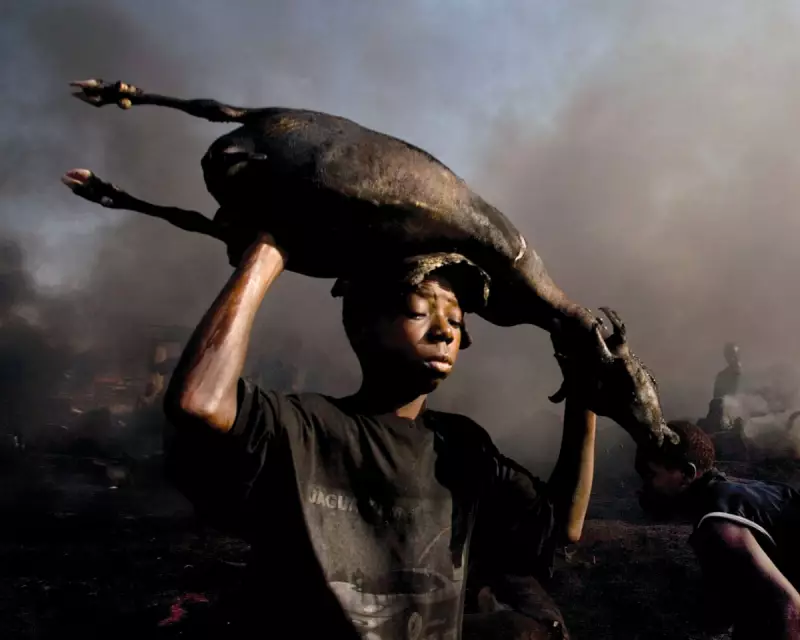
His work balances stark documentation with moments of profound humanity and resilience. In America, his project 'Ageing in America' captured the poignant wedding of Gerald Gross and Ricky Caminetti, who fell in love in their 80s. Conversely, in Nigeria's Niger Delta, his 'Curse of the Black Gold' series includes a distressing image of a 14-year-old boy transporting a goat carcass roasted by tyre flames at an abattoir—a stark symbol of the region's complex relationship with oil and survival.
Kashi states, "As a photojournalist, you can have the privilege of expansive knowledge of the world... You will also witness pain and suffering, hatred and violence." This duality is evident in his coverage of the Syrian refugee crisis in 2013 and his ongoing investigation into the epidemic of chronic kidney disease among Nicaraguan sugarcane workers.
An Evolving Archive of Our Era
Beyond individual images, Kashi reflects on his life's work as a living archive. Spanning nearly half a century, his collection has grown into what he describes as a "thriving, and continually evolving organism." It serves not just as a record, but as a library for further exploration into the human condition during a period of immense global change.
From the revived traditional fashions of Saigon schoolgirls in 1994 to the embattled lives of Arab Christians in 2008 and the construction of India's Golden Quadrilateral highway in 2007, Kashi's photographs form a mosaic of modern history. They underscore his belief that photography must seek the common good, expose problems, and remain open to capturing the beauty of the human spirit and its enduring resilience against all odds.