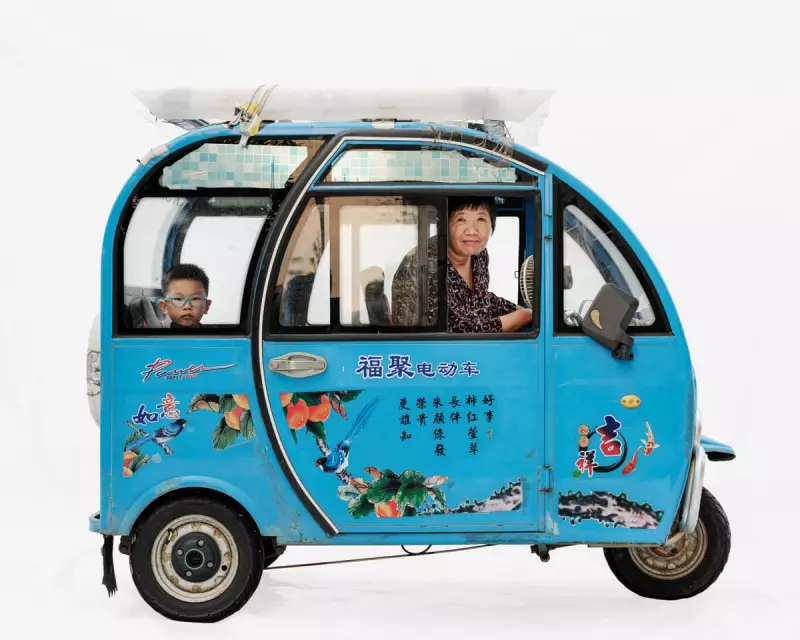
Award-winning Dutch photographer Martin Roemers has turned his lens on one of the defining relationships of the modern age: our profound and often personal bond with the automobile. His new photography book, 'Homo Mobilis', presents a compelling global portrait of people and their cherished vehicles, from London's bustling streets to the dusty roads of India and the highways of the United States.
A Decade-Long Journey on the World's Roads
Roemers embarked on this ambitious project over a ten-year period, travelling across continents to capture the essence of car culture. The resulting collection, published by Hatje Cantz, features 88 colour portraits that are both intimate and anthropological. Each image is accompanied by a detailed caption, revealing the owner's name, the car's make and model, and the poignant, humorous, or practical reasons behind their attachment.
The photographer's technique is distinctive. He uses a large-format plate camera, which requires subjects to remain still for longer exposures. This process strips away the background blur of motion, focusing squarely on the individual and their machine. The effect is a series of staged yet revealing tableaux that invite viewers to ponder the car's role as a symbol of freedom, status, memory, and identity.

More Than Metal: Stories of Identity and Aspiration
Through his portraits, Roemers uncovers the deeply human stories embedded in these metal shells. In London, we meet owners like Jill, posing with her 1973 Volkswagen Beetle named 'Lizzie', a car she has cherished since passing her driving test. The book also features a Berlin-based musician with his meticulously maintained 1977 Ford Transit van, a vehicle that has been his mobile home and recording studio.
Further afield, the project documents a Kolkata man with his iconic Ambassador taxi, and a Texas couple with their colossal, customised 'dually' pickup truck. These images collectively argue that the car is far more than a tool for transport; it is a mobile repository for our dreams, histories, and personalities. Roemers draws a parallel to historical portrait painting, suggesting the car has become a crucial accessory in defining who we are to the world.
The Environmental Paradox and a Changing Future
Roemers does not shy away from the central paradox his work illustrates. While celebrating the cultural significance of the automobile, 'Homo Mobilis' is implicitly a document of a carbon-intensive era that we know must evolve. The photographer acknowledges this tension, noting his project arrives as society grapples with the climate crisis and the future of urban mobility.
In this light, the book serves as a potential historical record. It captures a peak moment of personal car ownership before a possible shift towards shared, electric, and autonomous vehicles. Roemers suggests that future generations may look back at these portraits with a sense of nostalgia or curiosity, much like we now view photographs of horse-drawn carriages.
The publication of 'Homo Mobilis' is supported by an exhibition at Camera Work gallery in Berlin, running from 10 January 2026. For those fascinated by photography, social history, or the enduring mythology of the open road, Martin Roemers' work offers a powerful, beautifully composed, and timely reflection on a love affair that is currently at a crossroads.