A Tense Moment in Bolivian History Captured on Film
In 1993, British photographer Rod Morris found himself in the high-altitude city of La Paz, Bolivia, during a period of significant political tension. The presidential election campaign of Gonzalo Sánchez de Lozada was underway, creating an atmosphere thick with apprehension across the capital.
The Assignment and The Scene
Morris had arrived in South America after winning a photography competition, which provided him with funds and a ticket to Chile. From there, he travelled by train to the Bolivian Altiplano, experiencing altitude sickness that was only alleviated by traditional coca tea. While primarily exploring the region, he also held an open-ended commission from the Financial Times to capture images from financial districts in South American cities.
This professional obligation led him to La Paz's government quarters and financial district, where he encountered a compelling scene. "There were loads of soldiers and police around," Morris recalls, "and rumours that any unregistered land would be sequestered by the new government."

The Photograph That Changed Everything
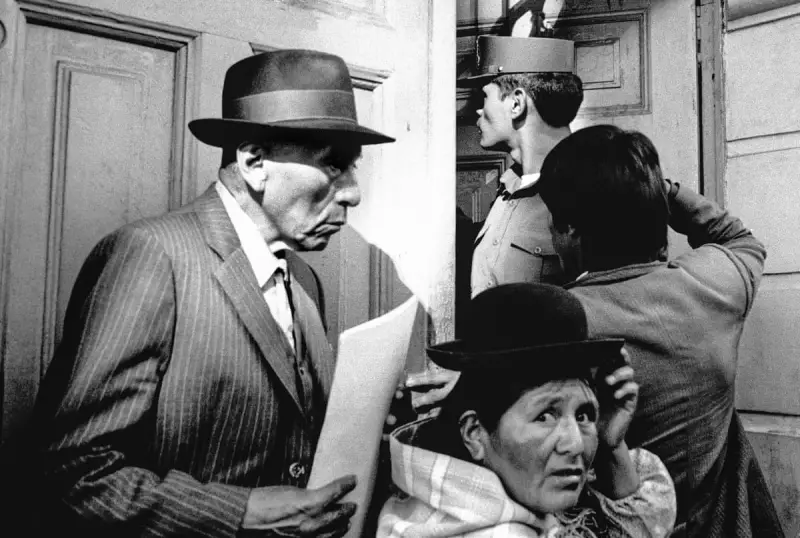
What Morris witnessed was a queue of anxious Bolivians holding documents, apparently trying to file claims before an impending deadline. "This wasn't a wedding picture or a happy occasion," he notes. "I gather that the claims had to be filed before a deadline which was probably quite close."
Using his preferred 35mm camera, Morris captured the moment without discretion. "My camera was quite loud and you can see one of the people looking right at me," he observes. The resulting image shows figures forming a chain leading toward a doorway guarded by a soldier, creating what Morris describes as a "filmlike quality" with inherent tension and ambiguity.
Consequences and Aftermath
Shortly after taking the photograph, plainclothes police officers approached Morris, bundling him into a car and transporting him to the local station. "I was questioned for a long time about why I was there and what I was doing," he remembers. Although he claimed to be a tourist taking personal photographs, officers attempted to confiscate his film.
Morris managed to divert them with unexposed rolls, but the ordeal wasn't over. "On the way out, I had to walk down a line of police who took turns to punch and kick me all the way to the door," he reveals. The beating served as a warning, accompanied by threats of surveillance should he remain in the area. Unsurprisingly, Morris didn't linger in La Paz after this violent encounter.
Legacy and Artistic Perspective
This particular image remained unpublished for years before becoming part of Morris's Still Films series, which explores the intersection between photojournalism and film-making. "I've always been drawn to black and white, filmic images, and scenes I stumble upon that look as if they've been set up," he explains.
The series examines how still photographs can evoke narratives that extend beyond their frames. "I don't like my photographs to be too rigid or immediate," Morris states. "I want them to be imbued with the same sense of excitement and wonder I felt when I pressed the shutter."
Reflecting on his approach, Morris emphasizes photography's subjective nature and his reluctance to impose external narratives. "I arrived in Bolivia without foreknowledge or judgment, and what was going on at the time is really kind of irrelevant to the image," he suggests. "I think the best photographs provide more questions than answers."
Despite the violence he endured, Morris values the photographic record he created. The image stands as a testament to a tense historical moment in Bolivian politics, captured by a photographer who paid a physical price for his art.