Jordan Fein's 'Broken Glass' at Young Vic: A Visually Bold Yet Thematically Shallow Production
Arthur Miller's late-career drama Broken Glass presents a challenging theatrical puzzle, one that director Jordan Fein approaches with undeniable style but questionable depth in his new production at London's Young Vic. Running from March 4 to April 18, 2026, this non-musical UK debut for the rising director showcases impressive visual ambition while leaving some of Miller's most profound themes underdeveloped.
The Complex Legacy of Miller's Final Major Work
Broken Glass stands as one of Miller's most psychologically complex plays, premiering in 1994 when the playwright was in his late seventies. The drama centers on Sylvia Gellburg (Pearl Chanda), a Jewish Brooklyn housewife who becomes inexplicably paralyzed following Kristallnacht, the 1938 anti-Jewish pogrom in Germany. Her husband Philip (Eli Gelb) and their unconventional doctor Harry Hyman (Alex Waldmann) navigate a tangled web of Jewish identity, repressed sexuality, and generational regret.
What makes Broken Glass particularly fascinating is how it diverges from Miller's better-known works. Rather than the thunderous classical tragedy of The Crucible or Death of a Salesman, this play presents a seething Freudian exploration of identity and desire. Miller, who rarely wrote explicitly about either Jewishness or sexuality, confronts both here with uncomfortable honesty.

Fein's Stylistic Choices and Their Ambiguous Meaning
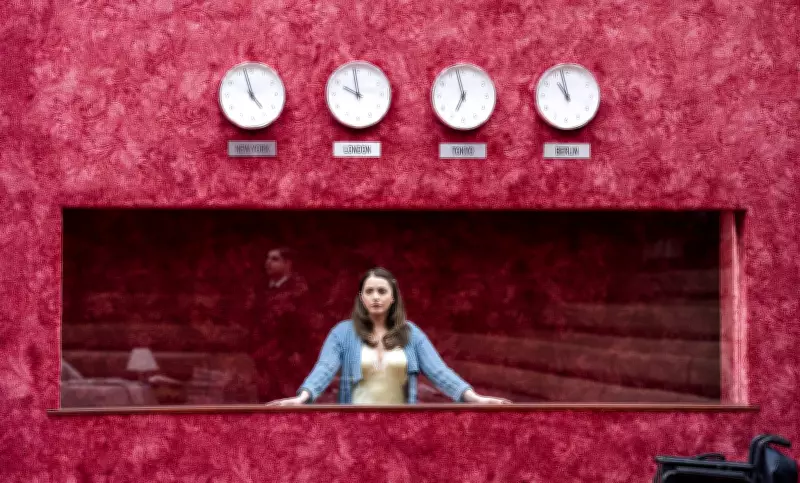
Fein, known for injecting edge into classic musicals like Fiddler on the Roof and Into the Woods, brings a visually led approach to this production. Rosanna Vize's set design creates a narrow strip of red-carpeted space in the theater's center, bordered by the front row of seats where actors occasionally sit. The design mixes anachronistic elements—a noisy water cooler, aggressively synthetic 1970s-style carpet covering both floor and wall, stacks of Metro newspapers—with period-accurate costumes.
At one end, a glass booth resembling a recording studio displays clocks showing times in New York, Berlin, London, and Tokyo. While visually striking, the design's intention remains ambiguous: is it highlighting the gap between the play's 1938 setting and its 1994 creation, or emphasizing the timelessness of its themes? The production's most powerful moment comes in a nightmarish, Lynchian sequence depicting Philip's breakdown, demonstrating Fein's capacity for creating compelling theatrical imagery.
Casting Controversies and Performance Highlights
One of the production's most discussed aspects is Fein's casting choices. Both Chanda (33) and Gelb appear younger than their characters as written—Sylvia mentions having given birth twenty years earlier. This age discrepancy creates a distracting layer of interpretation: is Fein making a deliberate statement about how we perceive these characters, or simply casting talented actors regardless of age appropriateness?
Pearl Chanda delivers a standout performance as Sylvia, balancing earthy realism with a sense of profound dislocation. In one particularly brilliant scene, she and Philip argue at complete cross-purposes—he shouts about their failing marriage while she howls about Nazi Germany, each oblivious to the other's concerns. Alex Waldmann brings free-spirited intensity to Dr. Harry Hyman, creating a character whose charm masks his professional limitations.
Eli Gelb's performance as Philip proves more problematic. His mannered, tragic clown interpretation lacks the vulnerability and humanity that distinguished previous portrayals by actors like Antony Sher (2011) and Henry Goodman (1994). While Gelb demonstrates technical skill, he struggles to convey Philip's complex relationship with his Jewish identity—his pride at being the first Jew hired by his realtor employer conflicting with his desire to assimilate into WASP culture.

The Production's Strengths and Limitations
Running two hours without interval, Fein's production maintains a compelling pace and visual consistency. The director clearly understands how to create striking theatrical moments, and the production's stylistic confidence is evident throughout. However, Broken Glass ultimately reveals itself as more of an actors' play than a directors' one. Its power resides in the psychological complexity of its three central roles and Miller's nuanced exploration of identity politics.
Where the production succeeds visually, it sometimes falters thematically. Miller's uncomfortable examination of American antisemitism—through Philip's discussions of employers who won't hire Jews and Harry's memories of studying medicine in Germany precisely because their schools lacked Jewish quotas—doesn't receive the nuanced treatment it deserves. The play's exploration of how personal and historical trauma intertwine similarly feels underdeveloped.
A Fascinating But Flawed Interpretation
Jordan Fein's Broken Glass represents a fascinating and occasionally brilliant production of an equally fascinating play. The director's visual imagination and willingness to take risks with Miller's text deserve recognition, particularly in his UK non-musical debut. However, the production's stylistic boldness sometimes comes at the expense of emotional depth and thematic clarity.
For theatergoers familiar with Miller's more famous works, this production offers an intriguing look at his late-career experimentation. For those seeking a definitive interpretation of Broken Glass, Fein's version provides stunning visuals and strong performances but may leave them wanting greater psychological insight and thematic development. The production runs at the Young Vic through April 18, 2026, with tickets ranging from £12 to £59.