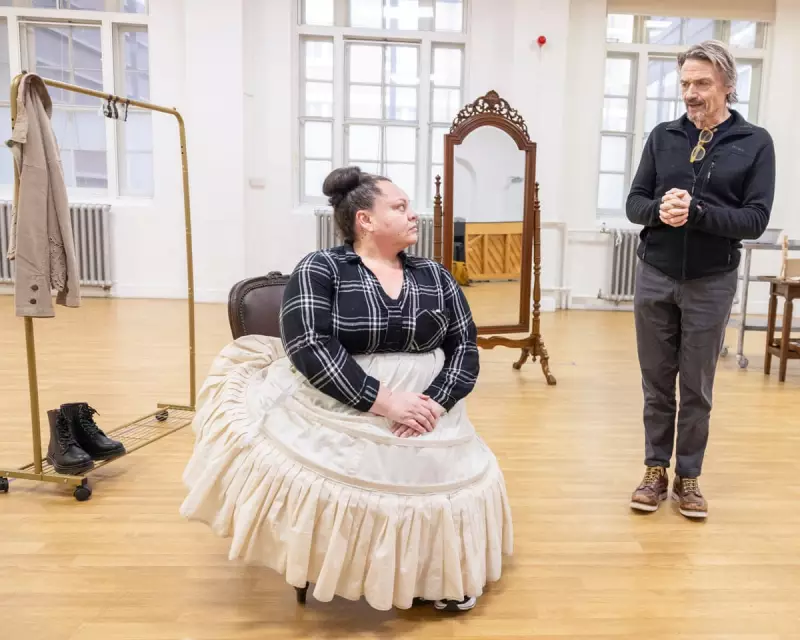
From Showman Stardom to Presidential Drama: Keala Settle's Transformative Journey
In a rehearsal studio overlooking the Thames, Keala Settle is preparing to inhabit one of America's most complex historical figures. The Broadway performer, who achieved global recognition through her show-stopping performance in The Greatest Showman, now takes on the formidable role of Mary Lincoln in Mrs President, a haunting psychological drama opening at London's Charing Cross Theatre this month.
A Role of Personal Resonance
For Settle, this 75-minute production represents more than just another theatrical engagement. "I've never related to anything so closely," she reveals, drawing parallels between her own experiences with fame and grief and those of Abraham Lincoln's widow. The play imagines a pivotal encounter between Mary Lincoln and pioneering photographer Mathew Brady, portrayed by Hal Fowler, as she attempts to redefine her public image following her husband's assassination and the Civil War.
"This role – I jumped at it," Settle explains, noting how her own journey toward self-acceptance mirrors Mary Lincoln's struggle against public vilification and media scrutiny. "I'm absolutely going to be who I'm going to be and it will not fit anyone's mould."

The Greatest Showman's Legacy and Aftermath
Settle's breakthrough performance as bearded lady Lettie Lutz in The Greatest Showman catapulted her into international stardom, with her anthem This Is Me winning Golden Globe recognition and an Oscar nomination. However, the aftermath proved challenging for the performer, who describes struggling with the sudden celebrity spotlight.
"When I did Showman I was not ready," she admits, recalling how an emotionally charged rehearsal of This Is Me went viral just four months after her mother's death. "I could not watch it for probably longer than five seconds. I saw myself as a five-year-old girl who had not yet been looked after."
Health Challenges and Personal Transformation
The pressures of fame took a physical toll, with Settle suffering a mini-stroke and undergoing ten-hour double bypass brain surgery just before the 2018 Oscars. Diagnosed with the rare Moyamoya disease, she was forced to reassess her approach to life and work.
"I'm used to 'Give, give, give, and when you're dead, keep giving'," she reflects. "That's when I went: OK, I've got to look after myself." This health crisis became a turning point, leading her to seek projects that challenge her in new ways.
Cultural Roots and Identity Formation
Settle's complex background – born in Hawaii to a British father and New Zealand mother, raised in French-speaking Louisiana – shaped her understanding of identity from an early age. "I would come home and it would be: we're learning Māori alphabet and music and Tītī tōrea stick game; then we'd go outside and have to find another identity because this identity was not for outside."
Her mother's ambitions for her musical career created additional tension, with Settle feeling pushed into performance rather than choosing it freely. "It was really awkward for me to have someone who I trusted or was supposed to trust, at least, shove me in front of people non-stop," she remembers.
From Musical Theatre to Psychological Drama
Mrs President marks a significant departure from Settle's musical theatre background, which includes Tony-nominated performances in Hands on a Hardbody and originating roles in Waitress and West End productions. The shift to straight drama represents both a challenge and an opportunity for deeper emotional exploration.
"Without music, you have to work 10 zillion times as hard to find the tools to make that kind of impact because music has its own healing powers," she observes about the transition.
Finding Grace Through Adversity
When asked whether her experiences with The Greatest Showman and subsequent health challenges prepared her for this role, Settle responds emphatically: "Yes. There's no way I could do this had I not gone through all of that. I wouldn't understand it."

She describes this understanding as both "horrifying but also empowering," allowing her to approach Mary Lincoln's story with compassion while maintaining grace for herself. "It's horrifying but also empowering that I can understand every bit of this story and still have the grace not only for that woman but also for myself."
Reclaiming Narrative Control
Settle sees strong parallels between her own experience of public perception and Mary Lincoln's historical treatment. "The way that I lead my life is something a lot of people can't cope with because it's not their version of me," she notes, drawing direct comparison to how the former first lady was characterised by contemporary media.
Ultimately, both women's stories represent a reclaiming of personal narrative. As Settle puts it: "She takes all of it back by saying: 'You're right. I hope you enjoyed the show because I survived it.'"
Mrs President continues its six-week run at Charing Cross Theatre until March 8th, offering London audiences a rare opportunity to witness Settle's powerful transformation from musical theatre icon to dramatic actress of considerable depth and emotional resonance.