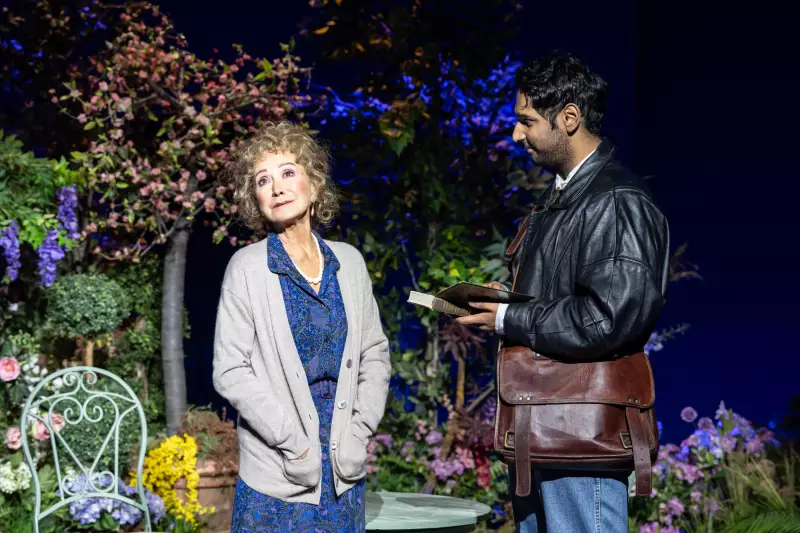
A poignant and timely revival of Tom Stoppard's Indian Ink has opened at London's Hampstead Theatre, serving as a moving tribute to the late playwright who died in November. While not considered his greatest work, this production gains profound emotional weight from the return of Felicity Kendal, Stoppard's former partner, who now plays a different role decades after the play's premiere.
A Deep Cut in the Stoppard Canon
It feels somewhat surprising that this is the first major production of a Stoppard play since his passing, especially with a high-profile revival of Arcadia reportedly in the works. For the past three years, Hampstead Theatre has built a tradition of staging the playwright's lesser-revived works over the festive period, much to the delight of dedicated fans. Indian Ink, however, remains a deep cut. Originally a radio drama titled In the Native State, it was expanded for the stage in 1995, largely as a vehicle for Kendal at the time.
The play has never been a critical darling, and director Jonathan Kent's new production grapples with the same structural issues that have always been embedded in its framework. The narrative unfolds across two primary timelines. The first follows poet Flora Crewe in India in 1930, where, suffering from tuberculosis, she meets local painter Nirad Das who paints her portrait. The second, set sixty years later, features Flora's elderly sister, Mrs Swan, reflecting on her sister's letters with an academic biographer and Das's son, Anish.

Performances and Design
Ruby Ashbourne Serkis delivers a commanding performance as Flora, capturing her with a cut-glass accent, a radiant smile, and the breezy, sexually liberated aura of a golden-age Hollywood star. Opposite her, Nirad Das is portrayed as an Anglophile, desperate to paint Flora in a traditional English style, while she romanticises her Indian surroundings, oblivious to the political tensions of Gandhi's Salt March.
The stage design by Leslie Travers effectively separates the two worlds: a pretty Indian house adorned with jasmine and ivy for the 1930s scenes, and a lush English country garden for the 1990s sequences. The entire set is bathed in a distinctive blue light, evoking the play's titular ink.
Stoppard's Themes and Legacy
The production struggles to fully escape the play's radio-drama origins. Scenes are often static, with characters sitting and listening to speeches. These speeches frequently explore themes of national identity—what it means to be 'English' or 'Indian'—and art's role in expressing it. Stoppard, born in Czechoslovakia and having lived in India and England, clearly calibrates his own complex identity within these debates.
Intelligently, the play pre-empts contemporary culture-war conversations around cultural appropriation and colonial legacy. The clash is crystallised in a scene where Mrs Swan defends the civilising mission of the Raj, only for Anish to retort, "did you expect us to be grateful?" as he eats a piece of her Victoria sponge.
Ultimately, Indian Ink lacks the dense intellectual playfulness and constant wit of Stoppard's masterpieces like Arcadia or Rosencrantz and Guildenstern Are Dead. Its redemption lies in the powerful emotional resonance imported from the real world. Watching Felicity Kendal, now playing the elderly Mrs Swan, observe a young actress deliver lines written for her by her late lover just weeks after his death is an undeniably moving experience. This layer of meta-theatrical poignancy makes the revival a must-see for Stoppard pilgrims, even if the play itself remains a minor work.
Indian Ink runs at the Hampstead Theatre in Swiss Cottage from 16 December 2025 until 31 January 2026. Performances last approximately 2 hours and 45 minutes, with ticket prices ranging from £35 to £65.