The Wooster Group's Head-Spinning Blend of High and Low Art
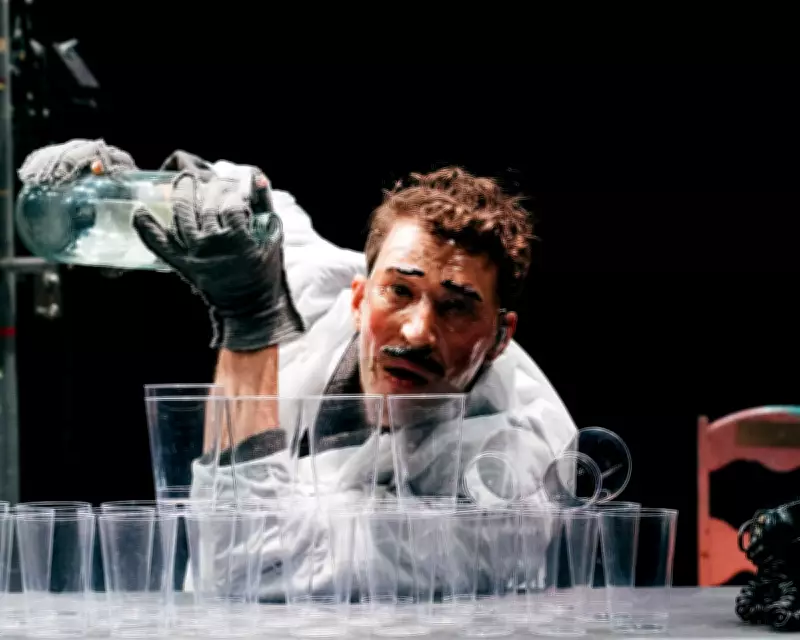
In wonderfully bewildering shows, New York's venerable avant-garde theatre company, the Wooster Group, has built a reputation for mashing together everything from baroque opera to sci-fi B-movies. Their next trick? A seance-style tribute to an old friend, Spalding Gray, in Nayatt School Redux, coming to London's Coronet theatre this April.
A Transformative Legacy
Spalding Gray used to perform a show called Interviewing the Audience, where he would invite a stranger from the lobby to join him on stage. Through innocuous questions, he would uncover profound stories about their lives. Watching Gray conjure this material made a lasting impression on a young actor named Scott Shepherd during his first visit to the Performing Garage, the Wooster Group's New York home.
"Interviewing the Audience was quite amazing," says Shepherd. "His first question was always the same – 'How did you get to the theatre?' – and somehow, he would find a thread from that into the person's inner being. It was one of the great early theatre experiences of my life."

From Seamstress to Star
Kate Valk had an equally transformative experience at the Performing Garage, a theatre so small that some seats were accessible only by climbing a ladder. As an inquisitive acting student, she saw Gray in two autobiographical pieces, Sakonnet Point (1975) and Rumstick Road (1977), and was immediately hooked.
"I gave up my apartment and moved in upstairs," Valk recalls. "It was such an amazing group of artists. I was like, 'Oh, I'm just going to give up everything and move in here because this is the place to be.'" Valk joined the Wooster Group in 1979, initially as a seamstress, and has rarely worked outside the company since.
Reimagining a Classic
Now, both Valk and Shepherd are returning to the role Gray created in Nayatt School (1978), part of his Rhode Island trilogy and a forerunner to pieces like Swimming to Cambodia. Nayatt School Redux is not a straightforward revival but a reimagining in the Wooster Group's distinctive style.
"When we go back to look at the old work, it's not like an artist can pull out her old painting from the warehouse and look at it," says director Elizabeth LeCompte, who lived with Gray in the 1970s. "We only have very deteriorated, black-and-white material to work from."
Where Gray was once a friend and colleague, he is now a character in a play about a play he made. "We're getting as close to channelling his performance in Nayatt School as we can," says Valk. "I'm the survivor, because I'm still in the group. I knew him, I worked with him, I was young, now I'm old and I'm the person who's translating and telling you what he did."
The Wooster Group's Signature Style
Taking its name from a school in Barrington, Rhode Island, where Gray grew up, the original Nayatt School featured LeCompte's celebrated collage-like juxtaposition of disparate elements. It blended vaudeville-style radio skits with T.S. Eliot's postwar play The Cocktail Party, a curious combination of drawing-room comedy and esoteric religious debate.
This fusion of pop culture and high art has characterised the Wooster Group's work for decades. In 1984, LSD (Just the High Points) sat at the meeting point of Timothy Leary's countercultural drug taking and Arthur Miller's The Crucible. In 1988, Frank Dell's the Temptation of St Antony combined Gustave Flaubert with Lenny Bruce. And 1997's House/Lights was half-Gertrude Stein and half-sexploitation flick.
A Fun Cocktail of Contrasts
For LeCompte, who trained in painting and photography, such head-spinning collisions reflect how she sees the world. "I grew up with the television and art, and they do that all the time," she says. "You can go from the most serious soap-opera scene to a toothpaste ad. As a kid, I thought, 'Oh, they're in the bathroom and they're going to come out of the bathroom and continue the scene.' I didn't see that you needed to connect those things in any rational way."

She compares her technique to frottage, the artistic practice pioneered by Max Ernst in which pencil rubbings are taken from rough surfaces to create something new. "That's what I do with the texts and the people," says LeCompte, rubbing her hands to demonstrate. "The performers are material and I like to rub myself up against them." She adds, with a laugh, "Not in the literal sense."
The effect can be discombobulating, but it can also be funny. "It seems to be fun when it's high/low," says Valk. "For instance, this difficult writing by Gertrude Stein juxtaposed with a girl gang from a 60s B-movie. It's a fun mix, like a cocktail. Sometimes, it's not logical or reasonable, but you put the source material and the text so they're vibrating against each other and then they somehow grow together."
Precision and Athleticism
Getting these combinations to work can be challenging, but once LeCompte has set her course, she never abandons an idea. The matching of live actors to recorded film and audio requires immense discipline. Even if a Wooster Group performance leaves you bewildered, you never lose admiration for the precision of the actors and technicians.
"As performers, Scott, myself and Ari Fliakos – the whole middle period of the Wooster Group – have an athlete spirit," says Valk. "With the copying, the speed, the deftness and the technical skills to follow and respond physically, there is a feat that needs to be accomplished. All three of us enjoy that."
A Sense of Joy and Wonder
If any of this sounds highfalutin, it is to underestimate LeCompte's sense of joy and wonder. She is less the austere auteur than the enthusiast, delighted at the absurdities of life and art. When Valk refers to the company's "career", LeCompte raises her eyebrows, adopts an expression of cartoon horror and draws scare quotes in the air. Imagine calling it a career!
Heading for 82 and looking decades younger, she retains her sense of delight and mischief. She flashes another broad smile and heads off to rehearsal, ready to bring Nayatt School Redux to London audiences.
Nayatt School Redux is at Coronet theatre, London, from 17 to 25 April.