Mars College: The Desert's Off-Grid Alternative to Traditional Higher Education
Two hundred miles from Los Angeles, in the barren expanse of California's desert, an unconventional educational experiment is unfolding. Mars College, located just a mile from the tiny settlement of Bombay Beach and forty miles from the nearest grocery store, represents a radical departure from traditional higher education institutions.
An Unorthodox Learning Environment
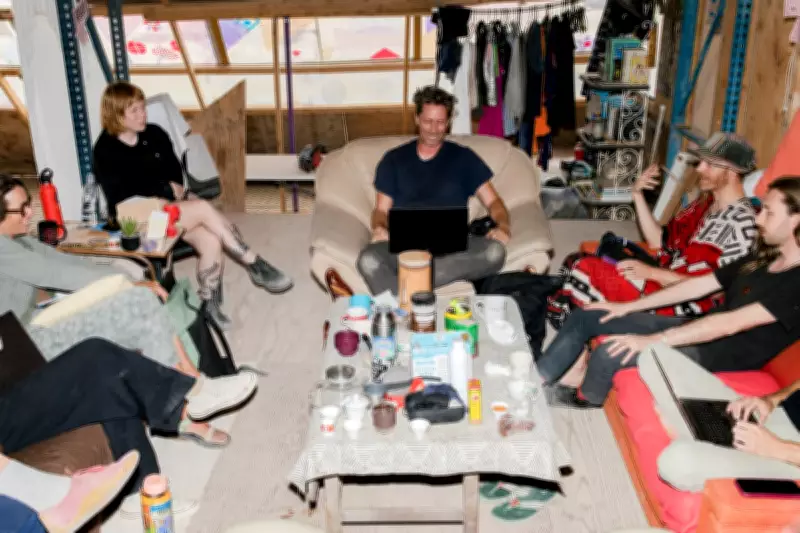
The scene could be mistaken for any creative writing workshop across America: a dozen students gathered around weather-beaten couches, laptops balanced on knees, sharing poetry and offering constructive feedback. But zoom out from this intimate circle, and the reality becomes clear. These writers sit in a temporary plywood-and-metal structure built directly on the sand, surrounded by endless desert stretching to the horizon, punctuated only by the pesticide-laden Salton Sea.
"It's unclear who gave it that nickname," says co-founder Gene Kogan, a programmer and artist. "But, you know, it kind of looks like Mars out here."

At Mars College, there are no grades, degrees, or mandatory attendance requirements. There are no tuition fees, trained professors, or public utilities like electricity or indoor plumbing. Most power comes from a towering wall of solar panels, while drinking water must be driven in and trash driven out.
The Educational Philosophy
Daily classes at Mars College are taught by anyone with something to share, ranging from creative writing workshops to mathematical shape theory, solar panel installation, and AI-inspired art creation. All instruction occurs within a cluster of temporary structures built each January and dismantled every April. For three months, several dozen students live in trailers, sheds, and tents flanking the main campus, paying a few hundred dollars for communal services including wifi, meals, and access to portable toilets.
Mars College founders argue their institution isn't collegiate in a traditional sense but rather a low-cost experimental community. As college tuition continues to soar and college-educated individuals face unprecedented long-term unemployment, people of all ages are seeking adventurous new learning approaches. Mars presents itself as a college for challenging times: a dystopian, isolated place where students learn both off-grid living skills and modern AI tools.
Origins and Evolution
The seed for Mars College was planted at Burning Man, where former Silicon Valley engineer Freeman (who prefers using only his first name) began constructing temporary structures from warehouse pallet racks. After the festival ended, Freeman found himself with leftover materials and no purpose for them.
In 2019, he purchased twenty acres of desert land near Bombay Beach for approximately $20,000, creating the campus for what would become Mars College. Kogan, armed with a mathematics degree from Columbia University and a Fulbright scholarship, brought the people through an open Twitter call promoting a "free and highly unconventional experiment in living and learning in the desert."
"More or less, the first cohort was all of my friends," Kogan recalled recently while sitting inside the college's main auditorium, where AI-created art videos played on small screens. "We were just like, 'OK, anyone who wants to come for any amount of time just come, we'll figure it out.'"
The Student Body
Today's Mars College students represent diverse backgrounds: some hold advanced degrees while others didn't complete high school. The current cohort of approximately sixty individuals includes a former English major fascinated by off-grid living, a forty-five-year-old microbiologist with a Berkeley PhD who compiles an AI-written academic journal on hot-pink paper, a woman from neighboring Slab City who runs a dog rescue operation, and a Vietnamese man who works as a Balinese Hindu priest when not in the California desert.
Students range from twenty-five to sixty years old, hailing from Brazil, India, China, various European countries, and across the United States. Prospective students must formally apply, though Kogan acknowledges the admission process is "very self-selective" due to the inherent challenges of desert living without immediate resources.

"We sort of emphasize that this isn't a vacation," he noted.
Daily Realities and Challenges
Life at Mars College isn't for the faint of heart. When desert winds whip through the camp, spawning hours-long sandstorms, a thick film of dust settles over everything. Spring temperatures reliably climb into triple digits, and basic amenities require constant maintenance and planning.
"Here, you can't take anything for granted," Kogan emphasized.
Amy Brown Carver, who leads the writing workshop, initially found the college concept somewhat cult-ish when her ex-boyfriend announced plans to attend. After visiting him that winter, however, she recognized the appeal and has enrolled every year since, now developing standup comedy material about her desert experiences.
"Because I'm new to stand-up and I'm doing the open mics and stuff," Carver explained, "there's something of an advantage coming in and talking about something [unique] like this each time."
Technology and Environmental Considerations
Given the founders' tech backgrounds, artificial intelligence significantly influences Mars College, including dedicated "AI Camp" programming. Classes cover "vibe coding" and "creative AI," while AI agents control auditorium lighting and help organize the communal kitchen. Students regularly deliberate how best to incorporate artificial intelligence into their creative work.
The potential environmental impact of AI doesn't overly concern Kogan, even in an area already defined by environmental challenges like the Salton Sea. Recent proposals for massive AI data centers near Mars College have sparked concerns about their electricity and water consumption.
"I encounter it sometimes, although I don't think about it too much, because I'm not much of an expert on this topic," Kogan said. "It doesn't have that much to do with AI, it's more just how energy systems work and so on."
Freeman expressed more enthusiasm about AI's possibilities in an email: "So much is happening in this field. It's nice being around other people using it extensively to see what it's capable of, and having projects to get experience using it directly."
Philosophical Questions and Future Directions
Mars College grapples with many philosophical questions facing traditional higher education institutions, particularly regarding AI's role in shaping the future. The former microbiologist who produces the camp's academic journal recently reflected on his editorial choices in a human-written editor's note accompanying AI-enhanced articles.
"Am I making slop? I hope not," he wrote. "I certainly am sniffing the slop. It doesn't stink too bad to me, but it also doesn't smell quite floral. There's some brain-broken territory that we are exploring here with bot-penned prose, and I hope you will forgive me for mixing the two together."
As April approaches, Mars College faces its annual transformation. All carefully constructed classrooms and buildings will be dismantled, students will pack their trailers and RVs, and the landscape will return to vast, open desert. Next year, they'll rebuild everything again, continuing their experimental approach to education in one of America's most remote locations.
Kogan maintains perspective about Mars College's role: "I'm not attached to the word [college], I'm not trying to convince anyone we're a university of sorts. In a lot of ways it's an alternative to college. In the future, I don't see how the university system as it is now can sustain itself."