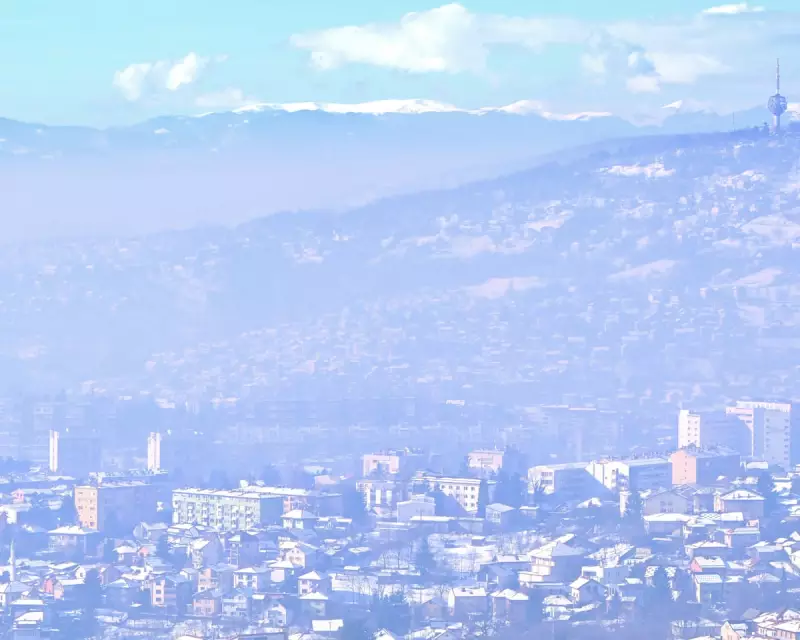
When considering the globe's most polluted urban centres, visions of Delhi's smog-choked streets or Beijing's hazy skies typically dominate. However, groundbreaking new research has uncovered a severe air quality crisis much closer to the heart of Europe, with the Balkan region bearing an alarming burden.
Europe's Pollution Epicentre
Professor Andre Prevot from Switzerland's Paul Scherrer Institute (PSI) delivered stark findings: "During winter months, particle pollution levels across the Balkans represent the highest concentrations found anywhere in Europe. These measurements frequently surpass those recorded in Beijing, and on certain days, they rank among the most severe pollution readings worldwide."
The researcher further highlighted the dramatic disparity with Western Europe, noting that sulphur dioxide concentrations in winter can exceed typical Western European levels by more than thirty times. This pollution divide has devastating human consequences, with approximately 3,300 premature deaths annually attributed to particle pollution in Bosnia and Herzegovina alone.

Mobile Laboratory Reveals Urban Reality
Understanding a city's true air pollution profile requires more than stationary monitoring. The PSI research team equipped a specially adapted van with state-of-the-art air quality sensors, installing sampling pipes on the vehicle's roof to conduct mobile measurements throughout Sarajevo during winter conditions.
Michael Bauer of PSI described their methodology: "We completed circuits around the city, each taking approximately ninety minutes, with up to six circuits conducted daily. One of our greatest challenges involved spending extensive periods navigating Sarajevo's congested traffic within narrow, hilly streets."
The researcher recalled evenings when visible smog blanketed western areas, with residential districts emitting distinct aromas of wood and coal smoke. Bauer particularly noted the pervasive scent of grilling, especially ćevapi, wafting through the city centre.
Exceeding Safety Guidelines Consistently
The team's analysis focused on specific components within the particle pollution mixture, yet even this limited measurement revealed alarming results. Pollution levels exceeded the World Health Organization's daily safety guidelines for sixty-six percent of the monitoring period, frequently registering more than eight times higher than recommended limits.
The most severely affected areas proved to be residential districts where home heating systems dominate air quality issues. Residents predominantly burn wood, coal, and sometimes rubbish for warmth, generating high concentrations of cancer-causing polycyclic aromatic hydrocarbons alongside other dangerous pollutants.
Prescribed Solutions and Implementation Challenges
A 2023 United Nations Development Programme study identified multiple interventions to address Sarajevo's air quality crisis. Recommendations included improving home insulation, expanding central heating systems and heat pump installations, implementing regular stove inspections, and launching comprehensive public information campaigns.
The research pinpointed nine priority areas within the city requiring immediate action. Bauer confirmed their findings align with these designated zones, stating: "Our results validate these priority areas. Existing plans aiming to reduce solid fuel heating in these districts by ninety percent before 2033 are urgently necessary. However, even achieving this ambitious target won't eliminate all pollution sources, requiring continued attention to other contributors."
Additional Pollution Sources Compound Problems
Sarajevo's ageing vehicle fleet significantly exacerbates air quality challenges. The average vehicle in the city is nineteen years old, with ten percent predating modern European exhaust emission standards. This contrasts sharply with United Kingdom figures, where the average car age is ten years, and commercial vehicles average between eight and nine years old.
Within Sarajevo's urban core, restaurant cooking emerges as a dominant particle pollution source. Bauer explained: "Commercial cooking contributes a substantial, non-negligible amount to downtown air pollution, particularly since residential heating plays a less significant role in these central areas."

Professor Prevot added a sensory perspective: "The aroma of grilling in the city centre was remarkably intense. On certain days, the atmosphere felt comparable to northern India... you could almost taste the pollution."
This comprehensive research illuminates a pressing environmental and public health crisis unfolding within Europe's borders, demanding coordinated action across multiple sectors to protect vulnerable populations from preventable harm.