Cyclone Narelle Approaches Western Australia with Destructive Force
Tropical Cyclone Narelle, a massive storm system, is set to make landfall along the remote north-west coast of Western Australia today, posing a significant threat of flash flooding to Perth. The cyclone, currently a category four system, is forecast to weaken slightly as it crosses the coast between Carnarvon and Kalbarri late on Friday, but it will still bring wind gusts of up to 250km/h.
Tracking the Storm's Path and Impacts
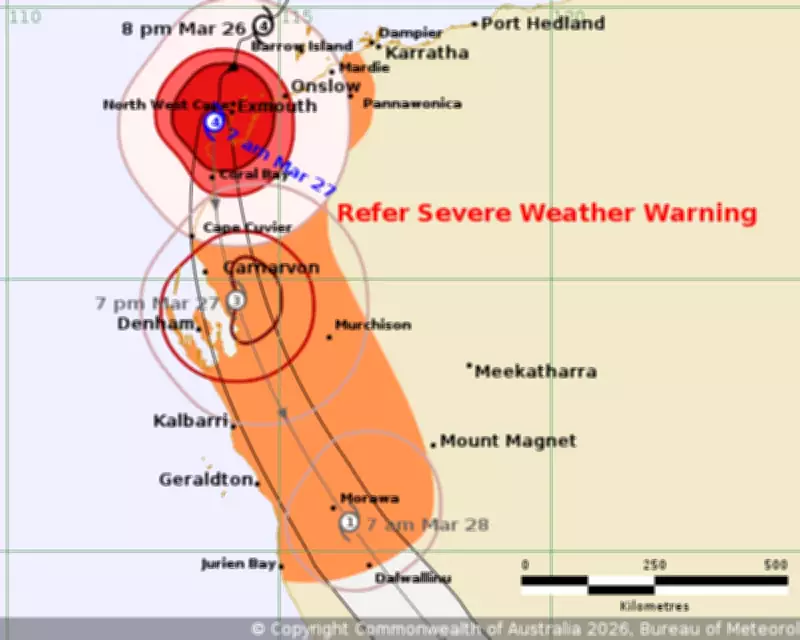
According to the Bureau of Meteorology, Cyclone Narelle was located 40km west south-west of Exmouth at 7am AWST on Friday, with signs of weakening expected to continue. Senior meteorologist Ilana Cherny stated that the system is likely to pass close to the North West Cape as a category four this morning before moving south and crossing the coast near Coral Bay to Cape Cuvier in the afternoon. If it remains offshore longer, it could cross near Denham in the evening, potentially as a category three.
The BoM has issued warnings for "very destructive wind gusts" along the west coast to Coral Bay and Cape Cuvier throughout Friday morning. Cherny emphasized that heavy rainfall accompanying the cyclone could lead to flash flooding, with Perth and the southwest region expected to receive 50 to 100 millimetres of rain over Friday and Saturday. A flood watch is in effect from Exmouth to Perth's Swan River.

Historical Context and Broader Impacts
Cyclone Narelle marks a rare event, as it is set to be the first system to make landfall as a tropical cyclone in three Australian states and territories in over two decades, following Cyclone Ingrid in 2005 and Steve in 2000. The storm initially hit far north Queensland as a high-end category four cyclone last week, then moved through the Northern Territory as a category three last Saturday before tracking west to the Indian Ocean.
Prime Minister Anthony Albanese has assured that the federal government is ready to assist state, territory, and local governments in response to the storm's impacts. Clean-up efforts are anticipated to extend into next week as Narelle moves off the WA south coast into the Southern Ocean overnight on Saturday.
Climate Factors and Future Concerns
Climate scientists have linked Cyclone Narelle's early formation and intensification to global heating, citing record ocean temperatures in the Coral Sea prior to the storm. This highlights ongoing environmental challenges that could influence future weather patterns in the region.