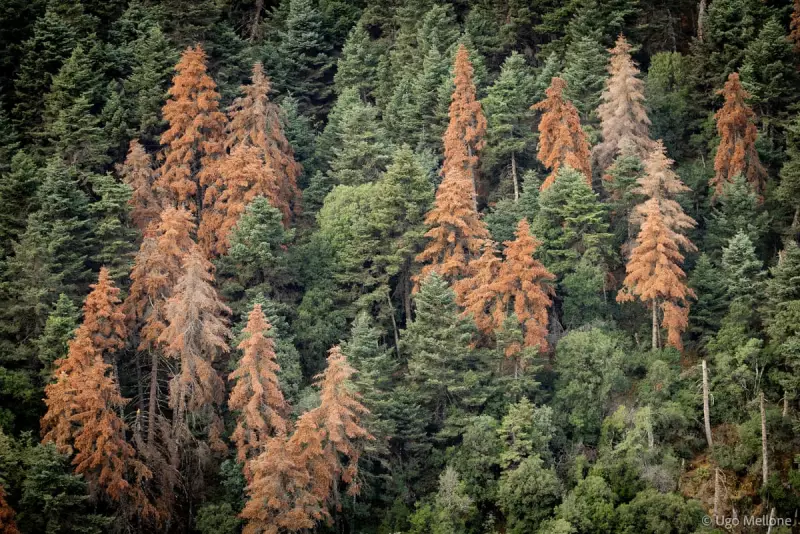
Greece's ancient fir forests, which have weathered countless storms across millennia, are now succumbing to a new and deadly threat. A combination of intensifying wildfires and prolonged, severe drought is pushing these iconic ecosystems towards functional extinction, scientists have warned.
A Millennia-Old Survivor Brought to Its Knees
The Greek fir, or Abies cephalonica, is a species uniquely adapted to the Mediterranean. For centuries, it has clung to the nation's mountainous slopes, its resilience becoming a symbol of the rugged landscape. However, research led by Professor Constantinos Cartalis from the National and Kapodistrian University of Athens reveals a catastrophic shift. The trees that survived the flames are now dying in their thousands, not from fire damage, but from the relentless climatic stress that followed.
"We are witnessing the collapse of an ecosystem," stated Professor Cartalis. His team's analysis, which combines satellite imagery with on-the-ground surveys, shows that up to 80% of fir trees in burned areas of Mount Parnitha are now dead or dying. The crisis is not confined to recently burned zones; even forests that escaped direct fire are showing severe signs of stress and mortality due to drought.

The Deadly Cycle of Fire and Thirst
The mechanism of decline is a vicious one-two punch. Wildfires, growing more frequent and intense, scorch the forest canopy and soil. This leaves surviving trees critically weakened. They are then finished off by consecutive years of extreme heat and water scarcity, which have become the new normal. The trees' natural defences are exhausted, making them susceptible to bark beetle infestations that deliver the final blow.
The impact is starkly visible in Parnitha National Park, a vital green lung near Athens. Vast slopes that were once deep green are now rust-coloured graveyards of dead trees. This die-off has severe consequences for biodiversity, water regulation, and soil stability, increasing the risk of devastating landslides.
Broader Implications and a Fading Future
The situation in Greece is a dire warning for the entire Mediterranean basin. Similar patterns of forest dieback are being observed in Italy, Spain, and North Africa. The research underscores that climate change is not a future threat but a present-day agent of ecological transformation. The models are clear: the current trajectory points towards the functional extinction of these fir forest ecosystems within decades.
While some scientists discuss the potential for assisted migration—planting hardier species from drier climates—others emphasise that protecting remaining old-growth stands is paramount. The loss of Greece's fir forests represents more than an environmental tragedy; it is the erasure of a living heritage, a fundamental change in the identity of the Greek mountains that future generations will never know.