Interstellar Intruder 3I/ATLAS Puzzles Astronomers with Unusual Behaviour
A celestial visitor from beyond our solar system, the comet known as 3I/ATLAS, is causing a significant stir in the astronomical community this week by failing to display a characteristic feature of most comets. This enigmatic object, only the third interstellar visitor ever detected within our celestial neighbourhood, has been caught acting peculiarly as it journeys through our solar system.
The Mysterious Case of the Missing Tail
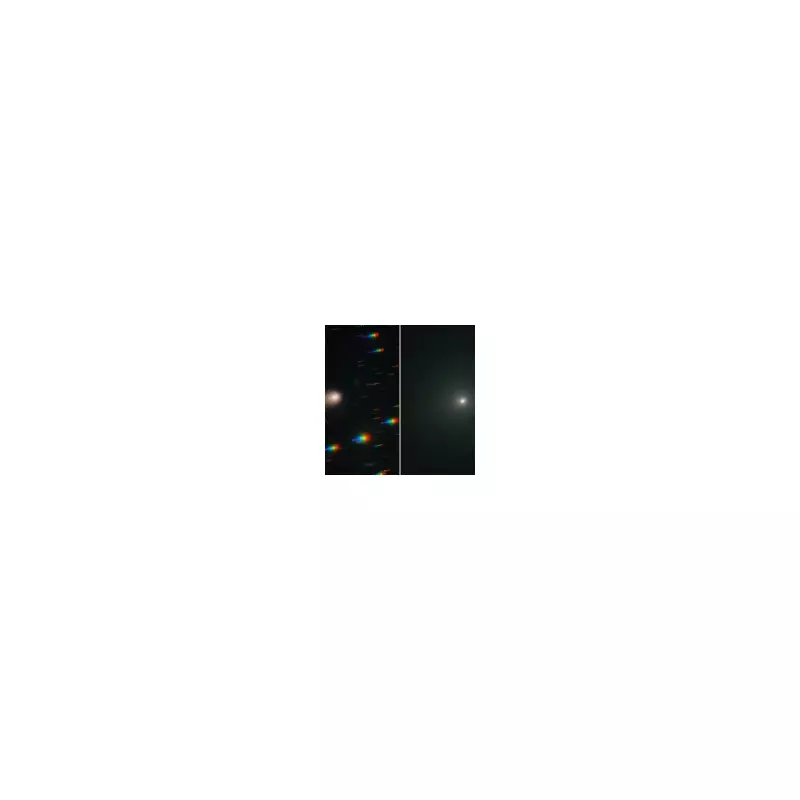
For the most part, 3I/ATLAS has conformed to expectations, behaving like a standard comet—a gigantic, dirty snowball of dust orbiting the sun. However, new observations conducted on Wednesday have raised eyebrows. Images captured by the Lowell Observatory in Arizona and the Ramon Naves Observatory in Spain show the comet glowing with a distinct green hue but, curiously, lacking a visible tail.
This anomaly has reignited speculation about the object's origins, most notably from Harvard astrophysicist Avi Loeb. Dr Loeb, who has previously suggested the object could be of alien origin, such as a probe, pointed out to Metro that 3I/ATLAS appears 'intact' and has a 'compact source of light', which is atypical for comets. He noted that the comet's coma—the fuzzy aura created when the sun vaporises ice—has not changed significantly since it was observed by the Hubble Space Telescope on July 21, 2025.

Adding to the intrigue, a third sighting by Austrian astronomer Michael Jäger described a 'complex tail structure' with a halo stretching half a million kilometres into space and visible 'jets'—explosions of gas. Dr Loeb posed the critical question: "Is the network of jets associated with pockets of ice on the surface of a natural cometary nucleus, or are they coming from a set of jet thrusters used for navigation of a spacecraft?"
A Scientific Debate: Alien Artifact or Natural Phenomenon?
Not all scientists are convinced by the extraterrestrial hypothesis. Dr Alfredo Carpineti, an astrophysicist and science writer for IFLScience, offers more conventional explanations. He argues that 3I/ATLAS is a dynamic object that is supposed to change. "If its tail was blown away [by solar winds], it is perfectly natural," he told Metro.
Dr Carpineti also suggested a simpler reason for the missing tail: our perspective from Earth. "Some observations suggest we simply are aligned in such a way we can’t see it at the moment," he explained, meaning we might be viewing the comet's tail directly from behind, making it invisible to our telescopes.
Despite these natural explanations, Dr Loeb remains intrigued. He places the odds of an artificial origin for the 3.5-mile-wide object at 40%, citing its odd chemical composition and the fact it had a tail long before its close approach to the sun. He also notes it arrived from roughly the same direction as the famous 'Wow! Signal' detected in 1977.
Dr Loeb has outlined two potential implications if the object is indeed artificial: its intentions could be entirely benign, making it an interstellar messenger, or they could be malign, a scenario "of great concern."
Why the Green Glow and What Happens Next?
The comet's striking green colour has a scientific explanation. Researcher Qicheng Zhang from the Lowell Observatory detected dicarbon in the comet's atmosphere. This molecule, made of two carbon atoms, glows emerald green when broken apart by the sun's ultraviolet light.
As for any threat to Earth, scientists assure the public there is no danger. NASA has confirmed the comet poses no risk and will make its closest approach to Earth on December 19, passing at a safe distance of 17 million miles before continuing its journey out of our solar system. Dr Carpineti dismisses the alarm, stating, "The boys who cry 'alien' should probably get a new line now."

For now, the scientific community continues to monitor 3I/ATLAS, collecting data that may one day solve the mystery of this strange interstellar guest. As Dr Loeb concluded, "For now, let us enjoy the view. After all, a picture is worth a thousand words."