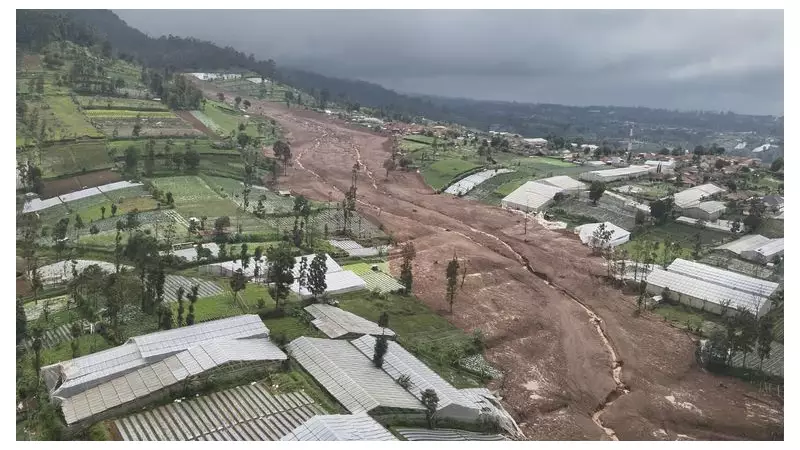
Rescue operations are continuing in Indonesia's West Java province following a catastrophic landslide that has claimed at least 25 lives, with dozens more feared missing under tonnes of debris. The disaster struck the West Bandung district on Saturday, triggered by days of intense torrential rain, leaving a trail of destruction and a community in mourning.
Search Efforts Amid Challenging Conditions
The search for 72 people believed to be buried under mud, rocks, and uprooted trees is being carried out by a 250-member team from the Indonesian National Search and Rescue Agency, known as Basarnas. On Sunday, improved weather conditions allowed rescuers to recover 14 more bodies, bringing the total confirmed fatalities to 25, according to Ade Dian Permana from the provincial search and rescue office.
However, the operation faces significant hurdles due to the unstable terrain. Mohammad Syafii, the chief of Basarnas, emphasised that the ground remains "flowing and unstable", complicating efforts. Heavy machinery has been largely unusable because of the soft soil, forcing teams to rely on manual methods, farm tools, and even bare hands, as seen in video footage released on Saturday.

Impact on Pasir Langu Village
The landslide has devastated Pasir Langu village, where more than 30 homes were completely buried under mounds of mud estimated to be up to 5 metres (16 feet) high. Mr Permana noted that "some homes are buried up to the roof level", highlighting the scale of the destruction. In response, around 230 residents from nearby areas have been evacuated to temporary government shelters for safety.
Rescue officials have stated that the operation will proceed non-stop as long as conditions permit, but they have issued warnings that further rainfall could destabilise the slope even more. Safety remains a top priority, with teams utilising drones, K-9 units, and ground personnel to scour the wide area.
Environmental Concerns and Official Response
Environmental activists have pointed to long-term environmental degradation as a key factor in the landslide. Wahyudin Iwang of the Indonesian environmental group Walhi West Java argued that the disaster reflects "the accumulation of activities that were not in line with spatial planning and environmental functions" in the North Bandung Area, a conservation zone critical for water catchment.
During a visit to the site on Sunday, Indonesian Vice President Gibran Rakabuming Raka urged local authorities to address land conversion issues in disaster-prone areas and pledged measures to prevent future tragedies. This call to action comes amid concerns that illegal development and neglect of regulations may have exacerbated the region's vulnerability.
Broader Context of Natural Disasters in Indonesia
This landslide is part of a troubling pattern of natural disasters in Indonesia, an archipelago prone to flooding and landslides during the rainy season from October to April. Less than two months prior, floods and landslides in parts of South and Southeast Asia, including Sumatra, killed over 1,300 people. In January 2025, similar events in Central Java province resulted in more than 20 fatalities.
The recurring nature of these incidents underscores the urgent need for improved disaster preparedness and environmental management in high-risk regions across the country.