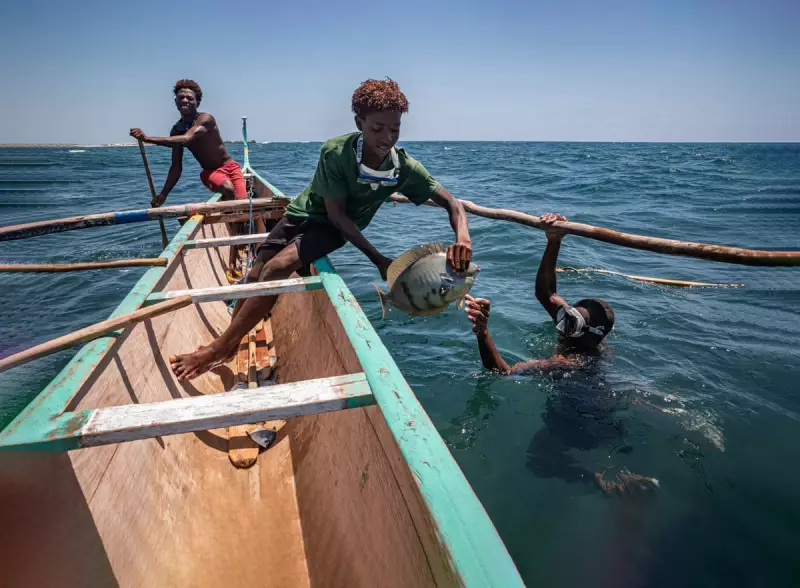
Along the sun-bleached shores of south-west Madagascar, the Vezo people have forged their identity from the sea for generations. This semi-nomadic community, tens of thousands strong around the city of Toliara, has long launched pirogues—dugout canoes carved from single trees—into the Mozambique Channel's turquoise waters daily. Their catch of tuna, barracuda, and grouper was not just a livelihood but the very rhythm of life. "We rely solely on the ocean," explains Soa Nomeny from the small island of Nosy Ve. "Whatever we catch today, we eat today. If we catch nothing, we don't eat."
A Sea in Crisis: Warming Waters and Rampant Trawling
This profound dependence is now under severe threat. For the roughly 600 residents of Nosy Ve and other coastal villages, the ocean's bounty is vanishing. According to Michel "Goff" Strogoff, a former shark hunter turned conservationist from the Vezo hamlet of Andavadoaka, fish populations began collapsing in the 1990s, with a sharp decline over the past decade. The drivers are twofold: climate change and industrial overfishing.
Rising sea temperatures have triggered widespread coral bleaching and reef degradation, destroying crucial fish breeding grounds. Erratic weather patterns linked to warming oceans have also shortened traditional fishing seasons. "There's no abundance near shore any more," says Strogoff. "We're forced to paddle farther." This sentiment is echoed by local fisher Hosoanay Natana, who now travels hours beyond traditional grounds for a viable catch.

Compounding the ecological damage is the impact of industrial trawlers. Despite a national ban prohibiting these vessels from coming within two nautical miles (3.7km) of the coast, weak enforcement means Malagasy and foreign ships routinely violate the rule. Their near-shore operations devastate fish stocks, leaving small-scale fishers like the Vezo with dwindling returns. The environmental organisation Blue Ventures reports that reef fish biomass across south-west Madagascar has fallen by more than half since the 1990s.
Seaweed Village: Cultivating a New Lifeline
Faced with this crisis, the Vezo are demonstrating remarkable resilience by turning to the sea in a new way. In the village of Ambatomilo, locally known as Seaweed Village, families are cultivating seaweed as a crucial supplementary income. Overseen by a locally managed marine area (LMMA) committee—a community-led conservation model supported by Blue Ventures—this practice offers a buffer against overfishing and climate shocks.
Fabricé and his wife, Olive, began farming five years ago. They harvest every couple of weeks, laying the fresh red seaweed across bamboo racks to dry in the sun. "The market pays around 1,500 ariary (25p) per kilo," says Olive. Depending on the season, a family can produce up to a tonne a month, providing significant extra income that cushions household finances when fishing fails. "We still depend on fish for daily needs," she notes, "but the seaweed helps us plan ahead."
Seaweed farming is now one of Madagascar's fastest-growing coastal industries. The crop is exported mainly for carrageenan, a gelling agent used in food, cosmetics, and pharmaceuticals. It also serves locally as fertiliser, livestock feed, and seasoning. Beyond economics, environmental studies show seaweed farms help stabilise coastlines by reducing wave energy and absorbing carbon dioxide, aiding in erosion control and carbon sequestration.
An Ancient Culture Navigating an Uncertain Future
The Vezo's legendary adaptability is being tested as never before. Outside the cyclone season, some families still undertake long fishing migrations, camping on sandbanks and uninhabited islets as they follow fish along the coast. "Extended migrations are always an option," says Natana. "Whether we embark or not depends on the fish stocks nearby." Some are drawn to distant waters up to 1,000 miles away, chasing high-value commodities like shark fins or sea cucumbers for Asian markets.

Cultural traditions remain a bedrock. On Nosy Ve, families gather for annual Tromba rituals, where elders invoke ancestral spirits and offerings are made to seek protection and prosperity at sea. Life on the island is a blend of endurance and fragility: homes are built from pounded seashells and palm fronds, nights are lit by torchlight, and meals consistently centre on rice and the day's catch.
Yet, the horizon is increasingly uncertain. As industrial fleets expand and reefs continue to decline, this ancient seafaring culture must travel ever farther for diminishing returns. Their struggle encapsulates a broader challenge across coastal Africa: how small, ocean-dependent communities can endure when the sea that sustains them is changing faster than ever before. For now, the Vezo persist, their nets and seaweed lines cast upon the waves, navigating the difficult currents of a transformed world.