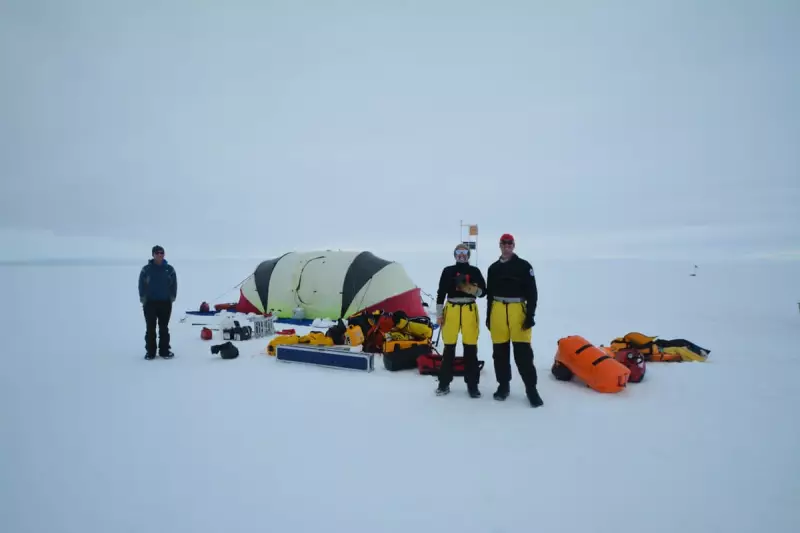
As the sun and moon hung in the polar sky, scientists braved -20°C temperatures on Antarctica's vast Totten Ice Shelf, focused on a hidden threat kilometres below their feet. Their mission to retrieve data is part of a global effort to understand a critical process: how warming oceans are melting the continent's ice shelves from beneath, with dire implications for coastal communities worldwide.
The Hidden Melt: A Gigantic Annual Loss
Led by Dr Ben Galton-Fenzi of the Australian Antarctic Division, a decade-long international study has quantified the staggering scale of this underwater melt. The research, synthesising models from nine global teams, estimates that Antarctica's ice shelves are losing approximately 843 billion tonnes of mass each year due to basal melting.
To visualise this, it is the equivalent of 843 giant ice cubes, each one kilometre long, wide, and deep, melting into the ocean annually. This volume matches the total amount of water the River Nile discharges into the sea every year.

While these floating ice shelves do not directly raise sea levels when they melt, they act as crucial plugs, holding back the immense ice sheet on land. "We need to know because the ocean-driven mass loss is one of the biggest uncertainties in Antarctic ice sheet projections and, therefore, in global sea level rise," Dr Galton-Fenzi explains.
Probing an Inaccessible Frontier
Understanding this process is fraught with difficulty. The water under ice shelves is the coldest on Earth, not freezing until about -2.2°C due to immense pressure, and is shrouded in perpetual darkness. "Satellites can’t reach it because it’s covered in ice. Ships can’t get in," says oceanographer Dr Steve Rintoul of Australia's CSIRO.
Breakthroughs are painstaking. Dr Rintoul's team gained rare insight when an autonomous Argo float, deployed under the Totten Ice Shelf, drifted and spent nine months under the Denman Ice Shelf. Its data confirmed that warm water is reaching and melting the Denman shelf, which alone holds ice equivalent to 1.5 metres of global sea-level rise.
The geological shape of the seabed complicates the issue. Ancient glaciers carved deep canyons, which now act as channels, funnelling warmer water towards the ice and potentially "seeding their own demise," Dr Rintoul notes.
Uncertain Futures and Global Consequences
The lack of data creates significant uncertainty about the speed of future changes. While one comprehensive analysis found Antarctica lost 93 billion tonnes of ice annually between 1992 and 2020, the new focus is on the destabilising role of the ocean.
Scientists warn that some of the continent's most vulnerable regions hold enough ice to raise global sea levels by about 15 metres if they were to melt entirely. "We do know with very high confidence what the sign of the change will be. The ice sheets will keep losing mass. It is how fast and how much is where the uncertainty is," states Galton-Fenzi.
The consequences extend beyond rising seas. Dr Sue Cook, a glaciologist at the University of Tasmania, highlights another "really urgent question": the potential for vast amounts of meltwater to disrupt major ocean currents, like the global conveyor belt that regulates climate. "If it gets disrupted, then the consequences could be dramatic," she warns.
The message from the ice is clear. "It depends how much greenhouse gas we emit," concludes Dr Rintoul. "There’s a reason the international community came up with temperature targets – they came in large part because of the risk of destabilising the Antarctic ice sheet. It changes the map and we can’t put the genie back in the bottle."