

Denmark's Solar Paradox: Climate Champion Confronts Rural Resistance
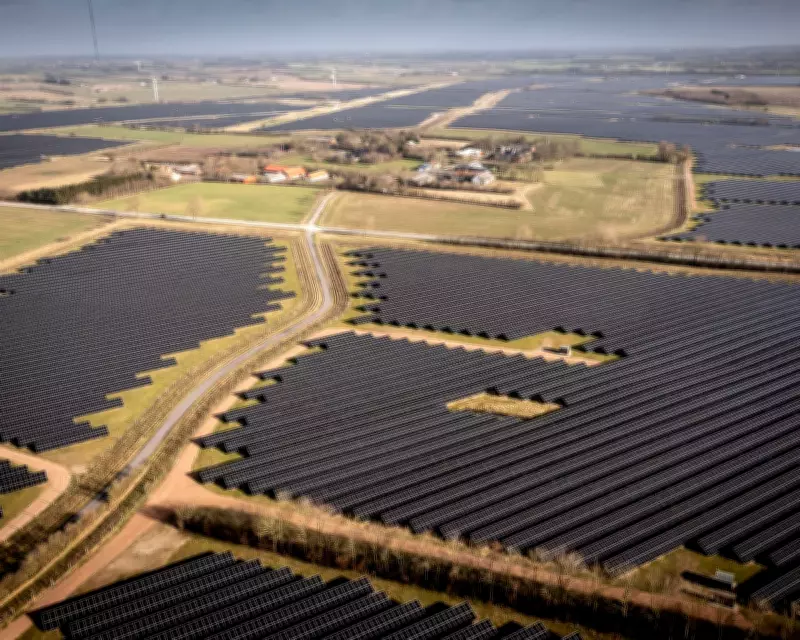
In the picturesque village of Hjolderup, Denmark, a stark visual contrast defines the landscape: traditional farmhouses now encircled by vast expanses of gleaming solar panels. This scene, captured in drone footage that has spread across social media, symbolizes a growing political and cultural rift in what is considered the world's most climate-ambitious nation. As Denmark prepares for crucial national elections, the spread of solar infrastructure in rural areas has emerged as an unexpectedly potent electoral issue, challenging the country's long-standing consensus on green energy.
The Rise of 'Iron Fields' and Political Backlash
The term "jernmarker" – meaning iron fields – was selected as Denmark's word of the year in December, reflecting how deeply the solar backlash has penetrated public discourse. This linguistic choice followed municipal elections where opposition to solar projects swayed results and prompted several councils to cancel planned developments. The phrase was popularized by Inger Støjberg, leader of the right-wing populist Denmark Democrats, who declared in a 2024 speech: "We say yes to fields of wheat, and we say no to fields of iron!"
This narrative positions solar panels as an industrial intrusion threatening Denmark's agricultural heritage and rural identity. Unlike conservative regions in Texas or Hungary that have embraced solar while criticizing other green policies, Denmark's rural communities are framing photovoltaic expansion as urban elitism imposing unwanted infrastructure on the countryside. The backlash represents a significant shift for a nation that generates 90% of its electricity from renewables and has set more aggressive climate targets than any other wealthy country.

From Local Concern to National Political Battleground
The resistance began as scattered local opposition but has been amplified and organized by political parties seeking to capitalize on rural discontent. Lukas Slothuus, a climate politics researcher at the University of Sussex who grew up near the Danish-German border, observes that the Denmark Democrats have provided "a clear vector to articulate that discontent politically" across the nation. "The far right have realized – and decided – that climate is a potent electoral battleground," Slothuus notes. "It's just about finding one issue to centre it around."
This political mobilization has yielded concrete results. The municipality of Køge voted in January to cancel a renewable energy park in Vallø, while Viborg's council halted a planned solar farm in Iglsø last month. Even on Samsø, the first island in the world powered entirely by renewables, councillors from across the political spectrum rejected a solar park last year. In Ringkøbing-Skjern, Denmark's solar heartland, enthusiasm for new projects has evaporated entirely.
The Complex Reality Behind the Controversy
Opponents of solar farms argue that photovoltaic panels are visually unappealing, destroy natural habitats, and depress property values in already-neglected rural areas. However, the scale of the issue may not match the political noise surrounding it. According to the Danish Solar Association, solar panels cover only 0.2% of Danish farmland, with approximately one-third of solar capacity installed on rooftops rather than open fields.
Mads Fuglede, a Denmark Democrats politician elected to the Ringkøbing-Skjern council in November, articulates the perceived urban-rural divide: "Solar panels have become a symbol of the political elite that wants a green transition and doesn't care about what happens to the countryside. Because that's not where they live or where their voters live." Notably, unlike some European counterparts who deny climate science, the Denmark Democrats claim to support the transition to a clean economy while opposing specific implementation methods.

Economic Challenges and Community Engagement
Beyond political opposition, solar expansion faces practical economic hurdles. Denmark experiences relatively few sunny days annually, limiting revenue generation for solar projects. As more panels have been installed, the number of days with negative electricity prices has increased dramatically, creating a cannibalization effect where additional capacity reduces profitability for all producers. Grid congestion and slow electrification rates further complicate the economic picture.
Torsten Hasforth, chief economist at Danish climate thinktank Concito, observes: "Over the next ten years, the official expectation is a very large rise in the amount of solar produced. But that kind of clashes with the reality on the ground – they can't make money." He suggests that some developers have done a poor job engaging local communities but believes the backlash "can be handled" through better planning and communication.
The Future of Denmark's Green Transition
The solar controversy raises fundamental questions about how clean energy developers can secure local support during rapid renewable expansion. Some municipalities have adopted a strategy of "green hushing" – advancing projects with minimal publicity to avoid backlash. Camilla Holbech, vice-president of renewable energy at Green Power Denmark, notes: "Municipal politicians that are in favour have been green hushing: not being too vocal about it, they've just gone out and done it."
Henrik Stiesdal, who built Denmark's first offshore windfarm in 1991, identifies social media as a key factor amplifying opposition: "The thing that has changed since the first decades is Facebook. Even though the greater population feels things are good, you can get enough local people and enough not-local-but-angry people to provide opinions."
As Denmark votes in national elections, the solar debate represents more than just an energy policy discussion. It reflects deeper tensions between urban and rural communities, between rapid technological change and cultural preservation, and between global climate ambitions and local autonomy. The outcome will signal whether the world's greenest country can maintain its climate leadership while addressing the legitimate concerns of citizens living amidst the physical infrastructure of the energy transition.





