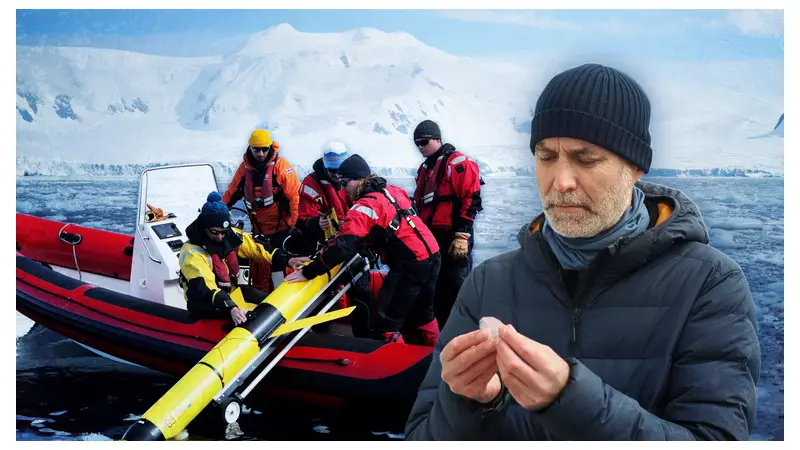
Fifty years ago, the bay near the Rothera research station in Antarctica would have been buried under a colossal sheet of ice nearly 250 metres thick. Today, a team from the British Antarctic Survey (BAS) navigates the same open water in an inflatable boat, a stark visual testament to the profound changes reshaping the frozen continent.
The Unseen Force Beneath the Waves
As the boat slows to negotiate a rubble of ice in Ryder Bay, the crackle and pop of melting fragments fill the air. The Sheldon Glacier, the destination ahead, has retreated over a mile. This pattern is repeated across the west Antarctic peninsula, where warming oceans and atmosphere have melted and crumbled the floating tongues of ice.
With Antarctica experiencing its warmest average temperatures on record last year, scientists view it as a crucial predictor for the planet's future. "Antarctica is a continent miles away from where we live in the UK, but it has a profound influence on what happens across the whole planet," states Prof Dame Jane Francis, director of the BAS.

While researchers have long studied how warmer currents break up glaciers, they now believe a critical piece of the puzzle has been overlooked: underwater tsunamis.
When a tower-block-sized piece of ice calves from a glacier face, the impact generates powerful internal waves beneath the surface. These tsunamis, which can be tens or even 100 metres high, violently mix the cold, fresh meltwater at the surface with warmer, saltier water from the depths.
"By mixing that warm water upwards, you're altering where that heat ultimately ends up," explains BAS oceanographer Dr Alex Brearley. This process could be significantly accelerating glacial melt from below, a factor missing from current climate models.
To capture this phenomenon, Dr Brearley's team is deploying robotic gliders laden with sensors into the waters in front of Sheldon Glacier. By patrolling the area throughout the Antarctic summer, they hope to measure these submarine waves directly for the first time, refining predictions of how fast the ice will disappear.
The Doomsday Glacier and a Global Tipping Point
While this crucial work begins at Sheldon, an international effort is targeting a far larger and more threatening ice body 1,000 miles to the southwest: the Thwaites Glacier.
Often dubbed the "Doomsday Glacier," Thwaites is the size of Florida and acts as a keystone holding back the vast West Antarctic Ice Sheet (WAIS). Its retreat is rapid, and recent studies suggest its total collapse may now be inevitable.
"What we want to learn is how effective these dams are in holding that ice back," says BAS oceanographer Dr Peter Davis, who is leading a drilling project from a South Korean icebreaker. "And ultimately, how quickly therefore is sea level going to change over the next 100 years."
The stakes are almost unimaginably high. Thwaites alone holds enough ice to raise global sea levels by 60cm. If the entire WAIS it buttresses follows, the rise could exceed three metres, redrawing the world's coastlines.
This represents one of the most significant potential tipping points in the climate system. However, scientists caution that the timeline is deeply uncertain. "It's actually quite difficult to know when a tipping point has been passed," notes Prof Francis. "It's not like it's going to happen on a particular day... it's a sort of a gradual process." Estimates for the collapse of the WAIS range from within this century to over 200 years away.
Antarctica's Role as the Planet's Thermostat
Understanding Antarctic melt is urgent not just for sea level forecasts but for predicting the overall pace of global warming. The continent is central to Earth's climate regulation.
The mighty Antarctic Circumpolar Current, which flows around the continent, is thought to have absorbed about 75% of the excess heat generated since the Industrial Revolution. It acts as a planetary circulatory system and air conditioner, with Antarctica itself as the thermostat.

Furthermore, the Southern Ocean is a colossal carbon sink. Its phytoplankton are estimated to have absorbed over 40% of the human-produced carbon dioxide taken up by the world's oceans. The nutrients that fuel this life are stirred by currents and potentially by the very submarine tsunamis generated by calving glaciers.
This creates a complex feedback loop. "That ice going allows that new life to come and that new life takes carbon out of the system," says Prof Lloyd Peck, a BAS marine biologist. In past natural cycles, this process helped cool the planet after warm periods.
But the current, human-driven warming is occurring over decades, not millennia. At Rothera, Prof Peck's dive team—maintaining the longest continuous marine assessment in Antarctica—has documented ecosystems struggling to adapt. Some species cannot survive a sustained warming of just one degree Celsius.
"The ecosystem balance is changing. The species numbers are changing. We know that," Prof Peck states. "We don't know if it's reaching a tipping point." The concern is that the rapid change may prevent the Southern Ocean from efficiently switching into a carbon-absorbing mode, leaving more heat-trapping gas in the atmosphere.
From underwater tsunamis accelerating glacial retreat to shifting ecosystems affecting the global carbon cycle, the research in Antarctica is painting an increasingly detailed—and urgent—picture of how changes at the bottom of the world will dictate the future for us all.